0
0

Maulana Fazl is a peace-loving politician — Fatima Surayya Bajia
 Crazy about learning how to drive, my 14-year-old son accompanying me exclaimed: “Look, Papa, how fast Bajia is driving her car!” By the time I turned in that direction, she had sped down the bend, leaving behind a thick cloud of dust.
She had been playing hide-and-seek with us for some time as she wanted to guide us to her home and I didn’t have the number of her cellphone (I doubt if she keeps any) to stay in contact. We followed on the road she had moved on and caught up with her while she was parking the car in her driveway.
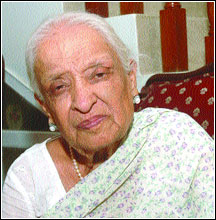
Unfazed by mouth cancer and her age that she has growingly become conscious of, noted playwright Fatima Surayya Bajia seems to be living a hyperactive life. “I have named myself ‘a civil society horse’. The whole day I keep running hither and thither with people’s requests, mostly seeking jobs. People who matter are good enough to accept at least five of the 20 recommendations I make to them. Yesterday I got up at seven in the morning and went from place to place before retiring to bed at 1am. This is almost my daily routine. Today is the driver’s day off and I have to drive around myself. I love doing my dusting and cooking though I have servants for these jobs,” she says in an interview with Dawn at her home in Bihar Muslim Society, off Shaheed-i-Millat Road, last Sunday.
Bajia has written several popular serials for PTV, including Shama (based on A.R. Khatoon’ novel), Afshan, Aroosa, Aagahi, Ana and Zeenat. Besides, she has done historical plays, children’s programmes, women’s programmes and literary programmes such as Auraq. She says she has not written anything significant during the last seven or eight years as first her mother died, then she lost her two sisters and a year or so ago passed away her brother Ahmed Maqsood Hameedi.
“If God gives me a few more months of life, I’ll publish eight to 10 books. I have written more than a dozen novels which I would like to have published soon. The plays and serials need work for publication as they have to be in a format different from their TV versions.” She was only 14 when her grandfather had her first, and so far the only one, novel published in India.
Whether she writes a play serial or any other TV-adaptable piece, she elaborately depicts the culture of the area and the period she sets the story in. In Auraq, the literary programme that ran for about two years on PTV, she vividly depicted the culture of the area -- whether Sindh, Pubjab, Balochistan, Frontier or Kashmir -- in the stories she included in the programme.
She surprised many literary critics when she came up with wedding songs purported to be written by Amir Khusrau. “I found snatches of Hazrat Amir Khusrau’s poetry here and there -- sometimes a line, a couplet or a stanza -- and turned them into complete geets. Having thoroughly studied the culture of that time, I was well aware of the saint’s poetic diction, and the vocabulary used during that era.
“A few couplets I got from the late Kajjan (singer Mehnaz’s mother), who didn’t know that they were written by Amir Khusrau. I went to an old man in Lalukhet who had Khusrau’s works written on a canvas sack. Although the ailing man refused to part with the piece of coarse cloth, I noted down some verses from it. What I could do on Khusrau was my most beautiful and cherished work.”
She reveres Amir Khusrau and says she has deeply studied Sufism: “It is not about donning a particular garb and paraphernalia. Sufi is one who may live among the common people and set a good example for them. For instance, he or she may be living in a hut with patched clothes, but would keep the clothes and the abode neat and clean.”
Speaking on the crises plaguing Pakistan, she says: “The situation in the country is frightening. But I believe in God and that He will set things right. Of the 18 million people, at least 16 million are quite innocent, gullible people. I call them slaves because they obey readily what they are told to do by their masters.
“I have seen the destruction during the partition of the subcontinent. God forbid if anything happens to Pakistan. Or to Afghanistan, India, Russia or even to the Jews. I can no more see any people’s destruction.”
Continuing, she says she has never hated anybody. “I’m willing even to pardon the thieves. When so many ‘big thieves’ get away with the nation’s wealth, why should these poor fellows be singled out for punishment?”
 She is wary of politicians’ integrity and has altered a famous couplet to describe her suspicion about them:
Gar hamin rehbar, hamin wuzara ast/ Kar-i-Millat tamam khwahad shud
But, surprisingly, she is fond of Maulana Fazlur Rehman. “Among all the politicians, I like Maulana Fazlur Rehman the best. He has many things negative about him, but he is a man of peace. He finds a way out to peace and cools down simmering situations. He is a wise man.”
Bajia is not happy with the media either. “The freedom of the press. The freedom of expression. Democracy. I have seen these things abused as much as never before. I do not call it Jamhooriat (democracy), I call it Bachcha Jamhoora (assistant to the street entertainer, whose master beats the tiny drum and collects children around). As in a household a child cannot be allowed to do what he pleases. In a true democracy good should be appreciated and bad should be scorned at.”
In the same strain, she attacks the TV channels. “Pervez Musharraf was a good man, I believe. He might have had his share of faults. But TV anchors began uttering remarks against him that did not become educated people. They even stopped calling him president while he was still in the presidency.”
Born into an educated in family of Hyderabad Deccan in 1930, Fatima Surayya was the eldest of the six siblings. The family sailed to Karachi on September 18, 1948, immediately after the fall of the Hyderabad state, which was invaded by the Indian army on September 11, the day the Quaid-i-Azam died here. She does not have a formal degree but had acquired extensive knowledge of Arabic, Persian, English and Urdu literature and history at home through private tuitions. In Karachi, when her grandfather and father died, she took up the responsibility of looking after her younger siblings, who all received a good education.
In recognition of her services, besides the local awards, she has been given the highest civil award of Japan. In the last government she was an adviser to the chief minister of Sindh.
Who will lead PPP in Frontier?
THE struggle for top provincial offices in Pakistan People’s Party ranks has broadened the base for changes in party and the government alike.
Besides change of provincial president Rahimdad Khan and general secretary Najmuddin Khan, PPP leadership wants to get replaced NWFP governor with a party man, who must keep an eye on coalition government’s activities. Apparently their demand sounds pretty but it does not hold any logic.
Anybody sitting in the Governor’s House is answerable to President of Pakistan. He will do whatever Islamabad will desire him to do but owing to the strategic importance of the Frontier, some other quarters do have a say in the appointment of the governor.
Awami National Party wants its man in the saddle but at present it is not easy for it to get it done. It preferred to retain the incumbent governor in the seat to avoid any fresh controversy with PPP and got appointed its own sympathisers as vice-chancellors of the universities. But after feeling the wind of change it has no option to agree on a new man.
According to sources, ANP has floated the name of Rahimdad Khan as governor but none of ANP leaders have confirmed this move. PPP circles, however, are hopeful about the landing of a party man in the Governor’s House.
Like other political parties, PPP too is not immune to the political groupings based on the ideological and opportunistic trends. PPP old workers, who had braved the successive dictatorial regimes and burnt their prime years for the establishment of an egalitarian society as enshrined in party manifesto, trying to get their comrades nominated on the top slots in Frontier. This kind of day dreamers are PPP asset but they are mismatched to the political culture the party had embraced after the assassination of PPP founding chairman Zulfikar Ali Bhutto.
The grey-headed old party guards, who had fought political and electoral battles with Awami National Party, which metamorphosed from National Awami Party and National Democratic Party to its present form, various factions of Pakistan Muslim League and the religious parties in the past, are ignorant to the demands of real politick.
They think competing with opposition parties, including their allies, on social, economic and political issue is inevitable for PPP as a major political force. After their six months silence, they have started criticising ANP on certain matters, particularly transferring of PPP sympathisers to the far flung areas and nomination of ANP men as chairmen of Zakat committees across the province.
The very same old class now is trying to secure the nomination of committed party men on the provincial slots of president and general secretary. PPP central executive committee members from NWFP have conveyed names of former Peshawar nazim Azam Afridi, NWFP Health Minister Syed Zahir Shah and Dir Lower Nazim Ahmed Hassan Khan for the post of PPP provincial president to the party co-chairman, who will select one of them for the task.
Mr Afridi is an old party activist, who has been affiliated with party when he was an activist of People’s Students Federation. Though Ahmed Hasan had changed his loyalties for some times yet PPP workers welcomed him in the ranks, when he rejoined the party.
Some local PPP leaders are opposed to the nomination of Syed Zahir Shah as provincial party chief or general secretary. They argue that he is suitable for the post of provincial governor.
On Sunday, PPP district Peshawar had convened a meeting of presidents and secretaries of different wards and discussed different issues, including changes at top positions.
According to the insiders, the participants had lashed out at party ministers, who were not taking care of party workers. They alleged that some of the ministers were involved in the venal transactions. They decided that party delegation would meet President Zardari after his return from China and inform him about the step-motherly treatment being meted out to PPP workers in the province.