



 0
0

Abdur Rauf Urooj: man of many talents
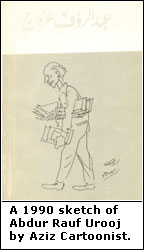
 Looks can be deceptive, so goes the saying. Abdur Rauf Urooj, a lean and lanky fellow with a dark complexion and who walked with a slight limp, was among those who proved the saying true.
Somewhat bald and always in a pensive mood, Urooj sahib was, let’s face it, physically unprepossessing. But this unassuming and seemingly unimportant scholar had such a magnetic personality that he drew towards himself writers, intellectuals and friends with such force that at one stage he had almost a cult-like following among the Karachi’s intelligentsia. Some critics, envious of his popularity, even feared that Urooj sahib was bent upon forming his own circle or school of thought. But he looked down upon such notions and laughed them off.
Abdur Rauf Urooj was a poet, critic, journalist, research scholar and historian. While his was a religious family where singing or even composing verses was considered sinful, nature had bestowed upon him a remarkable talent for the fine arts and he was, say those who knew him, also a musicologist. His drawing was exquisite and he had an ear for music. By the time he passed his eighth grade, he had composed a song “Phir aaj Divali aai” that was recorded and played by Deccan Radio.
His national identity card said that he was born in Aurangabad (Deccan) in 1932, but who knows? A great deal about the early life of this remarkable man is shrouded in mystery. We only know that he left his hometown in the early 1950s for Pakistan and arrived in Lahore when he was barely 18.
But what caused the migration, nobody knows for sure. He was a bit cagey about his early life. Was it a step-mother or a failure in love that made him leave everything behind at such a tender age, critics have made all sorts of conjectures.
 But the worst was yet to come. From Lahore, he moved to Karachi and to keep body and soul together had to hawk newspapers. In 1953, a student rally against the then government turned unruly in Karachi’s Saddar area and police opened fire on the participants of the rally. Urooj sahib was among the onlookers and a bullet that pierced through his leg was to give him a slight limp later.
Getting injured in police firing was something he could least afford as he had no relatives in Karachi and was doing odd jobs. Jam Navai, a poet in his own right, came to his rescue and took him to his home, looking after him just like a concerned father. Urooj could not forget Jam Navai his entire life and would talk about him with great affection. Jam got him a job at ‘Naya Rahi’, a literary magazine brought out from Karachi.
Once Urooj Sahib asked the owner of the magazine to advance him some amount due to him. The proprietor gave him a piece of his mind instead. He asked Urooj sahib to write a book on the history of Urdu marsia. Urooj did it within a fortnight and the book, published as ‘Urdu Marseye Ke Paanch Sau Saal’ (Five hundred years of Urdu Marsia) sold quite well.
His verses and critical essays began to appear in various literary journals and he picked up the literary thread that had snapped in Deccan. In those days, Urooj sahib composed musicals for Radio Pakistan. It was a novel experiment and found favour with Z. A. Bukhari, who paid Urooj handsomely. Slowly but surely the genius of Urooj sahib made inroads into the literary circles of Karachi. Shanul Haq Haqee invited him to work for the Urdu Dictionary Board as an external scholar and asked him to contribute to the board’s magazine ‘Urdu Nama’ as well. Urooj sahib wrote a long research paper, analysing the historical and cultural background of classical Urdu literature in three instalments for the magazine.
The contents and the topic, which was till then relatively rare, caught the eye of Peer Hussamuddin Rashdie. Rashdie sahib was known for his scholarship and his excellent personal library.
He met Urooj sahib and the meeting changed the course of Urooj’s life. Urooj sahib used to say that Rashdie sahib introduced him to modern research techniques and inculcated in him a taste for history. On Rashdie sahib’s suggestion Urooj sahib wrote ‘Tazkira-i-Farsi Shuara-i-Urdu’ and ‘Tareekh-i-Iran’, both in Persian, and won awards from the Iranian government.
Urooj sahib had joined daily ‘Anjaam’ but quit it to join ‘Mashriq’. Later, when ‘Hurriyet’ was launched, Farhad Zaidi asked him to join it, which he did. Urooj sahib, as was expected of him, floated a unique idea. He launched ‘Hurriyet Adabi Gazette’, a literary supplement that instantly gained huge popularity. It caused many skirmishes amongst the literary circles and won Urooj many foes and many friends alike.
He daily wrote a qataa, or a versified little piece consisting of a stanza, for the newspaper for about thirty years at a stretch, another distinction surpassed perhaps only by Raees Amrohvi. Though he had affinity for leftist ideas, his poetry does not consist of progressive thoughts only and it also shows considerable sensitivity to aesthetics.
Towards the last years of his life, Urooj’s stress on romanticism had increased and, coupled with the classical touch that his profound study of Persian and Urdu poetry had produced, created quite an aura. Some 20 years ago, I used to visit Urooj sahib quite often and found him very accommodating. He would especially take his time out for youngsters who sought his advice on poetry or research projects. I know quite a few poets and journalists who today are well known and owe much to Urooj sahib’s guidance and encouragement for their success.
His other books include ‘Khusro Aur Ahd-i-Khusro’, ‘Rijal-i-Iqbal’, ‘Iqbal Aur Bazm-i-Iqbal Hyderabad Deccan’ and ‘Bazm-i-Ghalib’. ‘Chiragh Afreedam’ is a collection of his poetry.
This unique man bade farewell to this mortal world on May 17, 1990, in Karachi.
DATELINE MULTAN - Road extension project irks citizens
Shakeel Ahmad
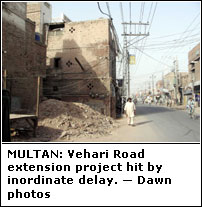 The reconstruction and extension of Vehari Road’s less than two-kilometre patch from Double Phatak here to Naz Cinema is in doldrums for the past three years due to various factors and the delays are causing frequent traffic jams in the densely populated area of the city.
The impeding factors include a stay order issued by the Lahore High Court (LHC), which has now been vacated, and refusal by some shopkeepers to accept compensation money determined by the land acquisition collector on the pretext that these sums are calculated according to the market prices prevalent in 2005.
On the recommendations of District Nazim Mian Faisal Mukhtar, former chief minister Pervaiz Elahi had provided funds for this project in 2005 and the provincial highway department called tenders for the construction of main Vehari Road from Double Phatak to Central Jail Morr and to Vehari Chowk.
Though a major portion of the project has been executed, the smaller patch of not more than a couple of kilometres is yet to be reconstructed and the delay is irking the citizens.
The highway department land acquisition collector had released Rs40 million to pay as compensation to owners of shops that were to be demolished to widen the road near Double Phatak and Shah Abbas Chowk.
Near Double Phatak, there were around 65 shops owned by 42 people that were to be razed for the expansion and reconstruction of the road.
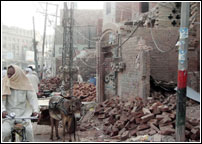 However, a conflict erupted between the shop owners and the department over the determination of market price of the land to be acquired for this project.
In 2005, the land acquisition collector allocated Rs27.2 million out of the total Rs40 million to be paid as compensation to the owners of these shops at the rate of Rs3,088 per square foot.
Feeling aggrieved, some owners moved the Multan Bench of the LHC and got a stay order against the demolition of their shops. However, Justice Khalid Alvi vacated that stay order in February this year.
After the court vacated the stay order, Land Acquisition Collector Farooq Ahmed held a meeting with the shopkeepers and asked for their cooperation on which five owners received their compensation money in April this year. Later, some other shopkeepers also joined them and started razing their shops after receiving compensation money.
However, a few shopkeepers are yet adamant and are reluctant to receive the compensation money, saying that it’s wrongly been calculated on the basis of market price of the land, which was prevalent in 2005, instead of the current market price.
A passer-by, Muhammad Aslam, bemoaned the traffic jams on this congested road occurring frequently and lasting for several hours.
He said that he was not hopeful about the completion of the project in near future as a lot of groundwork was yet to be carried out, including shifting of electric polls, gas and other utility connections and demolition of a masque.
Zahid Jamil, who is the general-secretary of Vehari Road’s Anjuman-i-Tajiran, said that traders were thankful to the district naizm for taking initiative to materialise this long-awaited project. However, he said, the shopkeepers were being paid meagre compensation as market price of all commodities as well as land had increased manifolds since 2005.
Union Council-33 Nazim Sheikh Sajid Sohail said the government had promised to provide land for Jamia Masjid Ghausia that would be razed to expand the road. However, he said, the alternative land for the area’s only mosque had not been provided so far. He said the locals would not allow razing the mosque until a chunk of land to build the mosque was provided.
Highway Department Superintending Engineer Qamar Zaidi told Dawn that demolition of shops in the wake of stay order issued by the LHC was a major hindrance in execution of this comparatively smaller part of the mega project. He said that since the major impediment had been removed, compensation money was being paid to affected shopkeepers.
He said the project would be executed within a few weeks from now and shopkeepers were cooperating enough by demolishing their constructions themselves.
He said they would initiate construction of the road and its extension the moment demolition of shops was over.



























