



 0
0

From the walled city to the walled cantonment
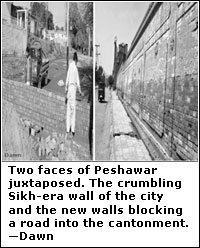 IN 1840, history tells us, General Avitabile, an Italian in the service of Sikh ruler, Ranjit Singh, had built the famous mud wall around what came to be known as the Old Peshawar City.
The British followed it up by turning the mud wall into brick fortification to safeguard the city against marauding tribes.
There were sixteen gates to enter the walled city of Peshawar, few however, remain. Some have been renovated, most have been pulled down. Little of the historic city wall remains. It has crumbled or caved in at various places while at others, the surging population has torn it down as the city itself expanded literally in all direction.
Prof Em Dr Ahmad Hasan Dani, an archeologist of international repute in his book “Peshawar: Historic city of the Frontier” wrote: “With the development of a new sense of security and promulgation of the rule of law, today the importance of these gates no longer remains.”
Old structures have crumbled under the vagaries of time. A hundred and sixty-seven years later, the city walls and most of its sixteen gates are no longer there to protect the citizens of Peshawar. Sikhs and the British were lucky, in those days; they could build a wall fortification to safeguard cities.
History sometimes can be cruelly repeating itself. Peshawar City, like many other cities of the NWFP, is under attack, not from the marauding tribesmen, but from militants, some of them indeed, from tribal regions.
Every day, a CD shop is blown or an internet café is targeted. Now the militants have turned their attention to snooker and billiard games as part of their campaign to weed out vice and enforce virtue amongst its hapless Muslim populace.
The police appear neither to have the resources, the weapons etc, nor the required number to deal with what is increasingly looking like a mini insurgency on the outskirts of Peshawar.
Figures speak for themselves. For a population of over two million, excluding the Afghan refugees, there are five thousand policemen. So for every four hundred people, there is one policeman.
Little wonder then, the police, though struggling to keep the law and order situation to the best of their ability under increasingly difficult times, they quietly concede that fighting an insurgency.
The result: citizens have become withdrawn, like the crumbling wall of Peshawar City, their faith in the state apparatus to ensure security, is also eroding.
Ironically, while the city walls crumble along with the crumbling sense of security, walls are being built in Peshawar Cantonment. All roads leading up to the military cantonment that includes the offices of the corps headquarters and security installations and departments, the sprawling Governor’s House, the Chief Minister’s House, the Chief Minister’s Secretariat, the Civil Secretariat, the Central Police Office and the Police Lines, have all been barricaded.
A cemented brick-wall has been erected on an entry road while at another barbed wire has been laid to restrict the entry. The security-conscious US Consulate has blocked three roads cutting it virtually off from the entire cantonment.
Entry into this high security zone is restricted for ordinary commuters. Vehicles displaying special stickers issued by the Station Commander are allowed to pass through the check-posts; others are routinely diverted to the main Saddar Road -- the hub of commercial activity in Peshawar. Little wonder, this often lead to heated arguments between the well-mannered soldiers and the visibly and understandably well-charged commuters.
As national security and law enforcement agencies take extraordinary measures to guard against any terrorist threat, man on the street wonders who is going to give him protection. City walls are crumbling but new walls are coming up.
| © DAWN Group of Newspapers, 2008 |


























