0
0

Taking care of business
 LIP service is now an art form courtesy our civic authorities. Day after day we must suffer, like so many fools, sheer bilge in the name of promises and pledges to make Karachi a more wholesome city. We were fine just the way we were, thank you very much. Nothing is taken to its logical conclusion, possibly for reasons of graft. Take, for instance, the Karachi Building Control Authority’s proclamation on July 2, 2007 that commercial ventures operating out of residential premises in Clifton must cease their activities forthwith.
The notice, for what it’s worth in newsprint now fit for paan wrappers, stated that [sic] “Since, under the law no business activity is allowed in residential areas of Clifton Block 1 to 7 and no policy to allow commercialization of these Blocks is under consideration, therefore KBCA had, on affidavit application of the above-said owners, given them a recession of one year so that during this period they may wind up their commercial activities from residential bungalows and arrange alternate places for their business. It may be clear that this recession of a long period of one year has now ended …” This came under the impressive banner of a “PUBLIC WARNING”.
A similar notice was served by the KBCA in 2006. Nothing has changed in the interim, not even the same old tired threats of punitive action. How come it’s still business as usual for these people who are engaged so profitably in commercial activity on residential premises? Is this the KBCA’s way of pocketing its ‘yearly’? We’ve even put an ad in the paper, nudge nudge, and surely a nod’s as good as a wink to a blind bat. And so it goes, year after year, in the Ministry of Silly Warnings. The Monty Python team would have been proud.
In one small square kilometre of Clifton Block 3, one of those dime-a-dozen ‘colleges’ is plying its trade in a house bang opposite the local union council office behind Bilawal House, an estate agent is operating out of Clifton Gardens 2, skin doctors specialising in laser therapy are working out of a bungalow, and miscellaneous other commercial operators keep doing business in flats and town houses. Will this brazen flouting of the law ever end? Not if the KBCA calls the shots.
Note also how the new, revamped South City Hospital (now South City H) has eaten up what used to be a bungalow located towards its rear. Was this plot, said to be the former residence of an adviser to the chief minister, ever officially redesignated as commercial? Adding insult to injury, for almost a year now, the lane that runs behind South City H has been commandeered by the project and effectively closed to traffic.
At least one adjoining plot has been taken over and now serves as a temporary repository for construction material and a tented abode for security guards and workers. Armed men who wear khaki uniforms remarkably similar to those sported by Aga Khan University guards enforce this wanton abuse of power.
And where are the area residents in all this? Helpless. People who paid top rupee for a desired ambience when buying their property have been reduced to watching their neighbourhood fall to pieces before their eyes. The right to life must surely also incorporate quality of life. If I am not mistaken, court judgements have been issued to that effect. I mentioned this once to someone who I think is fairly bright in most respects and yet so crushed, nay neutered, by the concrete jungle. “What’s the big deal,” he said, “it’s happening everywhere.” Yes, then I suppose it must be alright. Who are we plebeians to argue?
PECHS was massacred long ago, KDA is on its way and Clifton is well and truly in the cross-hairs. Karachi’s rapacious ‘development’ lobby dominated by the nouveau riche will see to it that we all live in slums. Choice construction companies owned by friends and relatives will administer the final rites.
Enough said, for now.
imalik@dawn.com
GR: painter of immutable silences
 True you cannot reduce paintings to words, as the author of a book on painter Ghulam Rasul maintains in her note. But then words is all that we have. Indeed they limit everything, they limit us, our lives. Yet, it would be a blank world if we didn’t have words. We would be tongue tied eternally. Come to think of it a painting is also a word, a statement in the language of shapes and colours. And perhaps we have no other painter who makes his statements so abundantly clear, so simply lucid, so effectively economical as Ghulam Rasul. Clarity is his hallmark, his identity as an artist. Maybe what she is referring to is the great quiet, that immense silence in which Ghulam Rasul wraps up his vision of the world. But Muniza Agha-Fawad doesn’t explore that stillness, that hush. Her Ghulam Rasul in Another Migration has suffered no change. He is rooted in his land and owns it, as Safdar Mir said a long time back, recognising this as what distinguished him from other artists who typically looked towards Europe for inspiration.
The title theme of migration that one initially thought was meant to give the book some kind of contextual integrity turns out merely to be pointing towards the artist’s training period in the States where he went under very difficult personal circumstances. All that the no-holds-barred liberalism of American art culture did was to encourage him to unshackle himself from the bias against figurative painting, but that’s about all. He is in no great way detached from his original passion for rural landscapes that he continues to paint with unchanged relish. So perhaps migration is just an attractive tag. It has little to do with Ghulam Rasul’s spatial, temporal or spiritual journeys, of which the last two he shows no sign of having made. He may have moved spatially but inwardly, in a spiritual way, he has stayed put. This is his beauty. He makes no progress. He wouldn’t be Ghulam Rasul if he did.
Take for instance a 1989 water colour titled Outskirts of Kathmandu or the 1988 Summer Palace Beijing, or the 1984 Paris Landscape and what immediately strikes you is their ‘un-foreign-ness’, their distinguishable closeness to the indigenous model. One notices how in the Kathmandu piece he is totally at home. So even spatial displacement is not moving him further from his home scene. But let us not give it a nationalist twist. Ghulam Rasul’s subjects may be local but what as an artist he is seeking in his mustard fields of Punjab or even the ghettos of Islamabad’s French Colony is the eternal and the unchangeable in them.
Landscape painters depict the permanence within which the drama of life’s transience is framed. (In comparison photo journalism strives to catch the transient, the passing topical moment). Muniza thinks his choice for the purity of landscapes is perhaps a diversion from the appalling corruption of life in Pakistan or a reminder to the people of the purity they have lost. A comforting idea but not true since Ghulam Rasul made his choice of what he was going to paint before the social rot started. His disillusionment does not predate his painting career.
Ghulam Rasul’s experimental shift to staccato strokes in his American paintings like The Kiss, Landscape USA, Summer 1969 or Relaxing Nudes is actually a shift away from himself. It is a bold exercise and a big break from his natural predilection for soft precise spaces enclosed in softer frames. Mercifully the experimentation period is not prolonged; the ‘migration’, if that it was, is bade a safe farewell. The native returns.
Ghulam Rasul is not exactly a minimalist though he uses its economy reducing shapes and shades to their closest simplifications and dimensions to tabletop planes. This economy strikes one immediately. One of his buffalo paintings that I first saw was at Saleem Asmi’s (former editor of Dawn) house in Rawalpindi. It left me totally unimpressed but the green expanse and the peaceable animal got imprinted on the screen of my mind. Ghulam Rasul has been known to me since then though twenty years may have elapsed before I saw another of his paintings at an exhibition.
Human beings in a GR landscape are just part of the scene. In his paintings of street scenes, houses and bazaars it is the street and the house and the bazaar which are the players of the act not the men and women who have an impersonal existence having no influence on the immutable forces of nature. All human beings can do is to merge themselves in the rhythm of the eternal song. They have no separate personality. Their self assertion as individual entities can only cause them suffering. One sees that levelling of human personality even in his portraits. ‘Artist’s daughter Ayesha Rasul’ is a fixture in the vertical arrangement. The houses and the streets in the French Colony of Islamabad are quite content with the ghettoised existence of their inmates.
His autumns and his mustard fields and wide expanses glow with a quiet serenity. But at last Ghulam Rasul ends his callous, cold blooded silence in Crows and Clouds. There is no hope in this reflection of his land. The gloom is permanent and the stillness, suffocating. In the rumbling darkness that seems to symbolise defeat, menacing crows hover over some impending catastrophe. There’s no time for ‘another migration’.
A hard going for GCU boarders
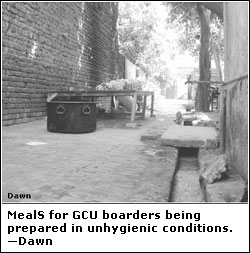 Boarders at the hostel of the Government College University, Faisalabad, are perturbed over a lack of facilities which has made their life tough.
The Sir Syed Hostel, hired by the Government Municipal College, Abdullahpur, presents a picture of neglect as the compound is not mopped and the washrooms and toilets emit foul smell. Most students prefer to go outside to take bath as the facilities in the hostel are seldom done up.
Constructed decades ago, the hostel has 98 (8x5) rooms each of which accommodates three students who pay full dues. Students from different cities taking classes from first year to MPhil are living in the hostel.
Its administration seems least bothered to resolve the problems and the boarders allege that it only focuses on minting money. Each boarder pays approximately Rs9,000 while getting allotment for a room.
The students say the situation is all the more difficult for them during Ramazan as they cannot perform ablutions for offering prayers.
The institution got the university status on Oct 23, 2002 and Dr Asif Iqbal, the then principal of the Education College Lahore, was appointed its first vice-chancellor. The varsity status, however, landed the administration in an outlandish situation as it launched new disciplines without doing homework.
Initially, the boys hostel situated on the old campus had been vacated to conduct classes of master’s in mass communication, Urdu, Pakistan Studies, education and other subjects. While boarders of the GCU old hostel were sent to the Sir Syed Hostel and many newcomers were accommodated here.
Sources said the students immediately raised objections to shortage of facilities at the Sir Syed Hostel and the administration promised that the best possible facilities would be extended to them soon. However, nothing has been done over the years and the boarders are finding themselves in a difficult condition.
The hostel offers unhygienic eatables. It has been running short of utensils and crockery and the staff hardly clean them properly during rush hours. No proper attention is being paid to clean the canteen premises properly.
Sources said food for boarders was being cooked without gas as the connection was disconnected a couple of months ago due to non-payment of dues. The students also face problems whenever someone visits them as the hostel has no guest room, TV lounge or common room. They often take their guests to Abdullahpur to entertain them.
A boarder told Dawn on the request of anonymity that living in the small stuffy rooms in summer was just like living in hell. “We have put across our concerns many times, but the administration responds by threatening a complainant that he will be shifted.”
He said the rooms were in bad shape and the administration held the boarders responsible for their maintenance.
Hostel supervisor Ijaz Farooq admitted that the boarders had been facing problems, but said a survey had been conducted and a development project, requiring Rs2.5 million, would soon take off and the hostel would be equipped with facilities.
| © DAWN Group of Newspapers, 2007 |