



 0
0

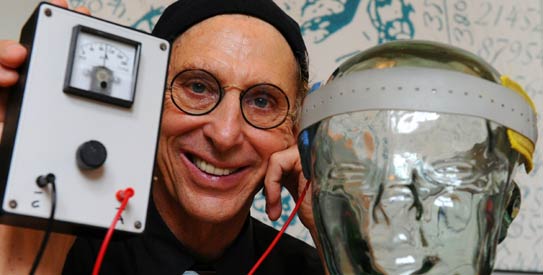
SYDNEY: Scientists in Australia say they are encouraged by initial results of a revolutionary “thinking cap” that aims to promote creativity by passing low levels of electricity through the brain.
The device, which consists of two conductors fastened to the head by a rubber strap, significantly boosted results in a simple arithmetic test, they said.
Three times as many people who wore the “thinking cap” were able to complete the test, compared to those who did not use the equipment. Sixty people took part in total.
Allan Snyder, director of the University of Sydney’s Centre for the Mind, said the device worked by suppressing the left side of the brain, associated with knowledge, and stimulating the right side, linked to creativity.
“You wouldn’t use this to study or to help your memory,” Snyder told AFP.
“You would use this if you wanted to look at a problem anew.
“If you wanted to look at the world, just briefly, with a child’s view, if you wanted to look outside the box.”He said goal was to suppress mental templates gathered through life experiences to help users see problems and situations as they really appear, rather than through the prism of earlier knowledge.
Snyder added that the work was inspired by accident victims who experienced a sudden surge in creativity after damaging the left side of their brains.
“We know that from certain types of brain damage and abnormalities or injuries, people who suddenly have damage to the left temporal lobe will burst out in the arts or other types of creative activities,” he said.
Snyder said the device had been in use by scientists for a decade, but this was the first study into how current passing through the brain could amplify insight.
He said the “thinking cap” had potential applications in the arts and problem-solving, although the science remained in its infancy.
“The dream is that one day we may be able to stimulate the brain in a particular way to give you, just momentarily, an unfiltered view of the world,” Snyder said.



























