0
0

MUSHARRAF’s Republic, hailed by the English-speaking chattering classes as the beginning of a brave new world, now betrays every sign of being stranded in a morass of boredom and predictability.
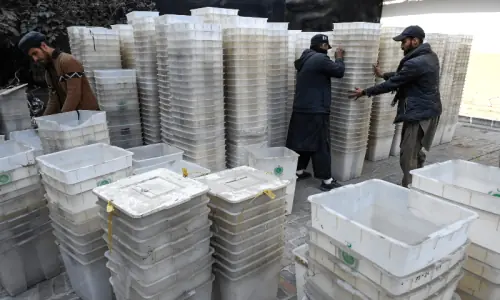
Nothing so highlights the predictable as the just-concluded local elections. The overriding lesson to be drawn from them: we are stuck with the general, stuck with the Chaudris and stuck with the Q League. There’s no breaking the collective stranglehold of all three on the nation’s windpipe, not with the kind of opposition we have.
So elated is the generalissimo with the local election results that he has handed out certificates of ‘moderation’ — the highest medal these days — to all the establishment-backed winners: MQM and Arbab Rahim in Sindh, the ubiquitous Chaudris in Punjab. If this be the face of Pakistani moderation, extremism begins to look like a better alternative.
We’ve had fixed elections before — indeed fixed elections threatening to become Pakistan’s leading specialty — -but in this era of enlightened moderation we have entered new territory altogether. The glorious referendum of 2002 when angels — invisible to mortal eye — stuffed ballot boxes, the general elections the same year which gave a whole new meaning to the concept of shifting goalposts, and now these local elections in which the important thing was not how you voted but how your votes were counted: the sanctity of the vote and the ballot box never raised to more dizzying heights.
Dress rehearsal for 2007: you could say that again. The intelligence agencies and corps commanders vetted district and tehsil nazims in 2001. With some help from the Q-League, the national establishment of spooks will do so again, the aim being to have loyalists ‘elected’ nazims in most, if not all, of the 105 districts of Pakistan, the nazims helping to elect more loyalists to the assemblies in the 2007 elections, and then the patriotic assemblies so elected endorsing the general as president for another five years.
This at least is the plan, everything subordinated to the supreme aim of keeping the general in power. It used to be called Suhartoization in remembrance of the general who ruled Indonesia as president for 32 years. But since he is no longer around, the new name for the process is Mobarakization, as tribute to the statesman under whose iron heel Egypt has languished since 1981. Still short of Suharto’s record but you get the point. Relinquishing power voluntarily is no part of the Islamic world’s agenda. Where power begins enlightened moderation ends, indeed comes to a crashing halt.
Not to worry, however, for good news is at hand. Never mind that Gen Musharraf has a hard time initiating a dialogue with his own people; as a sign of enlightened moderation he is going to initiate a dialogue with Zionism by addressing the World Jewish Congress in New York.
Musharraf apologists, of whom we are not likely to see a shortage any time soon, are already getting breathless in hailing this as a trail-breaking achievement. Dr Shireen Mazari: “This is an extremely proactive move in the realm of foreign policy for Pakistan and as such it is a welcome development for it signals self-confidence in our own identity.” Businessman-cum-columnist Ikram Sehgal: “This is one of the most important developments for the country...” The engaging Nasim Zehra: “The world needs master strokes of history, not little steps keeping a people immobilized with the illusion of mobility....Musharraf, for his shortfalls on the domestic political front, is now engaging on the practical side of enlightened moderation.” Master strokes of history and the practical side of enlightened moderation...I give up.
The Musharraf agenda becomes clearer: fix elections at home and curry favour with the Yanks abroad even if this involves something as totally irrelevant to Pakistan as addressing the World Jewish Congress. Nice idea talking to world Jewry but it wouldn’t hurt if the president first tried to talk to the people of Pakistan.
Q-League president Ch Shujaat Hussain, however, gets it about right when he calls (I am not making this up) for “promotion of mysticism to eliminate extremism in society”. Logic or reason being of little use in trying to make sense of Pakistani politics, mysticism should stand a better chance. Why not try the occult a bit later?
According to NNI (a news agency) “Chaudhry Shujaat said he met PPPP leader Makhdoom Amin Fahim at (sic) National Assembly and exchanged views with him about Sufism. He also contacted PML-N leader Sartaj Aziz and talked with him about Sufism.” This is a much-needed step in the right direction. After the local elections and how they were conducted, the nation as a whole could do worse than to think seriously of turning to Sufism.
Sahibzada Farooq Ali, National Assembly speaker in Zulfikar Ali Bhutto’s time, predicts that some time this year or early next year the district nazims will call upon the general not to take off his uniform in the greater national interest. This is the least the nazims can do in the service of patriotism. Last year it was the PPP Patriots (aka renegades) who took the lead in calling upon the president not to stick to his pledge to take off his uniform (in the national interest of course). It would be in the fitness of things if the nazims took the lead on the uniform issue this time.
One Churchill was good enough for Britain during the whole of the 20th century. At the Second World War’s end, the British people, seeing that Churchill had served his purpose (and also having had enough of him) kicked him out in the 1945 general election. One de Gaulle was enough for France and when he had been at the helm for about 10 years, the French were not too sorry to see him go. You get tired of even the best after some time.
This would be a truism anywhere else but not in Pakistan where a cure for the man-of-destiny affliction has yet to be discovered. No sooner we are rid of one than another comes riding from the sun. If that were all, it would be still bearable. The hard part is that they want to be around forever, sorely testing both their luck and the patience of the Pakistani people.
Not counting Ghulam Muhammad and Iskander Mirza, Musharraf is the fourth saviour or man of destiny Pakistan has had to endure. None of the previous ones had any idea when to quit. Ayub and Yahya were forced from office; in Zia’s case, providence intervened when his plane crashed bringing his eleven and-a-half-years rule to an end. Otherwise he had every intention of hanging on to power. Musharraf gives every indication of being afflicted with the same sense of timing: not knowing when to depart from the stage.
What if General Headquarters (one of the primary sources of national confusion) were to dabble in amateur theatre? Chances are the outcome would be hilarious, players coming on stage and then, however hoarse and frantic, the whispers of the cue-givers from the wings, showing not the slightest inclination of leaving and making way for anyone else after they had delivered their lines. Imagine the plight of the audience.