0
0

DO we not have eyes to see or the wit to understand into what pitiless swamp the steady tramp of our heavy boots might conceivably lead us?
If the American CIA had wanted to devise a method for the destruction of the Soviet Union it could not, in its wildest dreams, have invented a figure such as Mikhail Gorbachev. On the erstwhile Soviet empire Hitler's armies did not wreak the havoc which this latter-day czar - with no small subsequent help from Czar Boris - inflicted. Hostile as that empire was to Pakistan I can have no sympathy with it but I merely point, by way of illustration, to the fate worse than death which has befallen it because of self-induced folly.
If RAW wanted to cook up a plan to break the concentration of the Pakistan army and set it to the task of chasing shadows and other figments of the imagination it could not have done better than what we are doing ourselves.
Anyone not completely oblivious to reality will be aware of the slow war dance being played on our frontiers. Even if both Pakistan and India are equally to blame for this fraught situation - because both countries lack statesmanship as well as the capacity to reconcile ends with means - it requires no extraordinary wisdom to realize that while this situation lasts the Pakistan army, to the exclusion of every other distraction or consideration, should be devoting its entire attention to this danger from without.
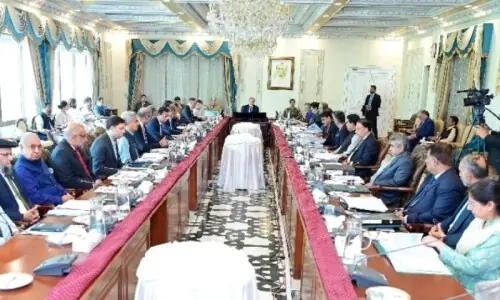
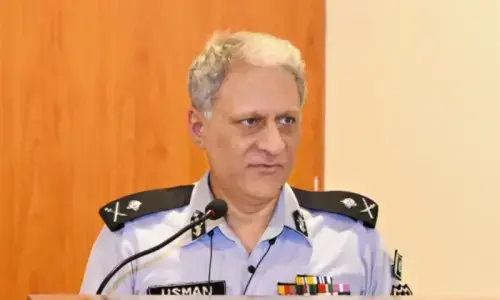
Instead of which the army, as every baffled citizen can make out, is involved to its teeth, and getting more involved by the day, in an open-ended agenda which includes, may the Heavens protect us, canal desilting, district monitoring (under the overall supervision of the Chief of General Staff, Lt Gen Aziz), railway reorganization (under the command of retired Lt Gen Javed Qazi who is being helped by a host of regular officers), the managing of electric utilities (WAPDA having been put under the command of Lt Gen Zulfikar Ali Khan), accountability (under Lt Gen Amjad), national reconstruction (under retired Lt Gen Naqvi), and the reorganization of cricket under the leadership of Corp Commander Lt Gen Tauqir Zia. Too many beribboned generals chasing too many shadows.
General Pervez Musharraf who wears three hats - army chief, chairman joint chiefs of staff committee and Chief Executive - lets no opportunity go by without declaring that the army is prepared to meet every eventuality and that its operational readiness has not been affected by its other duties. That may be so but even Napoleon's Grande Armee would have been hard-pressed to display the virtuosity or versatility which is currently being expected of the Pakistan army.
Indeed one could dwell on this point a bit more. What brought Napoleon to his doom? He took on too many enemies. What led Hitler to his ruin? The same megalomaniac failing: taking on Russia before finishing with England.
We seem to be doing one better than both Napoleon and Hitler. Any army would think it had its hands full with a situation like that obtaining in Kashmir and our long border with India. And yet not a day passes without the army command adding one more mind-boggling item to the already lengthening list of its internal functions.
The argument repeatedly deployed by the Chief Executive that it is the army's duty to look after external and internal security is only half-correct. Without cavilling at the external aspect of national security, safeguarding which constitutes the army's principal function, what constitutes internal security is open to question. The country's financial condition, the state of law and order, the quality of its justice system are all aspects of internal security. Is the army the institution best equipped to deal with these problems? Our own history would tell us it is not but if, despite the evidence, generals still insist on playing at administrators and law-givers it is an exercise in self-delusion to think their professional skills will not be affected.
None of this is to cast a reflection on the bravery and skill of our men in arms. The quality of our soldiers is second to none but time and again - in 1965, 1971 and even later - they have been betrayed by the blindness and ineptitude of their senior commanders. Must we keep repeating the mistakes of the past? If not, then the best service we can do for the army is not to burden it with tasks it can neither fully appreciate nor effectively handle.
Of course politicians have made a mess of things. Of course the army and the other services cannot be expected to look on indifferently as the country goes to the dogs. But this argument is convincing only up to a point. If politicians have behaved irresponsibly, the military, which in various guises has ruled the country longer than politicians, has shown itself no better at the art of government. Indeed the biggest disasters in our history can more honestly be laid at the door of military saviours rather than civilian incompetents.
This is not to excoriate the present government but only to make a timid plea for a bit of understanding and humility when we dish out blame for the country's travails and problems. If Benazir Bhutto and Nawaz Sharif were the only things wrong with Pakistan, we would have nothing to worry about. But our problem is that the bleakness of the horizon which makes Pakistanis the world's leading moaners and breast-beaters extends far beyond the exploits of these twin captains of democracy. Sad though it is to say so, in Pakistan no holy institution or body of men (including the shining knights of the fourth estate) can lay claim to all-round rectitude or perfection.
The army thus must be clear about what it wants. If external security weighs upon its mind then it must concentrate on that and forego the temptation of wanting to run the country as well. But if it remains in thrall to the mistaken belief that saving Pakistan internally - that is to say, saving Pakistan from itself - is also a sacred mission entrusted to it, then, in all fairness to itself, it has cut down on its external involvement by reducing tensions with India and putting 'jehad' on the back-burner.
This means reorienting the country's foreign policy so that Pakistan, instead of having a messianic view of its place in the world, learns to live with its limitations. It does not mean abandoning Kashmir or giving up on our nuclear programme, only the eschewing of unsustainable bellicosity. It also means Pakistan and the Taliban breaking out of the cycle whereby they strengthen each other's isolation.
In 1917 Lenin came to the conclusion that protecting the Bolshevik Revolution was more important than fighting Germany. So he accepted a loser's peace, with utterly humiliating conditions, at Brest-Litovsk. But events proved him right, for Germany was soon defeated while the Bolsheviks, helped in no small measure by the breathing space they had gained, consolidated power across the vast expanses of Russia.
The choice before the Pakistan army is less cataclysmic. It is not between humiliation and survival but between, to put it roughly, external vigilance and internal involvement. The army's commanders might be tempted to think they can carry off both these roles with aplomb but our history, which is a subject in depression, tells us they cannot. In trying to ride two difficult horses at the same time they risk putting an unbearable strain on their riding capabilities.
Greater entities than Pakistan have come to grief (if not perished) from softness or over-stretch. Pakistan is in no danger of being soft. But its guardians are in danger of over-stretching themselves by fighting against too many enemies on too many fronts.