



 0
0

I’m Meer’s fan, Ghalib’s partisan — Ahmed Hamdani
 As a young radio producer, Ahmed Hamdani entered the studio “empty-handed” the day the then director-general of Radio Pakistan, Z.A. Bukhari, was to read out a marsia. Hamdani was confident that the legendary broadcaster would not only have no lapses but would also finish his recital exactly within the stipulated 15 minutes. As if to test his junior colleague's capability, Bukhari wound up his recitation three minutes earlier. Hamdani lost no time in taking over the mike and began to recite verses suitable to the sombre occasion: Shah hust Husain, padshah hust Husain ....
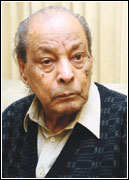
“Bukhari sahib was so pleased with my presence of mind that when the programme ended, he hugged me enthusiastically,” recalls the noted broadcaster, poet and critic in an interview with Dawn at his Gulistan-i-Jauhar residence on Monday.
Mohammad Ahmed Hamdani was born in Meeruth in 1924, did his graduation there and arrived in Pakistan with a group of other young men in 1947. Like many Karachiites, Hamdani was also reluctant to swap Karachi for another place. So, when he was promoted and transferred to another provincial capital, he preferred to resign rather than being transferred. When Raja Zafarul Haq, the then information minister, came to know of it, he persuaded him to withdraw his resignation, allowing him to stay on in Karachi. But another two years down the career, he was faced with the same dilemma. He decided in favour of staying in Karachi and obtained premature retirement. He chose to join Hamdard on the personal request of the late Hakim Said and ignored the couple of other offers he had received when the news of his retirement appeared in the press. He served Hamdard University for about a decade.
 Hamdani has seven highly appreciated books to his credit. He is working on the eighth one, discussing the growth of Urdu short story. Two of his books are collections of ghazals, a genre he fell in love with at a young age and is carrying on the relationship with utmost fidelity. "I have written a few poems also, but I don't attach much importance to them. Ghazal is what I find the best medium to express myself in," he says. “And I’m happy that my efforts have been praised by stalwarts like Akhtarul Eiman.” He quoted the renowned man of letters as having said: “Take out Hamdani’s contribution from it, and little will be left in modern ghazal.”His book “Nai shairi kay sutoon” discusses the works and personalities of 11 poets. To him, the sutoon (pillars) of modern poetry are Firaq Gorakhpuri, Faiz Ahmed Faiz, N.M. Rashid, Mira Jee and Akhtarul Eiman. He describes Ahmed Nadeem Qasmi and Aziz Hamid Madani as “motabar’, or significant, poets. The three 'famous and popular poets' he discusses are Nasir Kazmi, Saleem Ahmed and Ahmed Faraz.
Asked if he could name any poet from recent history who could be ranked among the greatest poets of the Urdu language, Hamdani shakes his head. Even in the case of classical poets, his answer is highly diplomatic: “I am a fan of Meer’s, but at the same time a tarafdar (partisan) of Ghalib's.”
He spent about 30 years in Radio Pakistan, but none of his ghazals was sung by vocalists as long as he was there. “I mostly did literary and cultural programmes, but had strictly forbidden artistes from singing my ghazals,” he says. “But they did it when I left the organisation, and this I appreciate.”
Of his friends and colleagues, he fondly remembers renowned poet and critic Saleem Ahmed. “Whenever he had any problem, he would ask for me. The night before he died in the morning, he was with us, laughing and cracking jokes: he had just returned from abroad. Our ideological differences never affected our strong friendly relationship.”



























