0
0

The optimistic scholar of Urdu from India
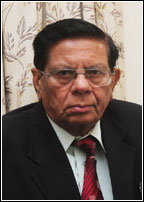
 “Urdu will never die. It has survived many challenges in its long history and it will survive yet more challenges. It will carve out its own ways and will flourish everywhere in the world, just like it has done in the United Arab Emirates and elsewhere. I am very optimistic about Urdu and its future,” said Dr Khaliq Anjum, the renowned Indian scholar of Urdu and Anjuman Taraqqi-i-Urdu Hind’s general secretary, when I shared my apprehensions about Urdu’s future with him. Last week, he was in Karachi to attend the international conference on Urdu, organised by the Arts Council of Pakistan in collaboration with Karachi University. He was at the breakfast table when I reached Karachi University’s guest house to meet the scholar who had shot to fame with his research work on textual criticism and Ghalib.
As we were moving to his room, I asked: “What about Urdu’s future in India?” He said: “Urdu’s future in India is as much in danger as Hindi’s. And the threat is from English, which has become the preferred language. Just like in Pakistan, it is spoken by the elite class to show off. The hegemony of English is one of the ill-effects of globalisation. It is destroying many languages and people are being robbed of their mother tongue. But still, I would say, Urdu will meet all challenges”.
Answering my question about Urdu’s future in Pakistan, he said: “Here the future of Urdu is slightly better because it is a common language, the lingua franca that connects the whole country. Secondly, here hatred against Urdu is mild and people who love Urdu are in greater numbers.” Dr Anjum settled on the couch and ordered tea for the two of us, delightedly informing me that he drank 15 to 20 cups a day.
Born in Delhi in 1935, Khaliq Anjum, whose real name is Khaliq Ahmed Khan, did his intermediate and graduation from Aligarh Muslim University.
Having got a Master’s in Urdu and diplomas in linguistics and library science from Delhi University, he joined Delhi University’s prestigious Karori Mal College as lecturer and taught Urdu for about 10 years. In 1970, he obtained a PhD from Delhi University. His doctoral dissertation was on Mirza Mazhar Jan-i-Janan, Urdu’s classical poet and a Sufi in his own right. Dr Khaliq Anjum also served India’s ministry of education for about five years. Indian Prime Minister Indira Gandhi had formed a committee for the promotion of Urdu, headed by Inder Kumar Gujaral. Being asked by the committee to submit a detailed report, Dr Khaliq Anjum toured the length and breadth of India to survey and to understand the issues. In 1972, with his report he submitted many recommendations, including the one that favoured establishing Urdu academies in every Indian state and Urdu schools and colleges in every locality where Urdu-speaking people were 10 per cent or more of the population. Most of the recommendations went unheeded and the only major implementation was the establishment of Urdu academies and that, too, only in 13 states, which are still functioning.
“You have been serving the Anjuman for long and have done wonders for it. How did it begin?” Dr Sahib grabbed the nearby pillow and leaning against it said: “Anjuman’s members were looking for someone who had a real commitment to Urdu. Urdu’s eminent writers such as Malik Ram and Sajjad Zaheer knew of the work I had done with the Gujaral committee and they thought I was just the right person. They invited me and I joined it in 1975. The Anjuman was in a real bad shape. There was a half-finished floor and the funds were meagre. Now we have a five-storeyed building known as Urdu Ghar. Anjuman publishes about 12 new books a year, a fortnightly ‘Hamari Zuban’ and a quarterly ‘Urdu Adab’. It now has over 600 branches all over India, which work for Urdu’s promotion”. When I asked him about his books, I realised he had literally lost count, let alone remembering their names. He then began recalling his early books and said his writing career began with the publication of ‘Ghalib ki nadir tehreeren’, a research work on Ghalib’s rare writings. Then he edited and translated Mirza Mazhar Jan-i-Janan’s Persian letters. Next to be published was a translation of Nikolai Gogol’s novel. He has also published works on Urdu’s eminent authors such as Mirza Rafi Sauda, Baba-i-Urdu, Hasrat Mohani, Shibli Naumani and Asif Ali.
 One of the most important of his books is ‘Matni tanqeed’, or textual criticism, a fine work that discusses the methods and techniques of evaluating, editing, annotating and compiling texts. With its revised and updated edition published both in India and Pakistan recently, the book has become even more useful and is recommended by most universities for their MPhil and PhD courses. His other significant contribution is the editing and annotation of Ghalib’s Urdu letters, compiled in five volumes. Being an expert on textual criticism, he was one of the first people in the subcontinent to adopt the German technique of compilation to edit these letters and his version of Ghalib’s letters is considered among the most authentic ones.
His other books on Ghalib include ‘Ghalib ka safar-i-Kalkutta’, ‘Ghalib: Kuchh mazameen’ and the forthcoming ‘Ghalib aur shahan-i-Taimuriya’.
In addition to Ghalib and textual criticism, Dr Khaliq Anjum’s another expertise is in the field of history and archaeology. His books ‘Muraqqa-i-Dehli’, ‘Dilli ke aasar-i-qadeema’ and ‘Dargah-i-shah-i-mardan’ deal with the archaeological sites of Delhi. His profound knowledge of Delhi’s history and its historical remains is also evident from the gigantic task he has carried out in three volumes: editing and annotating Sir Syed Ahmed Khan’s ‘Aasar-us-sanadeed’.
After trying for a while to recall the names of his other books, he stopped and said, “I think I have written some 63 books and sometimes forget their names too. Once I was looking for a book and when could not find it, I asked the librarian for help. He laughed and informed me that I myself had written that book.” He seemingly enjoys his absent-mindedness though he vehemently refuses to be labelled as ‘professor’.
Coming to the burning issue of Urdu’s script and the tendency of some elements favouring Roman or even the Devanagari script for Urdu, Dr Anjum said publishing Urdu books in the Nagari script in India was not a matter of choice but a compulsion. “Here in Pakistan you do not need the Nagari script but in India there are lots of people who want to read Ghalib or Ahmed Faraz and they cannot read Urdu’s Perso-Arabic script,” he said. “When Ghalib’s poetry was published in the Nagari script for the first time in India, it was so hugely popular that the publishers had to reprint it again and again for years at a stretch. And there are a large number of Urdu books being published in Nagari every year. I don’t think it has an adverse effect on Urdu in any way. Rather it popularises and promotes Urdu as these Urdu books in Nagari have footnotes that explain Urdu words in Hindi.
“But Urdu’s script should not be changed at all. And as for Roman script, even in India Urdu is not written in Roman script, unless there is a need, just like messaging is done here,” he further said. Reflecting on Pakistani society, he said he was surprised to see some people indulging in extravagance here. “Just have a look at the dressing tables of women here. We in India consider it a bad taste to so profusely decorate the dressing. Even wearing too much make-up is looked down upon. But here it is quite the opposite. In fact, the problem is that yours is a new country. People have got newly rich and they have to find new ideas to spend their money. But your country is making progress fast. I have been here many times and I have noticed signs of progress everywhere. As far as culture and sophistication is concerned, I do not expect it to be like it is in Delhi or Lucknow, which have 700 or 800 years old cultural traditions. Yours is a wonderful country, with political instability being the only weak area. But you people will get over it. As democracy flourishes, everything will be all right.
“And what about the literary standards?” I asked. “After attending the week-long conference, my impression is that the standards of literary research and criticism are much higher in India. But here creative writings are wonderful. Your creative writers and poets excel while Indian scholars are doing a better job, though I would make an exception for Urdu research being carried out in Pakistani universities. I regularly receive PhD dissertations for assessment from Pakistan and some of them are exquisite,” he said.
“And the reason for a better overall research in India and a better creative literature in Pakistan?” I asked. “Very simple,” said he, “We have the centuries-old institutions, libraries and in fact the major sources of Urdu research are much greater in India. While in Pakistan Urdu is the language of culture and higher expression. Even those whose mother tongue is not Urdu, take pride in their Urdu writings. They work harder. It definitely gives an edge.
“And I wish to thank all in Pakistan for their friendliness and their hospitality. It is my personal experience many times over that Pakistanis are very hospitable by nature. They go to extra lengths in entertaining guests. Every time I come here, they shower me with gifts.” He seemed quite thrilled and I cracked a joke about our hospitality, but he was quite serious: “I ask all my hosts here to visit India, but warn them not to expect as much as you Pakistanis do. It’s really extraordinary.”
drraufparekh@yahoo.com
Different faces of war and politicians
 THE major political parties, which have been feeling the heat of a war-like situation in the province, have proposed to the Frontier coalition government and Islamabad to withdraw the army troops from the Federally Administered Tribal Areas and Swat immediately and give a free-hand to the political administration and the police to deal with the militants in their respective domains. They suggested this at a regional level’s APC organised by the Joint Action Committee, a conglomerate of the NGOs, in Peshawar.
The participants – religious, nationalist and left-leaning progressive parties – came with different panaceas to get the violent-hit tribal and settled areas freed from the militants. They all were agreed that the mess they are passing through was a creation of the United States, which has turned the Afghanistan into a new military outpost to monitor its rivals in the region. The religious leaders were of the view that the United States is fighting not war on terror, but a ‘crusade’ against the Muslim states. Despite their conspiracy theories, they were convinced on the early pullout of troops from Fata and Swat.
“The militants want no patrolling on the roads that is why they attack policemen in and outside the police stations. When the police will be nowhere, the militants will be facing no hurdle in transporting their weapons from one area to another,” argued Jamiat Ulema-i-Islam (F) provincial secretary Maulana Shujaul Mulk.
He said the police were capable to deliver more than any other security agencies in the troubled areas. It is not a simple, he said, lawlessness, instead it is an insurgency, wherein the military has got itself caught unnecessarily. Most of the participants were of the view that the overlapping of authority in the affected tribal areas is a major issue, which needed to be addressed on prior basis.
The Jamaat-i-Islami thinks that as long as the US and Nato troops are stationed across the border in Afghanistan, destability and violence will continue in Pakistan. It believes that a nexus of Israel, US and India is active against Pakistan in different guises. JI provincial general secretary Shabbir Ahmed Khan proposed to Islamabad to suspend the container service operating through the Pakistani territory to the US and Nato forces in Afghanistan. The JI has also planned a public rally on Dec 18 to stop the Nato container service plying between Karachi-Peshawar-Kabul.
The nationalist forces feel that the decision-makers in Islamabad do not pay considerable attention to the problem being faced by the people at the western border of the country. The US drones have been striking at different parts of the Fata for the last many months, but it is being treated as a routine practice.
They say that if a minor shootout occurs between the anti-smuggling forces on the eastern border, it is considered as a signature tune to an impending war, which smacks of a parochial approach in national affairs. They add that the 20,000 fresh US troops will start pouring into Afghanistan in the first month of the next year, which may multiply problems for Pakistan.
The Awami National Party, which is the prime target of the militants, is also confused over the unfruitful stay of army troops in the Fata and Swat. “We have no control over Swat, once a peaceful district of the province,” claimed Senator Haji Mohammad Adeel, senior vice-president the ANP. The party has negotiated a deal with the militants in Swat, which could not materialise owing to reasons unknown.
“What can a political party do, except to opt for a peaceful settlement? That we did, but the other party (militants) targeted our workers. We don’t believe in bloodshed. We want execution of the accord, but not on the dead bodies of party workers,” he reiterated his party’s stand.
The National Party (PN) thinks that the US invasion and then the arrival of International Security Assistance Force under a United Nations-sponsored move into Afghanistan have complicated the things instead of getting the country out of the chaos. PN provincial chief Mukhtar Bacha called upon Kabul, Taliban and Islamabad to play their respective role in rooting out violence from the region.
He presented a three-point agenda, which according him can give an end to the war and violence on both sides of the border. He proposed that (i) the United Nations should replace the ISAF and US forces with its own peacekeeping force in Afghanistan, (ii) All shades of Taliban warring groups should lay down arms and start negotiations with the Kabul for a peaceful settlement amongst Afghans parties and (iii) Islamabad should convene an all parties’ conference on how to get the country out of the ongoing violence.
Some others parties have the opinion that the religious parties had damaged the national liberation movements across the globe, including in Afghanistan, where the Afghans had been fighting for their national independence for the last three decades against the foreign occupation of their country.
At present, they say, Afghans are fighting for their national independence, because the United States had forcibly occupied their country. They argue that the massacre and destruction on both sides of the Durand Line is an extension of the war being fought inside Afghanistan and the US allies are also paying the price for it.
CDA’s apathy behind increase in road accidents
 Road safety measures being taken by the Islamabad traffic police to reduce the number of accidents are getting no help from the Capital Development Authority.
The presence of traffic wardens at all main road crossings and highways to facilitate the flow and save vehicles from accidents during rush hours does seem to be producing the desired effect and fatal or near fatal accidents continue to cause concern to the general public , particularly pedestrians whose rights are not respected by both motorists and CDA.
The construction of two avenues – Seventh and Ninth --- and the project to widen the Islamabad Highway and change it into an Expressway are much needed works. But the basic need of pedestrian bridges across the fast moving tracks is being overlooked.
Two bridges are under construction along the --- kilometres long Seventh Avenue, but no such facility is being provided on the Ninth Avenue and the Expressway. This shows CDA is only concerned about the comfort of the motorists at the cost of the safety of the pedestrians.
Last year at least 140 fatal and 170 non-fatal accidents took place in the capital city. The ratio of accidents slightly decreased in the current year and during January to November at least 120 fatal and 140 non-fatal accidents occurred.
The Islamabad Highway after its widening from Faizabad to Kural has become the first vehicles’ track in the country with eight-kilometre long 10 lanes built at the cost of Rs1.2 billion. Each side of the road has two lanes made of concrete for heavy vehicles like trucks and passenger lorries and the other three are carpeted for light vehicular traffic.
The Islamabad Traffic Police personnel on duty there say that three to four accidents take place daily at the newly widened Expressway and 20 to 25 of these every month are fatal causing death, serious injury or loss of a limb.
The reason behind the increase of road accidents at the Expressway was the absence of pedestrian bridges on the fast moving track where the speed limit was 80 kilometres per hour. They said that ITP had asked the CDA to immediately start the construction of bridges at the nine passenger stops. which are nine to avoid the accidents. However CDA has failed to respond.
Earlier, the Islamabad Highway had three pedestrian bridges at Dhoke Kala Khan, Kuri Road and Zia Masjid. But at that time it had only three lanes. These bridges were demolished for widening the road.
Now thousands of people dash cross the Expressway daily in three steps – first they cross the two lanes made of concrete for the trucks and wait at the edge of charcoal patch to cross the remaining three lanes whenever they find a gap in the flow of traffic. After reaching the divider they repeat the practice in reverse to reach their destination.
Although the traffic police have imposed speed limits at the Expressway but motorists do not care. The situation becomes dangerous at night when traffic control is taken off the expressway. Lane violation is also common on the Expressway particularly to avoid waiting for the two signals to turn green by speeding up to beat the red caution. At night blinded by the beams many pedestrians lose their life crossing the five lanes.
The use of beams is prohibited on single- way roads but motorists can use it on two-way roads. In any case the beams kill.
Likewise, the Seventh Avenue has not a single signal and its speed limit at 70 kilometres per hour is often seen to touch the hundred marks when nobody is. Similarly, the Ninth Avenue has two signals and 10 stops for passengers’ vehicles. Its speed limit is also70 Kilometres per hour but who cares. Only one pedestrian bridge has been constructed there.
The ratio of accidents at the two avenues as compared with the Expressway is less because no passenger vehicles use the avenues. But pedestrians face a daily risk crossing them.
Often one accident follows another as police do not cordon off the accident spot and traffic ignorant of the blocked road crash into the place causing more loss of life and property. Last week, an assignment editor of a private TV Channel met with an accident due to the rush of public at the incident spot and the negligence of police for not cordoning off the area. Abdul Ahad, reached the spot along with his colleague to cover the incident, in which an army truck crashed into a wall and its fuel splashed on the road.
A motorcyclist suddenly appeared on the road but due to the fuel, the driver lost control and hit Ahad and an onlooker. The motorcyclist and the onlooker suffered minor wounds but Ahad suffered multiple fractures. He was taken to the District Headquarters hospital from where he was referred to a private hospital. Due to his critical condition the doctors avoided operating upon. Ultimately, he was operated upon in another hospital where he is recovering.
Gang, patrons escape action
ONE wonders as to what prevents Chief Minister Shehbaz Sharif from taking action against police high-ups who have been harbouring the notorious Bajwa gang, though the provincial government had announced a crackdown on the gangsters some three months ago.
Carrying a head money and wanted by police in different cases of heinous nature, gangster Bajwa along with his accomplices had gunned down one of his rivals Basharat even after the announcement of strict action against the gangsters by the provincial government.
Investigation conducted by Dawn revealed that the district police had arrested Khurram alias Khurmi Bajwa a couple of months ago and kept him at an undisclosed location for several days.
He was arrested as the Bajwa family had developed differences with their mentor and former Punjab assembly speaker Afzal Sahi. However, Khurram was released soon after both parties reached an agreement that they would not field candidates in the election against each other.
Sources said the then district police officer Mohammad Amin Wains, now serving as Sialkot DPO, had been eliminating criminals in ‘encounters’ which also frightened the Bajwa family.
Considering it a looming threat, the Bajwa family saved the skin by settling their issues amicably with Mr Sahi. By this way, sources said, they secured the safe release of Khurram Bajwa.
Following the deal, the Sahi family had used the Bajwa family to meet their political ends, but they failed to yield the desire results even in the last general and local body elections, sources said.
Ghulam Rasool Sahi, brother of Afzal Sahi, had lost the city district nazim election as power muscles of Clock Tower market traders extended full to Rana Zahid Touseef.
Traders were averse to the attachment of Bajwa’s with the Sahi family. They were afraid that criminals would unleash a terror in the district if the district nazim was elected from the Sahi family.
However, district nazim Rana Touseef has also failed to tide over the activities of the gangsters who are looting the businessmen with impunity.
The Bajwa’s had also been openly supporting the Sahi family while police officers also facilitated the criminals to steer clear the wrath of the then provincial assembly speaker.
Attendance at the district assembly sessions by Mukhtar and Khurram Bajwa was also a clear proof of Bajwa’s influence and ‘powerlessness’ of the police. They attended the assembly sessions despite the fact that several cases were registered against them in different police stations.
A police inspector, requesting anonymity, confirmed the arrest of Khurmi and said they could not get the green signal from their high-ups to eliminate Khurmi. He said that was the right time to get rid of the criminals easily, but now the police could not achieve the task given by the chief minister.
During the CM visit on Dec 1, the elected representatives had severely criticized the police officials for their failure to arrest the criminals who had been striking at will.
They categorically informed the chief minister that police officials serving in the district were inefficient and were not able to net the criminals.
Sources privy to the meeting said the participants charged the police with extending all out support to let escape the Bajwa’s from the country.
To save their skin, the police officers passed the buck on the lower staff by accusing them of leaking information regarding the action against the Bajwa gang that landed police in trouble, sources said.
They said law minister Rana Sanaullah had raised the issue that if the subordinate staff had been extending helping hands to criminals then what the police officers had been doing in the district.
The minister said that police officers had the decision-making powers and could make transfers at any time and such excuses that the lower staff had been leaking secret information to criminals were mere an eyewash.
Sources said the CM had announced the suspension of the Jhumra police station staff, but he did nothing against the mentors of the criminal groups. Different agencies have provided all the information to the CM about the Sahi family’s involvement in patronizing the criminals which is the main hurdle in netting them.
A superintendent of police, requesting anonymity, said the CM took the right decision as the suspended policemen had been furnishing secret information to the Bajwa gang.
He, however, remained tightlipped when asked to recall any action ever initiated against the suspended policemen.
Besides, sources said, the killing of Basharat was also a sheer example of police high-ups’ failure to net the criminals. The immediate family members of the deceased had time and again informed the police that criminals had been giving them life threats, but nobody bothered to protect him.
Denying all allegations leveled against him, former provincial assembly speaker Afzal Sahi said he had no links with the gangsters and, therefore, there was no question of patronizing them.