0
0

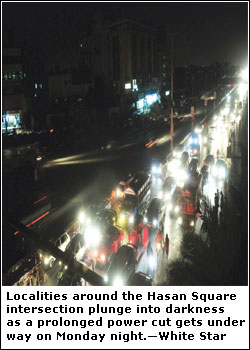 KARACHI, Oct 27: A large number of Karachi Electricity Supply Company consumers complained on Monday that banks refused to accept the 60 per cent payment of enhanced bills issued to them under the new tariff rate, while adding that an end to prolonged and unannounced load-shedding was nowhere in sight.
The banks’ reluctance to accept electricity bills angered many power consumers and sparked noisy arguments between people and bank staff at many places on Monday.
Some consumers complained that post offices also refused to accept the 60 per cent payment of bills and asked them to first get the bills changed at KESC offices.
Banks’ staff claimed that they had not yet received any instruction in writing to accept the 60 per cent amount of the total electricity bill, which customers were insisting on after a series of written and televised statements of government functionaries had appeared in the media.
Some people who went to the KESC offices in their areas also faced the same problem when the KESC staff expressed its inability to issue instructions to banks to accept the 60 per cent of the total bill.
Despite the massive protest in recent days against the tariff hike, no one in the power utility seems to get serious about the issue of reduced payment, said a power consumer. No one is answering, as there is no accountability of the power utility, another angry consumer added.
However, the industrial sector in the city, to facilitate its members, organised itself and set up special cells where the KESC personnel have been deputed to complete formalities for payment of bills.
Many KESC consumers also complained that the power utility personnel were also changing electricity meters without any prior notices or intimation of their move. On the other hand, many consumers are not even aware that their meters have already been changed and that what the reading was at the time of the meter’s removal.
People said they feared that the ‘questionable manner’ in which the meters were changed showed that the KESC had planned to impose excessive units on them by installing new ‘fast meters’.
They also maintained that on the pretext of the ‘faulty old meters’ the KESC was planning to charge the consumers for the units which the consumers had not even consumed.
The KESC spokesman, Qashif Effendi, did not respond to Dawn queries with regard to the above two issues.
Meanwhile, the KESC continued to operate its Bin Qasim power plant. However, unit 5 of the plant is still out of order and not expected to be restored in three to four days.
Unit 1 is generating about 160 megawatts, unit 2, 170MW; units 3 and 4 are churning out 70MW each, while unit 6 is also producing 160MW.
Kanupp is not expected to be restored before Oct 30, causing a shortage of about 80MW.