



 0
0

The sad story of Mohammad Hussain Azad’s library
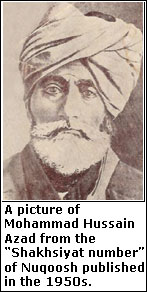
 In addition to being a great writer and pioneer of modern Urdu poetry, Muhammad Hussain Azad (1830-1910) was an extraordinary book lover. It is, however, not enough to describe him as a mere “book lover”. He was an incurable collector of books. In fact, he was such a great bibliophile that he spent almost his entire life and savings on building up a personal collection that boasted thousands of rare volumes and manuscripts. He opened his library to the general public at great personal expense but, in the end, the invaluable treasure was squandered. An account of the ruining of Azad’s library reads like a sorrowful story, bringing out our national apathy and callousness.
Maulana Salahuddin Ahmed – who like many other ‘maulanas’ and ‘maulvis’ of Urdu literature was not a ‘maulana’ in the traditional sense of the word – used to publish a literary magazine, Adabi Dunya, in Lahore. In 1961, a special section on Azad was published in the magazine to coincide with his 51st death anniversary. The section includes, among other write-ups, an article by Azad’s grandson, Agha Mohammad Baqar, on Azad’s library. The article, which was titled “Kutub Khana-i-Azad”, gives readers a valuable insight into the hardships Azad underwent to collect rare books and build up a personal library.
He writes: “Azad spent the greater portion of his income on the purchase of books. Whenever he found a good or rare book, he would buy it. He first travelled to Central Asia and was loaded with books when he came back. Then he went to Calcutta and brought many good books from there…during the summer vacations he wouldn’t rest and would ask his students to inform him if anybody from their town wanted to sell books. On such occasions, he went himself and bought books. Azad came to Lahore in 1861 and visited Iran in 1885. During the period he had saved about Rs10,000, a surprisingly high amount of money in those days and the fortune could have bought him a prized piece of land but instead Azad spent all that money on travelling to Iran and buying books. From Iran, he brought a large collection of books.” Agha sahib further wrote: “In those days, when means of transportation were cumbersome, bringing books from faraway lands was very difficult. Azad travelled on donkeys and camels. Whenever he encountered a storm or rain on his way, he would pile up the treasured books, cover them with his mattress, sit on them and cover himself and the pile with his quilt. With a view to saving money for the purchase of books, Azad would take cheap meals, often eating only bread and washing it down with water so that one more book could be added to the collection.”
The same issue of Adabi Dunya carried an article by Salahuddin Ahmed which sheds more illuminating light on Azad’s quest for books. He writes: “Not only did Azad stay in the mosques and seminaries of Iran as a student to acquire education but whenever he heard of a rare book, whether it was in a far-flung village or a mountainous monastery, he went there, often on foot, and got the book at any cost.”Salahuddin Ahmed then quotes Azad, giving in Azad’s own words the details of the hardships of the journeys he took to procure books. Azad says: “From Turbat we reached Karez and on our way had to face the downpour. On every step I would say ‘May God save the books’. Here I met Yaqoob Sultan, a nobleman. He was picking lice from his clothes. He came up to me with his young son and spoke with such great affection that I acceded to his request to visit his place. From there I got two books – ‘Unsari’ and ‘Jamae’ – although both were defective. He would have never given those books up but I had an ivory kohl receptacle that he had seen and liked very much. So I had to sell the ivory receptacle to get the books.”
 The excerpts may seem a bit lengthy but they are just right to make you feel and understand the circumstances and ways in which Azad accumulated his prized collection. After collecting rare and invaluable books, Azad got allotted a few ‘kutcha’ buildings to establish a library by requesting the government. The old buildings were near Lahore’s Delhi Gate, now known as Circular Road. Azad got the buildings demolished and some new ones constructed, spending about Rs2,500 of his hard earned money on them, though the government had informed him before the allotment that the piece of land would remain government property.
Furniture and fixtures were added to the building, which was formally inaugurated by Sir Charles Aitchison, the then Lieutenant-Governor of Punjab, and was named ‘Kutub Khana-i-Azad’. According to Agha Muhammad Baqar, Azad kept adding books and manuscripts to the library and allowed the general public to benefit from this rare treasure.
In fact the government had allotted those ‘kutcha’ buildings and the piece of land for a ‘public library’.
Azad offered his books, his time, his money and hard work to the public, but how did they appreciate and value the sacrifice? How was he rewarded for this national service? Forget about the rewards that may have been showered upon him in a civilised society, what became of his great gift to the nation is a sad story.
The Azad Library kept on serving till 1890. It was just about that time when Azad gradually fell victim to a dreadful disease. It began with insomnia and irritation which later turned into insanity. In the beginning, he had fits of lunacy and patches of sound-mindedness alternately and he even penned some 89 booklets during the period but with the passage of time his temporary lunacy became a permanent one. During the fits, he would pace to and fro or would have dialogue with the imagined spirits of literary celebrities. He even travelled to Delhi and Aligarh during such fits.
As Azad was not expected to look after the library under the circumstances, his son closed it down. When Lahore Municipality knew of the closure, it issued the notice that either the building be evacuated or the rent be paid. The row lingered on for a while but ultimately the building had to be evacuated and the library closed down for good. After a while, Azad’s son bought an old building inside Akberi Gate, near Chowk Nawab Sahib, a locality inside the walled city of Lahore. Getting the old structure demolished and replaced by a new one, Azad’s son had a room for books and they were kept there. During his ecstatic and frenzied moods, a woebegone Azad would go to the library building, roam in the garden around it and forlornly look at the library building. The collection, in the meantime, fell into decay. Some books were stolen; others remained unreturned by borrowers. With Azad’s death in 1910, the library was locked. And when his son was posted to some other town, the mice and termite had a royal feast on the rare books and manuscripts. The sad end of a treasure collected through unbelievable endeavours! Finally, the collection was donated to Punjab University in 1912 and was named ‘Azad Collection’. A total of 1,816 books were donated, according to Azad’s grandson. In 1961, however, there were 1,764 left. The rest had disappeared into thin air.
I do not know the present status of ‘Azad Collection’ and all I can do is hope that all is well with it. The disappearance of rare books from our public libraries is an oft-repeated lament. Almost all the important libraries have experienced this kind of “robbery”. I do not want to name or blame anybody though I know of quite a few libraries that have been deprived of rare books or manuscripts by them. However, I cannot help asking one question: what disciplinary action was taken against those responsible for looking after the libraries from where valuable and historical material has vanished over the years. Any clues?
drraufparekh@yahoo.com.
Handy colonial laws that serve all masters
 Laws enacted by the British rulers to arm its police force with powers to pre-empt any untoward happening that could disrupt public order and develop into some form of challenge to colonial rule smoothly passed into our legal heritage at the time of independence and since then have been used and abused freely by all governments to suppress civil freedoms. Section 144 of the Criminal Procedure Code (CrPC) and its later refinements in the shape of the MPOs (Maintenance of Public Order ordinances) are examples of such laws that governments of all shades and dispositions in tandem have held on to like dear life itself.
Laws are misused freely and a person arrested can be booked under any number of them and accused of all kinds of crimes past or present. But of late since the capital city has become a kind of hub of civil protest, the section of law that has been the darling of the law and order agencies is 144. It has been imposed indiscriminately in situations of all kinds not to maintain peace and order so much as to provide a legal cover to the police to arrest ordinary people.
The law has been in operation in the capital since March last year to an unusual extent. Though at a time its duration is limited to two months only, it seems to have acquired the ability to re-impose itself automatically on its expiry.
Section 144 and the MPOs empower the district magistrate to take action against anybody before the perpetration of any unlawful activity. Section 144 empowers the district magistrate to impose a ban on assembly of five or more persons in anticipation of threat to peace and damage to public property. The violator can be booked on charge of PPC 188.
MPOs – 3, 5 and 16 also empower the district magistrate to arrest people before the occurrence of any crime, bar people from entry into specified places, publish provocative materials and make similar speeches. Only the district magistrate has the authority to use the power with the help of the police.
The police picked up and detained hundreds of civil society and rights activists, workers and leaders of opposition parties and lawyers during the tussle between the former government and the judiciary under the powers of Section 144 and the MPOs. Besides, government not only banned people’s entry into the city but also created curfew-like situation in the twin cities to prevent people from gathering at the Constitution Avenue all through the agitation for reinstatement of the deposed judges. A war-like atmosphere was created on September 10 last year when barricades were erected, sandbag bunkers were built and spiked wire rolls were thrown across roads to block people from reaching the airport to greet Nawaz Sharif on his arrival from Saudi Arabia. Hundreds of people were arrested that day under Section 144 and the MPOs.
This scenario was re-enacted on September 27, 2007, on the occasion of submission of papers by presidential candidates. The government not only directed the police to arrest the people belonging to political parties, but also blocked all roads leading to the Constitution Avenue. Two days later on September 29 lawyers and journalists were mercilessly thrashed at the same venue.
Among the countless arrested was Fazal Subhani, a native of Swat, who was taken into custody by the Secretariat police on the charge of wandering in front of the Parliament House. He was accused of wanting to meet President Gen (retired) Pervez Musharraf on December 14, 2007.
This foolish desire to meet the President had him locked up in Adiala Jail for three days on judicial remand. Later, police said he was mentally retarded and would be freed only when his family members approached the police to hand him over to them. Police was concerned he might start wandering again looking for the President. So he was sent to jail.
The Secretariat police booked over one dozen representatives of civil society on the direction of the top judge for disobedience of orders promulgated by a public servant and violation of the Amplifier Act on May 18. The FIR said that the accused gathered in front of the Supreme Court in violation of PPC 144 and chanted slogans against the President and the Chief Justice of Pakistan.
The top judicator directed a senior officer of the capital administration to take strict action against the protesters, as the Supreme Court was not a place where people could gather and stage protests. However when police asked what type of action should be taken against them, once again Section 144 came handy which remains clamped on Islamabad in all seasons.
The residents of the twin cities of Islamabad and Rawalpindi witnessed one of the biggest traffic jams of their history on September 1, when demonstrators from Parachinar along with local people held a protest against the blockade of their roads for more than a year by the Taliban allegedly with the support of the government. The traffic jam paralysed the main highways and roads of the twin cities. The traffic jam had patients, children and the elderly stuck in miles long queues for more than four hours.
Section 144 could not help the administration and police to disperse the protestors from the scene. But since the protest was not against the government, no case was registered against the agitators.
The Registrar of the Supreme Court has asked the capital police to inquire into the incident of scuffle between the lawyers and police on Sept 5 outside the premises of the apex court.
The scuffle took place when a group of 25-30 lawyers from Multan Bar Association tried to break police cordon and scale the gates of the SC after removing rolls of the barbed wires. The police for once said they did not want confrontation with the lawyers and no case would be registered against them.
Two episodes of firing along with fireworks took place close to Red Zone area – Constitution Avenue -- by the activists and workers of PPP while Section 144 was in force on September 6.
The police said they would not register any case against those involved in firing in violation of section 144 as the crowd was celebrating. But Section 144 has no such exception.Likewise, the law enforcers sealed the Constitution Avenue on September 9, on the occasion of the newly elected President’s oath taking ceremony. Some of the PPP activists climbed the gate of the President’s House and jumped inside but no legal action was taken against them. Section 144 is an intelligent law. It knows where and when and whom to strike.



























