



 0
0

The perfect Iftar
 DURING the month of Ramazan, aside from striving for eternal bliss in the hereafter, there is one thing common on the minds of many believers: what’s for Iftar. Though by the looks of it, with the myriad ‘all-you-can-eat’ deals, overflowing buffets and lavish Iftar dinners that, not too long ago, were all the rage, it seems quite a few of the faithful are concentrating on much more worldly pleasures for the moment.
But a spade must be called a spade. For after a 14-hour fast (and with the current scorching temperatures) even the most ascetic amongst us look forward to the evening meal, if anything to thank the Almighty for the favours He has bestowed. And if one leaves aside the manifest gluttony that is the hallmark of the all-you-can-eat affairs, there is something truly humbling about having Iftar with family, friends or complete strangers. First the dangers of the all-you-can-eat business. Up till a few years ago I used to attend these dos, mostly to fulfil social commitments. For the life of me, people attack the food on offer with such ferocity that it seems the food will eat you if you don’t eat the food.
But this goes for nearly all affairs Pakistani as gluttony has become something of a national sport. For example, the way wedding food is downed by seemingly educated people makes one’s stomach turn. Ditto for political events and press conferences.
But – as usual – I digress. There is also the very real danger of overeating at the numerous available Iftar deals. From personal experience, I have often felt the need for a forklift to transport me from the dinner table to my vehicle after an all-you-can-eat Iftar dinner.
Now that I have firmly made my case against the aforementioned gorge-fests, we can talk about the delights of having Iftar like normal people. Though the Iftar spread depends entirely on personal taste, some things are must-haves. For starters, dates are essential. Though perhaps the best dates in the world come from the Hijaz region of Saudi Arabia, out of the stuff available locally, Iranian dates, especially from Bam, are particularly soft, rich and succulent.
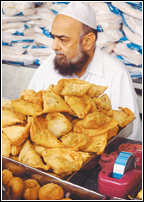
Though many health gurus might warn you against consuming too much fried food during Iftar (and they’re mostly right), what would an Iftar spread be without samosas and pakoras? And one must say that without downing a samosa or two, Iftar seems incomplete. Two shapes tend to dominate the genus samosa: the triangle and the crescent. I am by far partial to the crescent samosa, preferably with a flour (maida) crust and a savoury mince-meat (qeema) filling.
And what would a samosa be without its condiments? Ketchup, chilli sauce, hari mirch and lal mirch chutneys are the usual suspects, but I tend to prefer a yogurt-based dip lightly flavoured with either red chilli or black pepper. Perhaps the sensation of a samosa – smothered in your chutney of choice – melting in your mouth at Iftar time is unparalleled.
Though samosas with a variety of fillings – chicken, beef, potato etc – are available at a dime a dozen shops (halwais, bakers, candle-stick makers, etc), especially during Ramazan, there is one place where the combination of taste and hygiene is unbeatable: home.
 Pakoras also deserve an honourable mention in the list of Iftar goodies. There are many traditional varieties, with potatoes, onions, chillies and even spinach leaves fried in a batter of gram flour (besan). However, methinks that a sizzling, crispy pakora flavoured with only a little bit of onion and green chilli beats all the fancy varieties hands down. Add ketchup or spicy chutney to taste.
What Iftar spread would be complete without chaat? Here again the canvas is wide open to experimentation and innovation. However, two variants of chaat are usually served during Ramazan. The first is fruit chaat. The name is self-explanatory. Any variety of fruit can be thrown into the chaat bowl and depending on taste, a thoroughly sweet version can be concocted with seasonal fruit such as apples, melons, bananas, pomegranate, etc, or a spicier version featuring guava and flavoured with chaat masala and lemon juice can be made.
But this writer is totally partial to chaat made using chickpeas – referred to as cholay in the vernacular – as a base. The sky is the limit as one can add potatoes, onions, tomatoes and yoghurt to taste for a truly heavenly Iftar snack.
As for the beverage front, quenching one’s thirst is often more important than filling the stomach after the fast is over. My personal favourite is water; however, there can be little colour added to a food column by describing the uncountable benefits of good old H2O.
Sherbets, milk-based drinks and fruit juices are ideal, though fizzy drinks should be avoided like anything.
In conclusion, putting together the perfect Iftar is like creating a mosaic. You gather bits from here, there and everywhere and when put together, it comes together as a composite whole. And whereas a home-made Iftar has the subtlety of a classical mosaic, the all-you-can-eat deals are like garish paintings. Eat at your own risk.
Islamabad awaits magic — in its backyard
 FOLLOWING the heady election of Asif Ali Zardari as president last week, it would seem inappropriate to declare anyone else the king but Singh continues to rule the roost — at least on the cinema screen in Rawalpindi.
The Bollywood flick Singh is Kingg (no spelling mistake here, just one of those silly Hindi cinema histrionics) starring Akshay Kumar has scaled spectacular heights to become one of the biggest grossing Indian movies of all time.
Since the decision by Musharraf regime to reverse a more than three-decade-old ban to screen Bollywood movies, cinemas all over Pakistan have found a semblance of life with most running full houses.
The Cinepax in Rawalpindi has truly arrived as the entertainment hub for fun-starved citizens of the twin cities. Currently, residents of Islamabad have to traverse some distance to partake the magic of big screen but this has done little to dampen their spirits.
In fact, Islooites have been eagerly waiting their turn to watch all the action in their own backyard, for some time now.
The Capital Development Authority did raise their hopes last year by announcing a joint venture with a private company to construct the capital’s maiden Cineplex.
To be sure, CDA boss Kamran Lashari, who is currently fighting to keep his job, also performed a groundbreaking ceremony of this artful caper but we have not heard anything in the interim that would make us sit up and take notice.
Hopefully, it is not down to the change in the political filmi scene during this period with Pervez “enlightened moderate” Musharraf (at least where arts and culture were concerned) going out with a whimper and leaving the stage to Asif “free spirit” Zardari, who once owned the famous Bambino cinema in Karachi.
Reportedly, the incumbent has a taste for entertainment that matches, if not outdoes, his predecessor’s.
Islamabad’s new master plan also envisages a cine city. This ‘city within a city’ concept allows for the setting up of cinema houses, ceremony areas, halls and theatres in Zone-IV near Chak Shahzad.
However, the bad news is that we are still years away from the realisation of this project. But many pundits are betting on an upswing given the PPP track record in government — associated as it is with patronage of the entertainment industry.
Thanks to the lead provided by his predecessor to provide space for a liberal culture — seen by many as a “secularisation” tool to fend off creeping “Talibanisation”, Zardari is expected to build on the growing need to allow people to enjoy the fine things in life. Islamabad is currently, the only known world capital without a prim and proper cinema to cater to the public need for recreation. On reflection, the absence of a good facility is astonishing considering the public yearning for it.
Some film pundits feel it is down to the lack of interest in a moribund state of local cinema, which forced many theatre owners to close shop and replace them with other businesses in the last decade or so.
However, it may have only partly contributed to the dwindling interest. In my considered view, primarily, three factors compelled movie fans to make-do with mostly pirated prints in the confines of their homes:
(a) the absence of quality cinema houses
(b) ban on the screening of Bollywood movies (which, given the almost obsessive interest they evoke in Pakistan, make them a huge market and therefore, provide the necessary stimulus) and
(c) inability to bring latest Hollywood flicks to the local cinema.
Recourse to all three — in the comfy environs of Cinepax in Karachi, Lahore and Rawalpindi — and their resounding success reinforces this view. Ardent movie fans have even tided over ticket prices, which tend to be slightly on the higher side.
What is more, even though they have not quite developed a taste for local cinema, a burst of energy has ricocheted with the successful exhibition of Shoaib Mansoor’s Khuda Ke Liye, Javed Sheikh’s Khulay Aasman Ke Neechay and Mehreen Jabbar’s Ramchand Pakistani.
In fact, Khuda Ke Liye and Ramchand Pakistani have been screened in India, winning critical acclaim.
The Cinepax has sort of set the pace for what would follow when Islamabad gets its first state-of-the-art cinema promised to it last year.
In Rawalpindi, it has reached the stage where sometimes cinegoers have to return disappointed on account of the house being full.
Conversely, they just queue up to watch a movie in one of the other four mini cinemas — only to partake the magic of big screen.
The writer is News Editor at Dawn News. He may be reached at
kaamyabi@gmail.com



























