0
0

 WASHINGTON: The Pentagon’s intelligence arm is adding more polygraph studios and relying on outside contractors for the first time to conduct lie detection tests in an attempt to screen its 5,700 prospective and current employees every year.
The stepped-up effort by the Defense Intelligence Agency is part of a growing emphasis on counterintelligence, detecting and thwarting would-be spies and keeping sensitive information away from America’s enemies.
A polygraph is not foolproof as a screening tool. The test gives a high rate of false positives on innocent people, and guilty subjects can be trained to beat the system, according to expert Charles Honts, a psychology professor at Boise State University.The National Research Council noted these deficiencies in a 2003 report. The council, an arm of the National Academy of Sciences, found that lie detectors can be useful for ferreting out the truth in specific incidents, but are unreliable for screening prospective national security employees for trustworthiness.
“Its accuracy in distinguishing actual or potential security violators from innocent test takers is insufficient to justify reliance on its use in employee security screening in federal agencies,” the council concluded. “Polygraph testing as currently used has extremely serious limitations in such screening applications, if the intent is both to identify security risks and protect valued employees.”
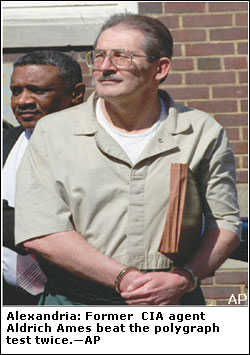
John Sullivan, a polygrapher with the CIA for 31 years, noted that turncoat Aldrich Ames, a CIA mole for the Soviets, beat a polygraph test twice.
But the prospect of facing a polygraph can deter future security violations, according to the council’s report. That prospect also increases the frequency of admission of violations – taking home classified documents, for example – and discourages people who may be security risks from applying.
“Right now the polygraph is the best tool they have at their hands but it’s not a tool that’s without problems,” Honts said.
The increase in lie detection at the DIA is three years in the making. In 2005 the agency’s director announced plans to test every prospective new DIA hire, whether a permanent federal worker or contract employee.
The DIA would not say how many prospective, current and past employees are screened annually, but a 2002 report to Congress said the agency conducted 1,345 counterintelligence polygraphs. It also said the Defense Department had an average of about 160 government polygraphers on its payroll annually for the last decade. The Pentagon’s polygraphing institute trains all polygraphers for the government. It produced 84 new examiners in 2002, according to the latest publicly available statistics.
Until 2004, Congress severely limited the Pentagon’s authority to conduct polygraphs for counterintelligence purposes. From 1988 to 1990, it could conduct 10,000 a year. From 1990 to 2004, that number was cut to 5,000. Congress lifted that cap in 2004 at the request of the Defense Department.
Polygraph sessions are typically three- to four-hour interrogations. A person is hooked up to a machine that measures physiological responses. The subject is asked a series of “yes” and “no” questions. The machine records changes in blood pressure, respiration and heart rate and electrical activity in the skin. The polygrapher interprets that data to determine whether the answers show inconsistencies or indicate deception, based on established parameters.
An unclassified DIA document describing the new effort says the contractor hired to perform the exams will conduct a minimum of 4,550 a year in 13 new polygraph studios. The polygraphers would have to work at a brisk pace to meet the target: each studio would need to complete 350 sessions a year to meet contract specifications. Those 13 new studios would be added to the eight now manned by DIA polygraphers. All would be overseen by DIA personnel.
The document says that the agency will, for the first time, hire contractors to administer the tests rather than relying on government polygraphers.
Mark Zaid is a lawyer who represents federal employees in lawsuits against the government, many involving disputed polygraphs. He said the government’s reliance on lie detection tools is an easy way around the more reliable, but more time-consuming, security background investigations. There is a massive backlog for these.
“It’s a cheap fix to a broken system,” Zaid said.
The problem, Zaid said, is that there is no process for government employees to challenge a polygrapher’s interpretation of a test. “They get labelled a liar, and that’s it,” Zaid said.—AP