0
0

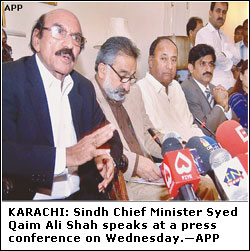 KARACHI, Aug 6: Sindh Chief Minister Syed Qaim Ali Shah said here on Wednesday that the government had already developed six sites for installation of coal-fired power generation plants and a number of foreign firms from the US, Germany and Poland have shown interest in these projects.
He was speaking at a press conference on Wednesday at the Chief Minister’s House after his return from the US where he presided over a two-day round-table conference. The conference was jointly organised by the World Bank and Pakistan government in Washington for exploitation of Thar coal reserves of 175 billion tons spread over 9,000 square kilometres for generation of energy.
The chief minister said that coal reserves were not only sufficient to meet our future energy needs for two to three centuries, but Pakistan can also export power to some Middle East countries and some neighbouring Indian areas where there was a power shortage.
The RTC was attended by 150 investors from 32 countries, including local entrepreneurs.
He said after the signing of the memorandums of understanding, likely during the current month, the firms could start work on the site within three months and power generation could start within three years.
“It will be possible only because of the one-window operation facility, which will be made available to investors with the formation of the Thar Coal and Energy Board.”
He said Pakistan’s 40 to 50 per cent power-generation depended on thermal energy from the imported furnace oil which was consuming some seven to eight billion dollars, which could be saved with the setting up of coal-fired power generation units. “As soon as these units are completed, it will be beneficial for all.”
Terming the RTC a big success, he said that as a result of this conference, there would be an investment of $10 to 12 billion which would be the biggest-ever investment in a project by international entrepreneurs.
He said at the conference some people had raised the question of law and order, but they gained strength when informed that since the formation of the Pakistan People’s Party government in April, the law and order situation, from Karachi to Kashmore, had much improved, and no incident of kidnapping for ransom had been reported in the interior of Sindh.
The chief minister regretted that some leaders were raising questions over the composition of the board, and pointed out that the Sindh Coal Authority’s objective was limited to exploitation of the coal only, while power generation was the federal subject and foreign investment was not possible without the support of the federal government.
He said that the prime minister had made it clear in the federal cabinet meeting, which was also attended by the four chief ministers, that coal was a provincial subject and not only its exploitation was a provincial matter, but even the initiative for energy would remain with the province, and the federal government would extend every possible support to the province.
He said that it required a huge investment, and as such it was not the work of one or two companies. Soon more international bids would be invited after the board meeting.
In reply to a question, the chief minister said that the notification for formation of the board was issued by the Sindh government which had a constitutional cover, but if at any stage, need was felt for a resolution in the assembly, it could be moved.
Answering to another question, he said that the board comprises ministers of relevant departments of revenue, water and power and some technocrats only.
Talibanisation bogey
Syed Qaim Ali Shah dispelled the impression of existence of Taliban in Sindh.
“The people of Karachi and other parts of Sindh and Pakistan are liberal and Pakistan People’s Party is a liberal democratic party which is against extremism and no one in Sindh will be allowed to carry out the agenda of extremism.”
He said if any one had information about the arrival of extremists in the province, they should be identified and the government would take action against such people.
About power shortage in Karachi, he said measures were being taken to temporarily meet power needs of the city by shortly importing 2,000 to 3,000 MW of power.