



 0
0

A brief history of haleem
 MANY foods in the East and the West are tied to certain occasions, both spiritual and temporal. Be it Thanksgiving turkey in the United States, matza ball soup consumed by the Jews during Passover or sheer khurma that is relished with delight during Eidul Fitr in the subcontinent, though these dishes may be associated with specific festivals, many of them have become delicacies that can be enjoyed any time of the year.
Perhaps similar is the case with that gooey subcontinental delight known as haleem. Though it is usually cooked during the month of Muharram, commercialization of the dish has ensured one can gladly lap it up on any day of the week in any month of the year.
It is unclear what exactly connects haleem with Muharram. A tradition – though unverified – says that Imam Zainul Abidin (AS), the fourth Imam, ordered the dish to be cooked after the tragedy of Karbala. Though one is not sure about the truth of this claim, it is a fact that throughout the months of Muharram and Safar, the faithful prepare cauldron upon cauldron of haleem as part of nazr-o-niyaz.
Haleem is basically a thick paste consisting of lentils, wheat, meat and spices, cooked to perfection. A good way to judge the quality of haleem before actually devouring it is to check the viscosity of the stuff, as well as to see if everything has been blended to perfection. Haleem’s Middle Eastern cousin is called hareesa, while in my culinary experience, two other subcontinental dishes may have stemmed from the same tree. The first is khichra, popular in northern India.
The main difference between haleem and khichra is that in the latter, the chunks of meat are quite prominent while in the former, everything is blended into a thick paste.
The other haleem -like dish is the Rajasthani delicacy of tukray. Tukray are basically made from dried rotis and come in both sweet and savoury versions. With enough fresh lemon squeezed on for good measure, the gulf between haleem and savoury tukray becomes quite narrow, and one remembers as a child getting confused between the two. But we’ll save discussing the joys and subtle flavours of Rajasthani cuisine for another day.
Closer to home, haleem can be found in many parts of Karachi, from humble push-carts to brightly-lit franchises that peddle tonnes of the stuff. Since common sense and not any class consciousness dictates that the chaps on the push-carts should be avoided, I, along with a few willing volunteers, decided to head for Burnes Road to try and see just where two of Karachi’s leading haleem merchants really stand.
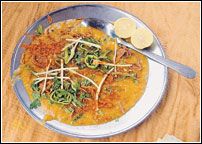 The first outlet we tried was Karachi Haleem. While my friend opted for a single plate of chicken haleem, I went for the beef version. Though I am no beef lover, I believe that in matters of haleem, one should be a purist. Before the haleem was brought out, the waiter brought us an assortment of condiments consisting of lemon wedges, what appeared to be chaat masala, mint, ginger, green chillies and fried onions. This, one must add, is essential to truly enjoy the haleem experience, even though some of the condiments looked like they’d been out in the open for much longer than advisable.
Soon the haleem was brought in, accompanied by warm naans. Though in the past I used to baulk at the thought of having haleem with naans, after having tried the stuff with bread at this establishment, I was forced to change my rigid stance. The naans were delightful, with a soft, almost kulcha-like quality to them, and scooping up the haleem with morsels of naan was a heavenly experience.
My friend had issues with the viscosity of the haleem as in his mind it had too much of a liquid quality. Little did I know that after trying another popular haleem joint, my friend would be proven right.
The second place I and an intrepid gastronomic adventurer tried was Mazaidar Haleem, also located on Burnes Road. Word has it that this joint’s mother venture was originally found (and still exists, methinks) in Federal B Area. Now the two haleem-wallahs have pitched their tents nearly next door on the culinary battlefield that is Burnes Road.
True to its name, the haleem here was quite tasty, primarily because it was thicker than the other place’s. With seasoning added according to taste, the mouth was treated to a riot of flavours, as all the ingredients came together in a scrumptious whole. Now that’s what I call unity in diversity.
However, the lemons at this joint had seen better days as it was a real effort to squeeze the juice out of them. And if you like your haleem tangy, this can prove to be a real disappointment. Also, the naans at here were limp and lifeless.
One felt that perhaps if the haleem from Mazaidar and the lovely, mouth-watering naans were brought together from Karachi Haleem, one would have a winning combination.
Thus was decided the battle of the haleem-wallahs.
When peace was a smashing hit, but failed to break news
 ISLAMABAD had its moment in the sun last week, whatever else anyone might make of what lawyers, political activists and civil society members were able to achieve in terms of the long winding Long March.
It wasn’t, of course, the first time the federal capital was the rendezvous of what has become the ultimate push in the Pakistani protest matrix. Islamabad and cousin Rawalpindi have seen a few such capers in the past though these have always remained within the realm of restoration of democracy, a dismissed government or simply a push for elections.
This march in the hot cauldron of June, for a change, was for the restoration of deposed judiciary. The jury is still out on how far it succeeded with the debate ranging from the number of participants to the blank it drew on a supposed sit-in. There is no dearth of political commentators, who think political parties and politicians supporting the lawyers movement simply hijacked it to their advantage, leaving the black coats blue.
While political pundits have since attempted to shift chaff from the grain, what is unquestionable is that Islamabad seemed to come alive while the action was on like never before.
The numbers are still being debated with the likes of Rehman Malik, adviser to the prime minister on interior, trying to be stingy with estimates like 15,000 on the one hand, and legal eagles like Aitzaz Ahsan, the spirit behind the lawyers movement, on the other, insisting on a handsome 500,000 plus — just the kind of figure, which in today’s Pakistan sounds more like the prize money offered in a gift scheme than a headcount of dedicated participants at a street theatre.
Regardless of who stole the arithmetic, there is no doubt that Friday the 13th was a rare departure from the superstitious foreboding associated with it.
For one, the march was peaceful. In fact, one felt its peaceful and safe conduct was the kind of breaking news that deserved but hardly found a mention in news bulletins or talk shows that are dime a dozen in today’s Pakistan.
Perhaps, we have become so accustomed to hearing the bad news that any good news is like a scrap from Ripley’s kingdom. And it is in this context perhaps, that Islamabad’s mega show has not been given its due.
Although tensions eased up considerably after the government decided not to indulge the politics of containers and reach a code of conduct with a representative team of lawyers, the roadshow was still noteworthy for there was always the potential of troublemaking by vested interest — including the element of risk to the lives of high profile figures at the heart of the lawyers movement.
For the whole Friday and wee hours of last Saturday, Islamabad’s Parade Ground was a picture of lively action — one huge meeting place for people from all walks of life apart from the dutiful lawyers, civil society members and political activists.
All the usual ingredients of a typical Pakistani demonstration were at hand — including the contrast in age provided by tiny tots and octogenarians — but a peaceful culmination of a Long March was a smashing hit.
It has since led ruling PPP co-chairman Asif Zardari to mock the march as a tame show and suggest only his party had a handle on taking the long route.
That is clever contextualisation. In this republic of disorder, the barometer of Long March success is measured against the number of casualties, preferably fatal and that, too, as a result of clash(es) with a trigger-happy long arm unleashed by the government of the day.
None of this happened on Friday the 13th despite the unprecedented scale of the gathering in an atmosphere where generally, the state of security has been suspect for a long time now.
At times, the Islamabad roadshow seemed more like its typical enactment in a Western capital where demonstrators appear to enjoy themselves in the midst of making an important statement with their cause and numbers.
The immediate aftermath of the Long March, however, has intrigued people more than even its conduct.
Where Friday night and the small hours of Saturday were full of boisterous activity, bright lights and matching oratory, a few hours thence, the Parade Ground was empty as a shell. It was almost as if the party had gone up in smoke and the participants vanished into thin air!
But removed from the political point-scoring and raging debate over the success and failure of the Long March, its peaceful conduct set a shining example: that it is possible to make a popular statement, unhindered, and with civility — right here, in the political nerve-centre of Pakistan.
The writer is News Editor at Dawn News.


























