0
0

Continuing militancy
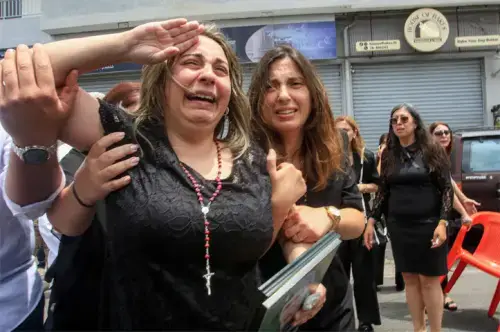
THE Baloch Liberation Army has claimed responsibility for yet another attack in Quetta, the third in three days. The first two attacks were carried out on Wednesday in which four people, including a security man, succumbed to targeted firing. In the latest incident on Friday, six cricket-playing youngsters from the Hazara community were gunned down by assailants on motorbikes. While the BLA has kept up armed attacks in Balochistan, despite the new government’s promises of ‘reconciliation’ and socio-economic development for the province, what has complicated matters is the hard stance of nationalist parties. On Friday, Bramdagh Bugti of the newly formed Baloch Republican Party voiced his support for the militants, saying that the Baloch were masters of their own resources and there was ‘no need’ to talk to others on the subject. This attitude is dangerous, especially in a situation where the government, conscious of Balochistan’s past ill-treatment, appears eager to make amends. Perhaps the most visible manifestation of this is its call for an all-parties conference, the release of Akhtar Mengal and Shahzain Bugti and the promise to abolish the Concurrent List, a move that would lead to greater provincial autonomy. Unfortunately, the delay in taking more concrete action is giving rise to scepticism about the government’s good intentions. For the Baloch, the military still dominates the provincial landscape and the government has yet to prove that it is in charge, and not the army.
All this foot-dragging has to stop if headway is to be made in allaying Baloch suspicions. For starters, the government should immediately take up the offer of Akhtar Mengal — whose credentials as a Baloch leader have been enhanced by several months of detention under inhumane conditions — for peace talks. Clearly, there is a need for moderate Baloch leaders to convince hardened nationalist groups to soften their tone so that a genuine breakthrough can be made.
However, again, the intervention of such leaders can only prove meaningful if the government shows more resolve in making good on its promise of addressing Balochistan’s woes and getting rid of the army’s malevolent presence. At this point feelings of alienation run high among the general population that has waited for decades for a solution to its poverty, underdevelopment and lack of control over its resources. In addition, the people have suffered grave human rights abuses, and hundreds of Baloch are said to be in the custody of intelligence agencies. Under these circumstances, and unless it acts soon to reverse the situation, the government would find it a challenge to hold the federation together.
Crude speculation
THE relentless surge in world oil prices has pushed most economies of the world almost to the brink, with developing countries most badly hit. And if one were to believe George Soros, who made billions from currency speculation, it is all the result of speculation. He likens the phenomenon to a bubble and believes it will also burst as did the financial bubble recently. But for that to happen, he says there should first be recession in the US and Britain. His logic is simple. Recession in the leading economies of the world would cause a sharp decline in the demand for oil and that would lead to a dramatic fall in prices. But that would not ease the Third World’s problem as recession in the advanced economies would affect the exports of oil-importing developing countries to the developed markets, making it difficult for these countries to pay for their oil even when prices are going down.
So either way developing countries are in trouble and they are likely to remain there for long unless of course by some miracle things take a turn for the better or if developing countries adopt innovative measures to save, conserve and put each barrel of imported oil to its most efficient use. Meanwhile, they urgently need to look around for alternative sources of energy such as hydro, solar, wind, biofuel and coal — all of which now look economically more feasible than in the past and potentially bankable considering that oil prices are now in the range of $130-135 a barrel and speculators seem bent on pushing them to $200 a barrel and even beyond.
The speculators know what they are doing. They see demand going up in the coming years. They also see that developing new oil fields to replace ageing ones has become too costly. They also know that the US dollar in which the commodity is traded will remain on a roller coaster for some time to come, encouraging producers to keep pushing up prices. And they also know that the oil-importing emerging markets will find it almost impossible not to subsidise domestic prices for end users. Still, all this is in the realm of the future. As things stand today, the demand-supply factor is said to contribute only marginally to the escalation in oil prices. In fact physical oil is said to be in excess supply today. What this suggests is that there are fewer buyers for physical oil at today’s prices but there are plenty of them for pieces of paper linked to the price of oil next month and next year.
No tobacco, please
WITHOUT proper public awareness, legislation no matter how strong will not be effective. This holds true particularly for tobacco control. Marking World No Tobacco Day on Saturday reminded us of the fact that although efforts to control tobacco use have intensified at the policy and legislative levels in recent years, lack of public awareness of the ill effects of tobacco and the rights of non-users is what stands in the way of success. Since 2002 we have promulgated the Prohibition of Smoking and Protection of Non-Smokers Health Ordinance and enacted it into law, besides signing the UN Framework Convention on Tobacco Control. We also established a tobacco control cell in the health ministry and charted out a five-year strategic plan of action (2007-2012). But tobacco use still remains high in Pakistan. It is estimated there are 22 million smokers nationwide, while 1,500 youths take up smoking every day. Building awareness among the population of the negative health impact of tobacco has to go beyond the mere symbolic efforts on every World No Tobacco Day, when the print and electronic media carry anti-tobacco messages issued by the government and WHO as well as news of conferences and walks organised by government and non-governmental agencies to commemorate the day.
This time the federal health and youth affairs ministries jointly launched a no-tobacco campaign earlier this week. It would help if, to begin with, there is a logo and accompanying slogan with which the public can identify this campaign. This slogan should be in English, Urdu and all other provincial languages. Besides, anti-tobacco advertisements on nationwide popular radio and television channels should target not only cigarette smoking but the entire spectrum of tobacco products used in Pakistan, including the chewable forms. Finally, to improve implementation of existing anti-tobacco laws, we need to publicise them in all ministries and government agencies as well as hotels, restaurants, hospitals, schools and all other public places. While we continue to work on tightening our anti-tobacco laws, tangible results in terms of reduced tobacco consumption can only come from a comprehensive and concerted, as well as a systematic and sustained, public awareness campaign. It is important to target the young — especially those who have not experimented with cigarettes — to pre-empt this dangerous addiction.
OTHER VOICES - Indian Press
A republic is born
The Navhind Times
ON the remnants of a 239-year-old monarchy, the world’s newest republic took birth in Nepal … ushering in a federal democracy. ...Let the government adopt a constitution which aims at institutionalising the achievements of the people’s movement. The victory of the [Communist Party of Nepal-Maoist] is a reflection of the growing aspirations of the Nepali people for freedom and democracy. Mr Prachanda has to ensure that these are not denied to the common Nepali.
It was political compulsion that brought the Nepali Congress closer to the CPN-M. But in the changed situation the bonhomie may not live long, as they are ideologically poles apart. Against this background, the CPN-M, instead of confronting them, would have to adopt a more realistic approach. With 220 members in the 601-seat constituent assembly, the CPN-M cannot think of forcing its dictates on the others. In fact, it would be a real test for the democratic values of the CPN-M. Mr Prachanda’s reluctance to disband his guerilla army sends an ominous message. With changing times, the Maoists should change their behaviour. It is now for the new leadership of Nepal, particularly the CPN-M, to ensure that the celebration does not prove to be short-lived. — (May 29)
Mush under pressure
The Tribune
WHAT … Nawaz Sharif said in Lahore … about President Pervez Musharraf was not necessarily his own view…. An overwhelming majority of Pakistanis wants Mr Musharraf to look for the exit route. … Mr Sharif has, however, gone a step further, saying that the former chief of army staff … must be tried for ‘high treason’….
Mr Sharif’s claim that he has the support of PPP leader Asif Ali Zardari for launching an impeachment drive against President Musharraf may not be without a basis. …Of late, Mr Zardari has stopped talking of a harmonious relationship with the presidency….
The pressure on Mr Musharraf to resign … has been mounting ever since his party suffered a humiliating defeat in the February 18 elections. The new army chief … may also be wanting the president to vacate the Army House in Rawalpindi he has been occupying…. President Musharraf has only the constitutional provisions … enacted by him without a mandate to defend himself, but under the circumstances he cannot muster courage to use them. The most honourable course left for him is to call it a day and cease to be a hindrance in the way of democracy in Pakistan. — (May 30)
Horrors we have no choice but to forget
I HAVE a clear memory of a terrible crime that was committed in southern Lebanon in 1978. Israeli soldiers, landing at night on the beach near Sarafand — the city of Sarepta in antiquity — were looking for “terrorists” and opened fire on a car-load of female Palestinian refugees.
It took the Israelis a day before they admitted shooting at the car with an anti-tank weapon, by which time I had watched civil defence workers pulling the dead women from the vehicle, their faces slopping off on to the road, an AP correspondent holding his hands to his face in shock, leaning against an ambulance, crying “Jesus Christ! Jesus Christ. I suppose all this is because of what Hitler did to the Jews.” Save for his remark, however, all I remember is silence. As if the whole scene was muted, sound smothered by the dead.
Yet I was running a tape recorder for part of the time, and when I listened to the old tape again a few days ago, I could hear many women, weeping, cars passing, honking horns above the shrieks of grief. My own original notes state, in my handwriting, that “a throng of women stood crying and wailing”. Yet all I remember now is silence. A child was on a stretcher, cut in half, a girl in the back seat of the car, curled in death into the arms of an older woman. But silence.
I was reminded of all this by an especially powerful interview conducted at Cannes with the Israeli director Ari Folman, who has made a remarkable film — Waltz with Bashir — about Israel’s later, 1982 invasion of Lebanon and about the “collective amnesia” of the soldiers who participated in this hopeless adventure.
Bashir Gemayel was the name of Israel’s favourite Christian Maronite militia leader who was elected president but almost immediately assassinated. It’s an animated film — a film of cartoons, if you like — because Folman is trying to fill in the empty space which the war occupies in his mind. Because he can’t remember it.
“I never talked about my army service,” Folman said. “I got on with my life without talking about it, without thinking about it. It was like something I didn’t want to be connected with whatsoever.” In one astonishing scene, Israeli soldiers come ashore in Lebanon — only to find that there is no one there. They are entering an empty country, washed clean of memory.
But Lebanon was not empty; more than 17,000 Lebanese and Palestinians, almost all civilians, died in that terrible war, and at the end of Folman’s movie, the animation turns to reality with photographs of some of the 1,700 Palestinian dead of the Sabra and Chatila massacre, murdered by Israel’s Phalangist allies while the Israelis watched from high-rise buildings. It is Folman’s dream that this film should be shown in an Arab country — given the dotage and stupidity of most Arab ministers, that is surely a hope that will not be realised — but it did almost win the Palme d’Or at Cannes.
Amnesia is real. And it afflicts us all. But it is also a block to memory.
Take my old letter-writing friend, poet Don Newton. He dropped me a note the other day, asking why humans have to create wars and mentioning, at the start, that he remembered the Second World War and, in 1944, Germany’s V2 missiles. What grabbed me by the throat, however, was the penultimate paragraph of his letter, written with an eloquence I cannot match — and whose power and suddenness will shock you, as readers, just as it shocked me. This is what Don wrote:
“I saw some of my friends killed around me when I was 12, when a V2 punched into the road near where we were playing ... I was lucky and survived but ran over the road to find my father lying dead by our front gate. He looked for all the world like a grey, dusty broken puppet with his left arm laying next to him. It had been sliced off just above the elbow by a piece of shrapnel that had also cut through the oak gatepost behind him.
‘‘Strangely enough, that sight seems to have wiped from my conscious mind all but a handful of memories of him and those are mostly unpleasant in their associations, like the time I burst into the toilet when I was only six, to find him sitting reading a newspaper, and blurted out that my younger brother by a year had been run over. Peter died in hospital the next day without ever recovering consciousness. This ‘amnesia’ is, I suppose, a defence mechanism but I find it weird and unable to break. I am struggling to put this problem into a poem and, hopefully, when it is out on paper maybe the fog will clear?”
I find this letter — horror and the mundane inextricably, unbelievably mixed together — unanswerable. The V2 explosion turns into a father’s death, the interruption in the lavatory into a child’s death. And a poem to clear the amnesia? Only a poet could suggest that. I didn’t see my father die but I was sitting beside my own mother when she died from the results of Parkinson’s. My memory is clear — she choked on her own saliva because she could no longer clear her throat — and I do remember sitting by her body and thinking (and here I quote another Israeli, a fine and brilliant novelist), “I’m next!”
So I turned, of course, to a haiku in Don’s latest collection of poetry, The Soup Stone, called “Mum’s Death, 1982” — the same date as Folman’s Israeli invasion when he (and I) were trying to stay alive in Lebanon:
Just sitting, waiting, For your last slow breath.
Suddenly — it’s here. Which is about as close to death as you can get in verse. And there really is a silence at the end.
— © The Independent
A minus-four formula
WHEN the curtain finally drops on the epic decade-long political drama being played out in the country, it is likely that many of the major dramatis personae presently occupying centre-stage will not be visible in the last scene. If this tragicomedy has to have a happy ending, some extremely bold and out-of-the-box changes in the script and the character of the principal actors in the drama will have to be effected.
All the principal actors in this increasingly sordid drama have adopted extreme positions, which are unacceptable to others. None of them has the right to hold the nation and its progress — indeed its survival — hostage to the achievement of their specific aims and objectives, however worthy they may seem in their own right.
The widely-held perception is that the principal source of the stalemate is the president and if he is persuaded or forced to give up the office whose entitlement he has lost both legally and morally, all else would fall into place within the framework of the current parliamentary structure. Unfortunately, despite the fact that it seems self-evident, there seems to be little chance that this much hoped-for outcome will materialise without fracturing irreparably not only the political and social fabric but also the economic sustainability of the nation.
It is not entirely clear where the present incumbent of the presidency derives his strength from, as most of his former supporters, both external and domestic, including his political followers, military brass and US Congressmen, have abandoned him one by one, at least in public. Surprisingly, he does not seem to be as vulnerable as he did in the first flush of electoral results three months ago.
Whether it is a secret deal with the United States or the PPP or some as yet unknown factor that is sustaining him is hard to discern. A prime suspect of his strength is the time-tested ploy of divide-and-rule which he has used with dexterity in the past with the aid of his minions who are embedded deeply in the ranks of his enemies.
Perhaps, his most potent weapon is the fear that he may yet take further desperate action transcending his Nov 3, 2007, misadventure which has remained unchallenged. Remote as it may seem, the possibility of its being undertaken — even if it fails to succeed — can’t be entirely discounted. Fortunately, Gen Kayani’s reported meeting with him is likely to have pre-empted this scary possibility. Whether he would walk out of the exit door of the COAS house into oblivion or settle in the presidency for some more time to test his feline luck remains to be seen. Gen Kayani may well be letting the horse escape before the barn door is firmly locked.
What about the other players in the grand political theatre being enacted presently? While none of them is hated or distrusted as strongly as Gen Musharraf, the political record of the leaders of the two major political parties is hardly unblemished. However, they have undoubtedly suffered under vicious military regimes of the past, as well as at each other’s hands and have considerably redeemed their reputations by their conduct during the last elections.
But for their tenacity, besides the exemplary courage of Benazir Bhutto, the country would not be anywhere near the cherished goal of democracy as it is today. However, they need to give serious thought to whether their continued occupation of the active leadership of their respective parties — which is burdened by their yet unredeemed political past — does not hinder progress on the road to democracy.
It would serve that cause much better if they passed on the baton to a new generation of politicians more inclined to the transparent and democratic functioning of their respective parties. They could greatly help matters if they allowed their party legislators to vote through secret ballot on such issues as the restoration of the judges, impeachment of the president and other constitutional issues which have stood in the way of their coalition’s effective functioning.
They need to display some measure of statesmanship and self-sacrifice to get the country out of the present logjam, which is incalculably hurting those whom they pretend to lead. As senior statesmen, they could well devote their time to promoting a democratic culture in the country and developing a code of ethics which would make politics resemble less a game of Monopoly with all the country’s assets on the stakes-board.
The fourth principal actor in the drama is the chief justice who has been the rallying point of the present struggle for democracy. But for his courageous stand on March 9, 2007, the country would not have been able to push military dictatorship into the corner in which it finds itself now. He, his brothers on the bench he headed and the legal community have made tremendous sacrifices in terms of time, money and personal comfort, as well as life and limb. They — along with the chief justice — too, however, need to reassess their strategy and ponder whether the pound of flesh they are insisting on would not paralyse the entire body politic and the economy.
Should the chief justice announce that he would himself voluntarily resign after the judges are reinstated in accordance with the Murree declaration and after the invalidation of the Nov 3, 2007, emergency and PCO imposition, the way would be cleared for an objective debate on a non-person-specific constitutional reforms package, the need for which is universally recognised. His larger-than-life figure can now hardly fit in the chambers of the apex court and needs to be accommodated elsewhere in the national arena.
The ‘minus-four’ formula broadly outlined above, undoubtedly sounds utopian and innocent of realpolitik which continues to drive the destiny of our nation. However, if the situation continues to drift in the direction of chaos, the time for such utopian ideas may soon come to allow Pakistan to move unfettered on the road to democracy and to achieve the fulfillment of the rights of its people.
While each of the four may have played important roles in the past, they must realise that they are now much more of a distraction than the inspiration they once were.
syed.naseem@aya.yale.com