



 0
0

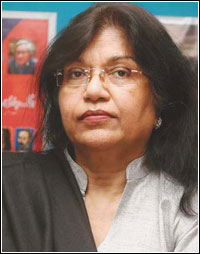
I’m a supporter of none but democracy — Zaheda Hina
 When she learned that she had won the coveted President’s Pride of Performance Award for 2006, she took the news with a pinch of salt. She thought someone must be playing a hoax on her as her views about the military-led government were well known. Or perhaps there was some confusion about the winner’s name.
When it was confirmed that it was none other than Zaheda Hina, the renowned fiction writer, columnist and rights activist, on whom “the president will be pleased to confer the award”, she spurned the offer saying there was no pride in receiving an award from a dictator whom she had been criticising relentlessly.
“If I accepted the award, I asked myself, how would I face the Baloch people, whose struggle I have been supporting and against whom the regime has launched a military operation? How would I face the innocent people being killed and crippled in bombardments in the name of the ‘war on terror’ to please the Americans?” says Zaheda.
In an interview at her Gulshan-i-Iqbal office, when I ask her to explain the paradox of her at once being a champion of secular causes and a supporter of Nawaz Sharif rather than that of Benazir Bhutto or Pervez Musharraf, she says she is a supporter of none but democracy. “I have been writing in support of Nawaz Sharif since Oct 13, 1999, a day after his government was toppled by retired general Pervez Musharraf, because I thought it was unjust to dismiss and humiliate an elected prime minister.”
When Zaheda poured out her grief in the columns that she wrote in the wake of Benazir Bhutto’s assassination, people said she was a supporter of the PPP. “I had supported Benazir Bhutto also but criticized, or praised, her government on an issue-to-issue basis.”
Calling herself an Urdu-speaking Sindhi, Zaheda hopes that the PPP which has formed its government in Sindh will bring about prosperity in the province. Of the five different columns she writes every week, one is for a Sindhi newspaper that she writes in Urdu and is translated for her Sindhi-speaking readership. Most translations of her books and articles, which have been rendered into various local and foreign languages, are in Sindhi.
 When the ‘operation silence’ was carried out against the Lal Masjid and Jamia Hafsa and hundreds of men, women and young girls were reported to have been killed, Zaheda Hina wrote with a pen seemed to have been dipped in blood. She grieved for the victims and vehemently condemned the operation. She said it was “the height of cruelty” and urged human rights bodies to condemn it forcefully.
She claims that the two seminaries had been nurtured by the establishment to use them when a need arose. “To get rid of a key witness to the scripted drama,” she wrote in a column, “Rasheed Ghazi was eliminated despite his willingness to surrender in the presence of the media.” Although on the left of the political divide and the common perceptions associated with it, she defended the right of the girls to get religious education, which she says was available to the poor girls and boys free coupled with board and lodging.
Her collection of essays on women titled ‘Aurat: Zindagi ka zindan’ is a depiction of women’s plight and issues. However, she is not a feminist in the common sense of the word. She insists that she is a defender of rights of every segment of society and is against compartmentalizing people. “We should not divide people into sections. Both poor men and women are exploited -- women twice as much, one, because of poverty and, second, because of their gender. If a man suffers injustice at the hands of a woman, I would raise my voice against her also.”
She says the peasants-army row in Okara, Punjab, had convinced her that there were only two classes – the oppressors and the oppressed. And it was incorrect to say that one part of the country was encroaching upon the rights of another.
Zaheda’s views on the Kashmir issue are also clear. “Sentimental slogans appeal to the public, no doubt. But we should accept the ground realities. If we want to give good education and good healthcare to our children, we will have to change our priorities. Hardly 12 to 13 per cent of the total budget is spent on all our needs and the rest goes to defence and debt servicing.” Although she is satisfied with the peace process between Pakistan and India, she apprehends that the secret agencies on both sides may try to derail this process.
As noted earlier, she writes five columns a weak – two for a local Urdu daily, one for a Jeddah-based publication, one for a local Sindhi daily and one for an Indian Hindi newspaper. She tries that all these columns do not overlap one another. A lot of work one may acknowledge. But her forte is story writing, which she does more effectively to put her message across. Her collections of short stories Qaidi Sans Layta Hai (Prisoner breathes) and Rah main Ajal (Death in the way), and a novella, Na Junoon Raha, na Pari Rahi (No more the passion, nor the fairy). Although the number of her Urdu columns runs into thousands, she has not published them in book form. However, Hindi columns have been published in book form under the title of Pakistan Diary.
In 2001, she received the SAARC Literary Award, initiated by the Foundation of SAARC Writers & Literature, from the then Indian president, K.R. Narayanan, in New Delhi.
Born at Sahasaram in Bihar in 1946, she migrated to Karachi with her family in 1948. She was just nine when she wrote her first story. Her first writing was published when she was 13 years old. Since the age of 16, her stories and other writings have been appearing in various magazines and newspapers. Although she writes to highlight certain issues, because of her style her writings have universal appeal. She has a son and two daughters, one married. But none has followed in her footsteps.
And what do you think was Faiz Ahmed Faiz’s last piece of writing? It was the English translation of a story by Zaheda Hina! “I was overwhelmed with emotion when I learned this from Alys Faiz a few days after his sudden death. Faiz Sahib wrote it, gave it for typing and left for his village, where he died of a heart attack shortly afterwards.”
She advises new writers to read as much as is possible and practise writing. “I recently saw an interview of Lata Mangeshkar on DawnNews. The veteran vocalist said she still does a lot of riyaz. If practice is necessary for a singer of her calibre, it is more so for writers like us?”
Darkness assails the centre at last
 We in Islamabad have had some experience of loadshedding in the past but it is now for the first time that we are getting a real taste of it. In my part of the city we are having six one- hourly sessions during day and night. The most discomforting hour is from 2am to 3am past midnight when even insomniacs doze off into a brief nap and when late sleepers are just in the soundest part of their repose. Perceptive burglars mindful of your rest find this hour pregnant with needed peace to search closets and open safes while helping themselves from the thawing refrigerator. Should he surprise you by breaking a piece of crockery or tripping over a misplaced chair in the dark, he can be sure to find you in the foggiest state of your mind and often more agreeable to handing the keys than reaching for the gun. If this goes well for both the parties and the house breakers depart in the safety of the dark hour, leaving you catching up on the broken sleep, it should not surprise the night watchman if he spots the burglar plant a kiss on a snoring Wapda lamp post.
While it is convenient for the shady businesses that prosper in the dark, the fear is growing we might be approaching our history’s worst daytime economic slowdown. There may soon be food riots as prices of essential stuffs fly out of reach of the common man spurred by the oil and power crunch and a law and order situation might arise that our establishment and its administrative arm, being probably the world’s most incompetent and corrupt of the lot, may not be able to control.
The worst case scenario painters foresee chaos and total failure of the state as it becomes the helpless watcher of its own last gasps. In that dark hour of general mayhem, fear and hopelessness the ‘messiah’ who has been waiting all along in the wings will emerge. He will bring peace to the land by banning everything that celebrates life and literally making Pakistan the land of the pure. We shall fast rewind to the golden days of the mediaeval era when there were no power outages because there was no electricity. We will grow our own food, breathe fresh air at last and listen to the interminable drone of the Persian wheel go round and round and round and the occasional sputter of the public executioner’s gun as some errant soul is dispatched to his fiery abode.
This improbable nightmare, that some even dream about, our people with their robust common sense will not allow to materialise, but it will continue to claim its adherents as long as the policy of appeasement is used by men in power to facilitate their rule. The surrogates of the awaited ‘messiah’ who had established parallel governments in open defiance of the unified command have again been let loose to reorganise and, quite unnecessarily, the ideological frontiers lost in the haze of enlightened moderation are being reopened at fealty feasts. The feeling is getting stronger by the day that we are straying from the change that February 18 had promised. People are not happy. A sense of despair has started setting in.
We, who had remained sanguine with the thought all kinds of trouble would remain confined to Karachi, including power black outs, and had therefore never bothered to question the authorities what they were doing to make more electricity are now suddenly in the midst of summer and the capital too is jolted to halts every three hours. Too late wondering what exactly these guys had been doing all these eight years of their unchallenged rule. All that we can remember is the Kalabagh Dam bogey that they raised whenever the issue cropped up. Had they been serious about the looming energy shortage they would have looked for alternatives that were available with our abundance of sun, wind and coal. And this incompetent bunch is still around drawing six digit salaries. The old economic adviser who remained part of Shaukat Aziz’s disaster team and made such long speeches on TV channels, claiming to have resurrected Pakistan from a failed state to the threshold of middle income nations, is still crawling around the new finance minister. Shouldn’t he be asked which middle income nation has six hours of black out daily in its capital?
But perhaps by middle income nation he meant the middle income people who have power houses of their own. The generator is the new status symbol in Islamabad. The noisier the better because it keeps neighbours awake and aware of their poor state. It explodes into creative energy as soon as Wapda collapses. The generator owners are an aloof lot. They do not discuss power outages within their set. Those using the meek UPS are more friendly but they have to talk about it because it does not make any sound. The rest come out in the dark and kill mosquitoes, children of lesser gods. But it’s a pity the traditional hand fan is not being used any more. Woven into intricate patterns with the long leaves of certain grasses like the hardy date palm, the flap was mounted on a cane handle dyed red, green and yellow, that you swayed before your face for a personal supply of cool air. It was absolutely environment friendly, burnt no fuel and afforded you some exercise in the bargain. Its only defect was you couldn’t use it while sleeping. But mothers and lovers fanned their objects of love while they slept. Its larger version was the hanging fan — a wooden board suspended from the ceiling to which a heavy ornamental fabric was attached that when moved forward and backwards by a string, one end of which a servant boy sitting outside the room pulled and released, made enough air to cool a summer afternoon. “Are you dozing”, the Begum yelled whenever the fan slowed. Those good days may be returning.


























