0
0

Boys just want to have fun
 Now who hasn’t come across boys on the streets, playing games like cricket, football or even gully danda and pithu garam under the scorching sun? The cheers and applause of their friends after a big four or six, with an occasional broken neighbourhood window, usually die down after curses and accusations are showered upon them by area residents, many of whom have complaints of broken windows or disturbed afternoon siestas.
But everyone isn’t always alike. There are also people like a certain older gentleman who lives down our street, who has fun in watching the kids have their fun. “Don’t stop them from playing. It is not their fault that there are so few parks and gardens or open grounds here,” is what he tells the other residents. His rationale being, “what would you do if instead of these healthy activities the very same boys take to guns and knives and get into all kinds of unnecessary mischief?”
Still, people who object to children playing on the streets do have a point. It can be dangerous for the children. But why should anyone have problems with the younger lot when they take their game to a ground?
The handful of young spectators gathered at the football stadium on Khayaban-i-Rahat were scolded mercilessly recently by a man in his early seventies who screamed at the children to stop cheering for their teams during an inter-school football tournament. The man, who frequents the place for his evening walk, was not too happy to discover that there was a tournament under way there.
“I’m going to report you rowdy lot to the authorities,” he yelled at the kids, who really did get scared. They would hush up the moment he started approaching the stand during his rounds. Even when there was a foul on the ground and the referee blew the whistle, the man disturbed play by walking on to the field and going up to the referee, threatening him of dire consequences. For once the man seemed rowdier than the kids.
What is wrong with our people? We complain when our kids play on the streets, we complain when they play in open grounds and now we also complain when they are doing no harm by playing at a proper stadium. Where do our kids vent their surplus energy? Where can they have some fun?—Shazia Hasan
Spouses not allowed!
Many people marginalise wives as irrelevant baggage or condemn them as hysterical camp-followers who get in the way of a man’s work. This might only be true for warriors on the battleground, but certainly not for civil servants, who were taken aback when the management of a federal government-run training institute in the city did not allow them to keep their spouses with them during a 16-week-long course.
The management, in accordance with their rules and regulations, does not permit families of officers to stay with them during the course, despite the fact that some of them claim they had to bring their families along as they could not leave them behind at remote places where they were posted.
But owing to this rule they have to keep on relocating their families to hotels, hostels or at houses of friends in the city. A few officers, who were all praise for the faculty for its quality training, do feel that keeping their families away for such a long time is not in conformity with human rights.
Not everybody has relatives or friends in the city where they could keep their spouse during the course. Besides, there are some who do not feel easy with giving trouble (though methinks wives are not always trouble-makers) to relatives or friends.
A bureaucrat, who had held a senior post in the organisation, said he remembered that during his tenure, some participants of the course, who had some problems, were allowed to keep a family member with them. He said they did not encourage the participants to bring along their spouses or family on their training, but then decisions are taken on merit and on a case to case basis.—Bhagwandas
 Protocol duties & public safety
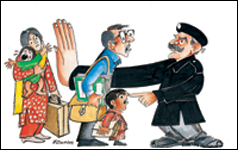
I read an interesting news item the other day that probably will help me sleep more soundly, knowing that security in the city will be beefed up soon. The Sindh minister for home affairs, in his first official act, has raised the monthly salaries of police constables by a few hundred rupees. Keeping in view the pathetic pay scales being disbursed to those who vow to “protect and serve” us, even this paltry sum will be considered a godsend.
It seems the new IG Sindh, Dr Shoaib Suddle, who holds a doctorate in criminology (criminals beware!), has plans to introduce reforms in the police department. Better housing conditions for the police trainees, less working hours, incentives for widows of slain policemen and jobs for dependants are other heartening features of the reforms plan.
Dr Suddle says the police department is facing a shortage of staff as there is only one police constable to deal with 500 people. Plans to expand the force initially by filling 8,000 vacancies are under way, with 10,000 more vacancies to be created later on.
The law and order situation being as it is, this is indeed a positive step. But planning is one thing: executing the plans yet another. In due course of time, plans usually come across bureaucratic hurdles and are eventually shelved.
The police force really needs revamping in every part of the country, but Karachians seem to be bearing the major brunt of the crime-wave, which seems to be rising at an alarming rate. So anything Dr Suddle has in mind that will provide succour and relief to the already disturbed Karachians will be welcome.
Our civil society in turn must be responsible for creating an awareness to respect the law, which sadly seems to be lacking. The rule of law is paramount in any civilised society for without it, anarchy and bedlam will prevail, which has been the case for quite some time. Another major point the new administration should ensure is that the law must be applicable to everyone, irrespective of status in society or political affiliation.
However, some of the recently elected ministers’ reported requests for security protocol in the form of police mobile escorts in their entourage saddens me. One wonders if the planned expansion and development is for the public good or to provide security to high officials of our society.
When the police department is already faced with a shortage of manpower, besides other resources, and when there is a political will to introduce reforms, why do the “status conscious” leaders make such requests? In the aftermath of what happened to Benazir Bhutto, security for ministers must also be accorded priority, but not at the expense of neglecting citizens.—Syed Ali Anwer
Compiled by Syed Hassan Ali
Email: karachian@dawn.com
Pensioners’ appeal
 Sir,
Sir,
We, the undersigned, beg to state that the Sindh Agricultural Supplies Organization (Saso), under the secretary agriculture, government of Sindh, was completely dissolved on 31.1.2004.
After its dissolution the related 712 employees were also dispensed with on assurance either to be absorbed in other departments of the government of Sindh or to be compensated with a financial package.
Prior to the dissolution of the organization, a pension fund was established by the then management of Saso in 1989-90 for the financial safeguard of the retiring employees. Consequently, the factor of pension facility in the defunct organisation became a problem for the Sindh government.
As such the salaries were immediately stopped after 31.1.2004 and all the employees concerned put pressure through the media and agitated for financial relief. The authorities concerned, with consultation of some members of the CBA, finalized a GHS (golden handshake) package for approval of the then Sindh cabinet and after 17 months, disbursed the amount to all the affected employees, including those who were eligible for pension, that restricted them to draw 70 per cent pension commutation as final settlement instead of 100 per cent.
The package was finalized by the authorities concerned after a mutual agreement with a few members of the CBA of the employees (non-gazetted) of the defunct organization as final settlement of the dues.
But now the question arises: why was an invalid CBA union consulted for an agreement when its legal status had expired after the notification of the cut-off date on 31.1.2004?
This bargaining of the GHS package with a CBA union could only be legal and acceptable to all the employees had it been done before 31.1.2004.
Therefore we, the undersigned affected employees, appeal to the honourable president of Pakistan, governor of Sindh and chief minister of Sindh to kindly support our complaint for restoration of forfeited 30 per cent pension commutation for payment to us considering the facts as narrated above for our financial safeguard.
For the employees of Saso (defunct),
ARSHAD JAVAID
Karachi
The city of lights
Sir,
Once upon a time Karachi was known as the city of lights. Slowly but gradually, the city of lights became the city of darkness. Now the situation has reached to such an extent that during the day and night, the electricity is hardly available for commercial and domestic users.
During the last two decades, different political parties and army rule came and went. But it is unfortunate that none of them has ever fixed responsibility on the people who were directly responsibly for enhancing the capacity of power generation in Karachi and have intentionally ignored the problem.
Is there any court in Pakistan that can hold the people sitting at the helm of affairs who ignored providing the right capacity of power to Karachi responsible?
The serving CEO of KESC has recently said that power was cut by Wapda due to non-payment of bills by the government departments. Does the CEO of KESC have the courage to publicly name each and every government department that defaulted in paying the KESC’s bills wilfully?
In normal cases, if a residential or commercial consumer does not pay his electricity bill just for one month, his power supply is cut off immediately. How come the KESC did not cut the electricity supply of those government departments that defaulted in paying their bills, due to which Wapda cut the power supply of entire Karachi?
Shall the people blame the CEO of KESC, who has wilfully overlooked the outstanding amount of several government departments in Karachi, due to which the city plunged into darkness? Does the CEO still deserve to serve the KESC when it was his duty to recover the outstanding amounts from the defaulting departments? How long will the KESC’s affairs continue to be run on an ad-hoc basis?
I would request the CEO of KESC to take the blame for inefficiency and immediately resign, so that a professional could be appointed to save the people of Karachi.
SYED A. MATEEN
Via email
Street crimes
Sir,
For the past few months Karachians have been putting up with an extremely high number of street crimes like cellphone snatching and carjacking etc. Threats are everywhere, whether a person is standing at a bus stop or driving from one place to another: the fear of theft looms large.
If one tries to combat the criminals, the armed robbers show no mercy in shooting him down.
At a recent family gathering, I was stunned to hear that a cousin’s cellphone was stolen at gunpoint while he was receiving guests. It is really astonishing to see how these criminals seem to have been given a free hand by the so-called Muhafiz force of Karachi.
Is there any end to such street crimes? This is a question that occurs in the mind of each and every Karachian who works tirelessly from dawn to dusk in order to feed his family.
I urge all the relevant authorities to act promptly in order to do cleanse the city of such criminals, who have usurped the tranquillity and peace of Karachi.
SYED TAHA JAMIL
PECHS
city@dawn.com
‘Stabilising a country through its military is old thinking’
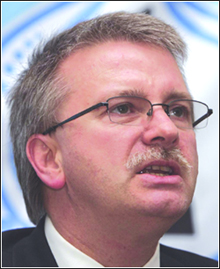 Michael Gahler has been in Pakistan for the past few months as chief observer of the European Union’s Election Observation Mission. A seasoned politician, he had the unenviable task of sifting through complex details and coming up with a final report on just how free, fair and transparent the February 18, 2008 polls were.
Born in Frankfurt am Main, the German member of the European Parliament is the vice-chairman of the Foreign Affairs Committee of the European Parliament and has been in that legislature since April 1999, dealing mostly with foreign affairs, development and human rights issues. Though aligned with Germany’s centre-right Christian Democratic Union, he is a member of the European People’s Party on the continental level.
Before Mr Gahler spoke at the Karachi Press Club recently, a club member observed that in the past, the European Union and the Americans had supported undemocratic regimes in many countries, including Pakistan. This writer asked the European politician why this sudden interest in Pakistan’s democracy.
“I take note of the global situation prior to the fall of the (Berlin) Wall. There was an East-West conflict that was transported to third world countries and in this regard, prior to this event, we definitely looked at whether ‘they’ were for us or against us. We didn’t look too much at the internal situation of a country. So in the past, this has indeed happened not only in Asia but in Africa as well.
“The European Union, with its approach to other countries and its foreign policy instruments, definitely wants and also must engage in multiple ways with regards to stability. I think we have learned out of our experience. We are pursuing other policies that are focussing also on the internal development of a country with regards to democracy and human rights. Our foreign policy instrument and development corporation instrument, which apply to Pakistan, provides support for democratic structures. If it were necessary, we can even use our European instrument for democracy and human rights.
“Our approach is not only security related: stabilizing a country through its military is old thinking. We think the stability of a country is largely to be reached by proper social development. That’s why the EU’s focus is on education. I think what this country needs is education, education, education. I say it quite bluntly, though it’s beyond the scope of my mandate here, but I think it is absolutely essential that young people in this country have free education in state schools and not to be in a situation that urges poor families to (send their kids to) the madressah, where they get fed, but where they are getting the mindsets which are perhaps not good for Pakistan in the 21st century.”
He was also asked how he rated the recently held polls as compared to past elections in the country.
“Well, I have observed this one. We have established our findings. Talking with other people who have a wider overview, they say perhaps after 1970 this was the best one. I definitely have no insight into 1970, but if that is the dominant opinion I am not opposing it. Perhaps (2008) was the second best so far.”
Mr Gahler was asked what Turkey’s chances are of joining the EU, as it is a subject that is being followed with some interest here.
“This is a very complex issue. First of all there are the issues of criteria, the famous Copenhagen criteria for political and economic standards that we apply. And there is the absorption capacity of the union. We are now 27. We need to reform if we want to take further states in. The homework Turkey has to do is huge. At the moment the country’s at the crossroads.
“On one end we see secular forces like the Kemalists, which are in their way old-fashioned as well. Kemalism is, in my judgement, an old-fashioned approach because it’s remained in the ’20s of the 20th century. These are nearly 90 year old viewpoints on how to organize a state.
“On the other hand the governing party, the AKP, is perceived by some as Islamic, others say it’s Islamist. I don’t think it’s an extreme party, but it has different wings. They are struggling at the moment: does more liberalization mean the use of the headscarf or is it the signal of the opposite? It’s very difficult to argue from the outside. For us, it is allowed for a woman to wear a headscarf if she wants. For the Kemalist Turks it is a symbol of Islamism. It’s a very strange discussion.
“Now certain Kemalists have complained to the (Turkish) supreme court to (proscribe) the ruling party. Have you ever heard of this done in any country? Not me. It shows the problems Turkey is facing at the moment internally. When they are not able to solve these, they are blocking their own way into the EU.”—QAM