0
0

Shoaib Akhtar — end of the road for man of many moods
 THE step taken by the Pakistan Cricket Board (PCB) to slap a five-year ban on controversial fast bowler Shoaib Akhtar is a clear message to the blundering brigade of players — that no one is bigger than the sport.
The PCB was very stern in putting the controversial pacer to rest for good on Tuesday as far as his future with the Pakistan cricket is concerned. To some, however, the verdict may have sounded like a joke, given the somersaulting natures and policies of the PCB officials and also because the decision was made on the April Fools’ Day.
Generally, the start of April is marked around the world by the commission of hoaxes and other practical jokes of varying complexity among friends, enemies and neighbours, or sending them on fools’ odd jobs, the aim of which is to embarrass the innocent.
 But whatever the repercussions Tuesday’s decision may have in the days to come, the PCB should, for once, be applauded for making a bold move to curb probably the worst case of indiscipline committed by an individual in the chequered history of Pakistan cricket.
An erratic individual and an injury prone superstar who seldom delivered on the field, Shoaib never paid any heed to various warnings from his employers since the moment he stepped onto the field in the late 1990s.
The world may also remember him as one of the fastest bowlers ever to play international cricket but unfortunately, he became a source of embarrassment for all those who had the chance to lead or manage the Rawalpindi Express, be it the cricket board chiefs, his coaches or the captains.
Bob Woolmer, the late Pakistan coach, used to feel very uncomfortable the moment Shoaib’s name was mentioned because he found it hard to understand the psyche of the temperamental speedster.
If Woolmer was aghast, Inzamam-ul-Haq, the Pakistan captain during Woolmer’s tenure, got agitated a number of times because he always believed the team would suffer with a disruptive figure like Shoaib around. One could vividly recollect the look of frustration on Inzamam’s face at several media briefings where Shoaib became a topic of discussion for his antics, which was often.
There is no denying that Shoaib was a match-winner when his moods weren’t dictating him. Tragically for Pakistan cricket, those moods swung so frequently that it became difficult for everyone to keep pace with them.
In his elements, he was indeed a class act. How can the followers of the game forget those two consecutive deliveries that uprooted the stumps of Indian batting legends Rahul Dravid and Sachin Tendulkar at the Eden Gardens, Kolkata during the inaugural match of the Asian Test Championship in early 1999.
Months later, the man grew as a genuine star at the 1999 World Cup in England and played a big part in taking Pakistan through to the final.
However, the umpires eyed Shoaib’s bowling action with a note of concern, and it was not a surprise that he was called for throwing not long afterwards to offset a pattern of highs and lows that hounded him until a report from the University of Western Australia concluded his action is the result of the bowler’s unique physical characteristics.
Accordingly, the PCB claimed that the report cleared Shoaib of any wrongdoing regarding his bowling action. But controversies shadowed Shoaib, who even had the disdain for the harmless crowds of Harare when he hurled a bottle at them.
Issues such as getting caught for ball-tampering, reprimands over flouting rules on tours never bothered Shoaib who was once served a lawsuit by a citizen for attending a fashion show on a night of religious significance.
When India toured Pakistan after a long gap of 14 years in 2004, Shoaib again was in the spotlight when Inzamam publicly questioned the authenticity of the paceman’s knee injury until the PCB medical board proved his injury to be a genuine one.
The last three years of his career were dotted by controversies and fitness problems. The biggest setback came in the shape of a two-year ban in late 2006 after he and fellow fast bowler Mohammad Asif were sent back before the start of the ICC Champions Trophy in India after both tested positive for the banned substance Nandrolone.
But Shoaib (and Asif) were given a reprieve when an appellate tribunal overturned the ban imposed by a PCB doping inquiry. Without learning anything from this disgraceful act, Shoaib was relentless in his war against the board officials and spoke his mind while paying no attention to the numerous show-cause notices issued to him.
His arguments with fellow players and team officials grew with each passing year and he showed little regard for valuable advice from bowling legends like Glenn McGrath and Allan Donald.
On his last tour, Shoaib was desperate to bowl his heart out for Pakistan on what was going to be a final chance to savour a Test series win against India.
Unfortunately, a viral infection on the eve of the Kolkata Test left him isolated in the hospital. When the tour ended, Shoaib cut a sorry figure with his team-mates avoiding him and the officials penning some unpleasant remarks in their tour reports.
By the time the five-year ban ends, Shoaib’s playing days would long be history until he makes another miraculous comeback in the near future which can never be doubted given the weird patterns of things in this country. That said, cricket would not be the same without Shoaib who will, sadly, be remembered for all the wrong reasons.
Yusufi titillates Haqqee’s memories
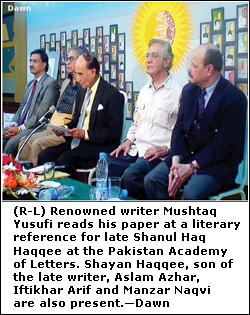
Inviting the great to one’s memorial meetings is not a wise thing to do. Lesser men can always be handy on such occasions to make the required solemn fuss to please the mourners, and more likely the dear departed, were he alive. Chronic amnesiac, Shanul Haq Haqqee, could make that strategic mistake any time however as fame held little charm for him compared to work. But as if on his behalf, the Academy of Letters invited Mushtaq Yusufi to give a commemoration talk about a man he knew when live strangers feel unsafe in his hands. The great charmer spoke, rather read from a bunch of papers he generally carries, for more than an hour, regaling a memorial audience in celebration of the life and works of a very unique personality of our time — a notable poet, eminent writer, linguist, great lexicographer, research scholar, and journalist. The result was, Haqqee Sahib, all but came alive.
It would be difficult to recapitulate all the anecdotes he told about Haqqee Sahib’s forgetfulness, his life style, his devotion to work, his single handed compilation of the Oxford dictionary, his verse etc., but the focus of the talk being words and their proper usage, it gave Yusufi an open ground to trot and scamper or dart at will in all directions where his own lexicon took him. On the way he would pick up his subject and recount what Haqqee said was the correct pronunciation of tajarba, tajruba or tajreba.
The emphasis on correct pronunciation though secondary to the importance of correct usage is nevertheless a part of the sanctity of words. Language has its dynamics and it grows organically as it were like other living things but while words may acquire new meanings over time in different cultural environs, they must be protected against their corruption. Poets perhaps have this liberty to make creative use of language but they too cannot be permitted to ride roughshod. The kind of strictness that Haqqee demanded of writers and lay users of language was his duty as a lexicographer.
From a not so very dissimilar perspective the work of Yusufi is also basically an engineering on the language, on the construction of modes of expression, the manner of saying things in a certain way, that process in which the sentence is studied for the possibilities of its wit content, turning the phrase sideways and transposing the clauses to discover its jocularity and finally so wording a statement that the obvious looks novel and yet familiar. The joker creates fun by playing on reality through exaggeration. Yusufi uses exaggeration but does not disfigure his objects. In fact he extracts their essential humanity in the ludicrous whether it is a sketch he is drawing, an event he is narrating, a comparison he is making or a juxtaposition of oddities he is attempting. We do not have another writer who displays such creative playfulness with words. It was in fact a very profitable thought to invite him to speak on Shanul Haq Haqqee.
Memorial meetings are supposed to be solemn events where people expect eulogies and tears to flow but Haqqee Sahib at a commemoration some two years after his death in Canada was fortunate to have people remembering him with smiles and laughter, all thanks to the devilish ministry of Mushtaq Yusufi. It was not at all unexpected to find his son Shayan Haqqee who had come to attend the meeting looking somewhat fazed by the general mirth of the evening but it was all a very genuine tribute to a great man that his father was.
Aslam Azhar who was the chief guest in his brief but meaningful remarks attributed Haqqee Sahib’s reputed forgetfulness to inhemak, total absorption in whatever he was attending to. It is from this concentration that one is able to make great achievements, like his great dictionary work or the absolutely perfect translations that he did from different languages.
Born in Delhi on Dec 15, 1917, Haqqee did his Master’s in English literature from St. Stephen’s College. His poetry works include two anthologies Tair-i-Pairahan (1957) and Harf-e-Dilras (1979). He is also known for his Tarikhi Qata’at, his Kehmukarnian and Paheliyan. He remained associated with the Urdu Lughat Board on the monumental 24 volume dictionary for 17 years and translated the eighth edition of the Concise Oxford Dictionary, Shakespeare’s Anthony and Cleopatra in verse, the Bhagvada Gita and the Arthashastra of Chanakiya.
His father, Maulvi Ehteshamuddin Haqqee, was also a lexicographer, besides being a fiction writer and a translator (he rendered Diwan-e-Haafiz in verse). So Haqqee’s relationship with words was a blood tie. His respect for them was biological.