



 0
0

Urdu is a ‘poor’ language
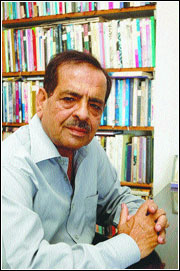 A LOVE saga that began in a digest more than three decades ago still keeps its readers spellbound as they eagerly look forward to its next episodes. Sometimes their wait becomes too long as the meticulous writer doesn’t release its instalment until he is satisfied with every aspect of it. Those unable to bear the wait any longer and wish to see its conclusion now beseech the writer to wind up the popular story before long.
“People ask me to conclude the story Bazigar, which I began in 1975 in the Subrung digest. They say many fans of the serial have died, many have grown old and wish to see it end in their lifetime,” says Shakeel Adilzada, a most outstanding name in the world of Urdu digests.
His engaging style, besides the intricate plot and its captivating twists and turns, have enchanted the readers to make the serial the longest running one. Now he plans to finish the intense love story that revolves around a young man of 17, who lost track of his sweetheart just before partition and is wandering in search of her from village to village and town to town in undivided India, struggling and facing unusual happenings that keep the readers glued to the pages till the finish.
Shakeel has parted ways with the digest he had founded but plans to complete the story in book form. Bazigar is real life-based fiction. Its earlier episodes have been published in seven volumes printed in the digest print size, each volume comprising about 300 pages.
“If printed in standard novel size, it will fill as many as 4,000 pages,” remarks the author. When I visited him last Friday he was sitting with a few people, apparently gossiping. His telephones kept ringing with intervals, with some callers seeking his opinion on certain language issues, such as how a certain word is pronounced. He satisfied their inquiries with an air of authority, telling them how the word was earlier written and pronounced and how it is now.
The writer was born in 1938 in the Indian city of Muradabad and migrated to Karachi in 1957. He began schooling in India and did his master’s from Karachi University. He immediately rejects the suggestion that Bazigar might be his autobiography. Before arriving here, he had extensively travelled Indian cities by train and makes his hero use the same mode of transport much of the time. “Third class train travel enabled me to talk to and observe various characters; the experience amply reflects in the story,” says Shakeel.
The digests
Digests were once very popular among readers and their numbers had grown to as many as 150. Now there are hardly a dozen. The most popular are the ones that address women’s issues and publish stories of their interest. The digests still in business include: Urdu Digest, Dosheeza, Pakeeza, Shuaa, Khawateen, Naey Ufaq, Sayyara, Subrung, Jasoosi, Hikayat, Suspense and Roohani.
Digests are more popular in villages and small towns where women can read Urdu and their life is not tied to modern technology. In big cities people have the biggest time-killer at their disposal: TV. The internet and cellphones are besides it. “On average, an individual gives two-and-a-half hours daily to TV and spares little time for reading. We have become a nation of viewers rather than readers,” says Shakeel.
The first digest, named Pakistan Digest, was brought out in 1947 by Mateen Mohani, a relative of Maulana Hasrat Mohani, but it survived only a few issues. In 1957 Altaf Hussain Qureshi launched his Urdu Digest, whose popularity climbed steeply. Shakeel admits that it was Urdu Digest’s success that inspired him and Jon Elia to redesign as digest the literary magazine they were jointly bringing out.
Shakeel says digests have done a great service to Urdu literature. They still translate the masterpieces of world literature into Urdu, the task only big publishing houses could accomplish. They also publish the classics of Urdu, motivating the readers to read writers such as Krishan Chandar, Saadat Hasan Manto, Bedi, etc. “This has re-established the local reader’s relationship with Urdu literature. They go back with renewed enthusiasm to read the works of these fiction writers.”
But despite his lifelong devotion to the cause of Urdu language and literature, the government has not recognized his services. “Our award is the appreciation we receive from our readers. I do not much care about official awards. Those who get these awards keep mentioning it with their names … ‘Mr so and so, the recipient of Sitara-i-Husn-i-Karkardagi, etc,’ lest people forget them.”
He deplores that the rate of literacy is very low here. “More than 70 per cent of our people are illiterate. And how many of the rest are eager to read can be judged from the pathetic number of books and newspapers printed in the country that boasts a population of 160 million. Only 1.1 million newspapers, including Urdu, English and regional languages, are published daily. The number of weeklies is around half a million and the monthlies — including all digests — barely cross a million. The average monthly publication of new books across the country is hardly 200,” says the author.
“The problem with us is that we have been born in a poor family, in a poor neighbourhood, in a poor country and, the worst of all, in a poor language. One cannot survive simply by making writing in Urdu his profession. Those who want to satisfy their urge to write look elsewhere for a living. Many publish their books at their own expense and distribute copies to friends for free. Sometimes they manage to sell part of their books.”
Shakeel says in Urdu, only a few stories of international standard have been written. “At the most 50, including that of Saadat Hasan Manto, Krishan Chandar and Ahmed Nadeem Qasmi. But in the West, including the translations of Anton Chekhov, Tolstoy, etc, there are numerous. I am really impressed by their writing skills.”
Talking about Ibn-i-Safi, Shakeel says he was the greatest detective and crime fiction writer of the subcontinent. “A legend in his own lifetime, he did not get his proper place in society. The genre of mystery stories in Urdu began and ended with him. I remember there was a shop near the Golimar roundabout with a chick curtain hanging at its door and inside sat and worked Ibn-i-Safi with his second wife. He was the most sought-after and most-read writer in Urdu. This compelled Baba-i-Urdu Maulvi Abdul Haq to say that he was serving the Urdu language like no other writer could.”
Jon Elia
Shakeel’s association with Jon Elia spanned several decades. “He arrived in Pakistan 12 days before me. Together we started a literary magazine, Insha, while living at Raees Amrohvi’s Soldier Bazaar house. Raees sahib was a good friend of my father’s. In fact, it was my father who introduced him to journalism. My father published a literary magazine and Raees Sahib became its editor.
“In a sense Jon was my coach. Whenever I wrote something, I showed it to him for his evaluation and correction. We successfully ran the literary magazine, which was later renamed Aalami Digest. At one stage our relations strained as I saw my future threatened. As I had gained the necessary expertise, I was confident I could bring out a magazine on my own. Hence, the Subrung digest came into being,” narrates Shakeel.
He is the chief script editor at a private channel. “I haven’t written any play for the channel because they haven’t asked me to do so. They are asking me to adapt Bazigar for TV but that, I believe, is a very big project and would need a lot of effort and resources to go on air.”
Why should poetry have no purpose
 Its an old debate, probably a closed and forgotten one that is hardly worth going into, but people keep saying things. The other day at the launching of Mr Minhaj Barna’s slim book of verse it was said, quite unnecessarily though, that it was something between journalism and literature. Did that mean it was not poetry? And if it was not, was that because of its alleged closeness to journalism. Would that mean poetry, if it is to be poetry, should not be saying things that are printed in newspapers; that the Muse forbids reference to anything that is part of the daily grind. One would hope journalists who cannot hold their pen for inspiration would not be barred from entering the hallowed citadel. Our African friends are more permissive in this respect. In the Zulu tradition, every man must compose a poem before his death. Probably without that he would not be allowed to enter the paradise of his tribe. Ought not all gods make this condition incumbent on their respective bondsmen. Perhaps, but heaven must have its peace too.
Oscar Wilde did say to be art proper it must be quite useless too, but then he was fond of saying smart things. To hold that the intangible, the remote and nebulous alone make good poetry is to close a whole world of things on the creative sensibility that it interacts with and gives meaning and substance to human life. But on either side we tend to get carried away. Now Ishrat Rumani seems much sold on to what he calls ‘maqsadi’ poetry, which in the shehre a‘ashob tradition has a substantial amount of poetry behind it. He has recently published a voluminous review of this genre (678 pages of tightly lined medium print) with focus on the works of Feza Aazmi whom he calls ‘a major voice of reason in Urdu literature’.
Rumani’s book Maqsadi Shaeri — aik Jaiza has three parts comprising 10 chapters that discuss from definitions, genres, and forms of poetry to poets and the distinctive features of their verse, modern trends in poetry, its experimental forms, poems from other lands, the tradition of purposive poetry from Nazir Akbarabadi onwards to the poetry of Feza Aazmi which forms the major part of this study. The last chapter looks at society in the light of universal values and the role of writers in the 21st century. Though generally the book relies mainly on the views of other writers and critics and in this respect provides a virtual treasure of opinion on literary matters, in this chapter in particular Rumani comes out with his own views and is not shy of describing the glut of poetical collections flowing from the printing machines as ‘funerals of paper’. One tends not to disagree with him. Though one would have liked if he had not compared Feza Aazmi’s ‘epic’ poems with those of Milton and Dante who are discussed more with Iqbal, Rumi and Hafiz.
In Rumani’s words Feza Aazmi is “founder of a new brand of serial poetry in book form, based on critical analyses of the past and the present and a vision of the future. His five volumes of long, book-length poems are significantly different from the poems of the past in this genre. These are different in the subject matter, in their sweep, in their treatment and even in their technique and style. Above all, these are a perfect example of poetry with a purpose.” The first of these poems, Kursinama addresses the state of governance in developing societies, the second, Marsiya-i-marg-i- zamir is a critique of society’s moral values, Azab-i-Hamsaegi deals with Indo-Pakistan relations, Aawaz-i-Shikastagi takes on the clash of civilization theory and finally Aurat that dwells on the plight of women in a men’s world.
Feza Aazmi’s poems have been acclaimed for their subject matter, thought and style. Dr Wazir Agha speaks of his fluent diction and his ability to transform the ordinary into something poetic: Prof Fateh Muhammad Malik sees Maulana Hali’s reformative zeal reflected in his poetic sentiment; Dr Farman Fatehpuri regards him far above those poets whose renown comes from mushaeras, publicity and self promotion. He thinks that his nazm in spite of its philosophical strain is closer to ghazal while his ghazal will be cited in the history of the genre with critical approval. Dr Anwar Sadeed thinks Feza as the lone gardener of the orchard has work to do since the evolution of the modern poem has rendered the field of purposive poetry barren.
Feza Aazmi’s poems have been ably translated into English by Farzana Ahmad, his wife. Dr Sardar Zaidi, regards the rendition from the Urdu ‘tongue’ to English ‘language’ an improvement over the original. Whether it is so, only husband and wife can decide between themselves. But why should Urdu be qualified as a ‘tongue’ and English as a ‘language’ doesn’t look like a merely semantic distinction. Mr Aazmi, the poet, may ask Dr Zaidi, the reviewer.
Ishrat Rumani’s book is a work of much labour. Students of Urdu literature will find in it valuable reference material and not only on Feza Aazmi.
Water gushes anew in Soan Valley
 The Pakistan Poverty Alleviation (PPAF) has established a Water Management Centre (WMC) in the Soan Valley to alleviate farmers’ sufferings regarding water shortage through a phased programme.
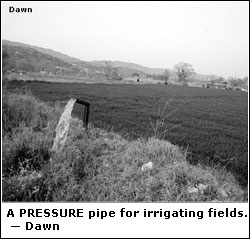
Through its pipe irrigation intervention, executed by non-government organization Soan Valley Development Programme (SVDP), 56 pipe irrigation schemes have been completed in the first phase in the Soan valley, 55 kilometers from Khushab.
“The pipe irrigation has proved extremely successful as it has benefited 1,116 farmers. More than 3,167 acres of irrigated and 901 acres of Barani areas have been brought under cultivation through the irrigation system,” SDVP chief executive Gulbaz Afaqi told Dawn.
The project heralds good times for Alam Sher, a farmer of the area, to whom water has been the prime concern for decades. The picturesque Soan Valley houses 20,000 or so residents.
The underground water level has been depleting with every passing day. About five years ago, the under ground water level in the valley was 50 feet. Now it is 100 feet.
In the mountainous area where farmers are scattered and have uneven landholdings, it is very difficult for them to set up a conventional irrigation system.
Under the second phase, 66 pipe irrigation schemes have been completed with 30 per cent contribution by local communities. Up to 1,257 farmers have directly benefited from the schemes. Mr Afaqi says 715 tube-wells have been covered with 3,054 acres of the irrigated and 1,404 acres of the rain-fed land brought under efficient irrigation.
“The pipe irrigation system has witnessed a minimum increase of Rs100 million in the income of 3,220 families averaging 31,055 per family by bringing rain-fed area under irrigation and growing cash crops.
“The WMC programme aims at alleviating poverty, reducing vulnerability and improving food security through sustainable agricultural development by focusing on management of water and water-related disasters. By 2012, it is hoped the WMC will develop itself as a recognised and highly regarded policy and technological hub, addressing water related issues in south Asia.”
Mr Afaqi says the PPAF carries out its various interventions through 72 partner organisations working in 31,500 villages with more than 92,300 communities in 112 districts across the country.
The Soan Valley was badly hit by acute drought during 1997 to 2002. Natural resources like groundwater and forest in the valley had been over-used. Lesser rains also played havoc with existing meager water resources. By 2002, almost all 3,500 dug-wells in the valley got dried up.
In the first phase in 2003, the PPAF issued a grant for efficient on-farm water management schemes in the valley. With the funding 34 sub-projects were executed and PVC pressure pipelines were laid on 373 tube-wells in different villages of the valley, thus benefiting over 847 households and 4,842 farmers. The underground pipelines covered 1,827 acres of the irrigated and 310 acres of the rain-fed area.
 The PPAF also offered the SVDP a Drought Mitigation and Preparedness Plan (DMPP) to be implemented in four union councils of the valley with Rs42 million in July 2004.
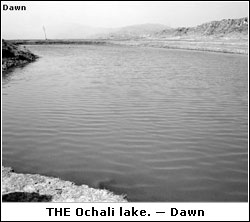
The project included a water balance model for future envisaging change in crop pattern and construction of physical infrastructure projects like delay action dams, check dams, rainwater harvesting ponds and efficient irrigation schemes. The PPAF and SVDP also engaged WWF-Pakistan to keep in purview the environment-poverty nexus in the area and also build a GIS base of the natural resources and proposed interventions.
In Jan 2005, the PPAF offered another DMPP project worth Rs42 million to the SVDP to cover the remaining two union councils in the valley. The projects being executed under the DMPP are delay action dams, check dams, drinking water supply schemes, rainwater harvesting ponds and change in cropping pattern.
DELAY-ACTION DAMS: Five delay-action dams have been built in the valley to break the run-off of rainwater in different watersheds and enhance seepage of water into aquifer so that the groundwater table rises.
These dams have been constructed with a 10 per cent community share in the form of labour and material. These dams will benefit a good number of farmers besides improving the groundwater table level.
Ten Natural Resource Management projects will be executed in March/April 2008 in catchments of delay-action dams and check dams to increase vegetative cover so that the silt is controlled and reduced. It includes plantation of trees and bushes, seeding of grasses and shrubs. It will enhance life of dams and improve vegetation in the watershed area.
CHECK DAMS: To break the run-off in the catchments of delay-action dams and stop silt from the pond area, 19 check dams have been built in the valley which will increase life of the delay-action dams.
DRINKING WATER: Eleven projects to supply clean drinking water to communities have been completed with a 20 per cent share by local people. As many as 907 households and 6,075 farmers have benefited from the schemes. Local people operate and maintain schemes.
RAINWATER HARVESTING PONDS: Fourteen rainwater harvesting ponds projects have been completed in micro-catchments and hard areas. These ponds sustain water for livestock by collecting seepage from micro-catchments. Some 2,782 households and a large number of livestock are benefiting from these schemes.
CROPS: Before 2003, cauliflower was the major cash crop in the valley. This vegetable needs more than 15 irrigations for crop duration of 75 days. Now with SVDP efforts and farmers cooperation, potato has emerged a new major cash crop in the area. Now potato (in accordance with a NESPAK study) covers 46 per cent irrigated area of the valley.
Where Sher Aalam and his fellow farmers are worried over increasing water scarcity in the valley they also want better health and education facilities there. ”We have only the District Headquarters Hospital in the valley which has only one qualified doctor to treat all kinds of patients,” he says.
| © DAWN Media Group , 2008 |


























