



 0
0

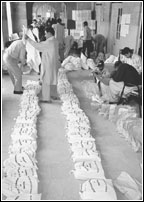 KARACHI: Excluding the provincial capital which has its own dynamics and dimensions, elections in Sindh entail a massive spending spree worth a whooping Rs6.72 billion. And this happens to be a conservative estimate in the absence of any auditable statistics or campaign managers who would afford to speak on the record. It is all off the record, shrouded further in folds of anonymity.
The process starts with the filing of applications for party tickets – Rs25-30,000 – and a certain amount of about Rs100,000 on being awarded the party nomination. Once it is in hand, there is no looking back till the election day as far as spending money is concerned.
Unlike the cities where visibility is the key factor, panaflex billboards and banners have yet to ensure a strong footing in rural areas where old-fashioned party flags, posters, stickers and such other entities continue to hold sway. Information gathered from across the province suggests that on an average, it takes about 10 large-sized panaflex hoardings and about a hundred small ones to cover an NA constituency, together costing about half-a-million rupees. Besides, 40-45,000 party flags are also required for the purpose. Produced in bulk quantities at Rs15-17 per piece, flags alone cost candidates Rs750,000. Add to it the cost of producing stickers, posters etc., and one can round off the NA figure to Rs1.5 million. Interestingly, Rs1.5 million is exactly the ceiling imposed by the Election Commission of Pakistan on all candidates vying for a seat in the august National Assembly. Whatever happens beyond this point, as such, is illegal.
Since there happen to be a number of villages and small towns in a rural constituency, candidates generally have to do a lot of traveling, attending receptions and get-togethers at various places. The cost almost always is borne by the candidates themselves who have to dish out anything between Rs20-50,000 per reception – about Rs2 million in total under this specific head
The next item on the agenda happens to be media coverage which, according to the insiders, is costing candidates about half-a-million to have their activities covered by regional media. This, however, is the amount spent specifically by the candidates and is in addition to the sum various political parties are spending on their projection and promotion.
The biggest expenditure in a rural constituency relates to transportation because of huge distances between villages and towns. Without proper arrangements, it is almost impossible to convince people to walk all the way to the polling stations to cast their vote. The activity heats up a day before the elections and in those two days a candidate ends up spending a colossal amount on transportation. On an average, he needs about a hundred vehicles which cost him Rs12-15,000 per day, or about Rs3 million over two days.
For remote areas, motorcycle rickshaws are hired to fetch people to the poling station and to drop them back home. It takes about 80-100 rickshaws per union council, which means about 800-1,000 in a constituency, costing about Rs800 per rickshaw per day, and adding up roughly to Rs1.5 million over two days.
Candidates also have a fleet of about 20 vehicles – quite a few of them being lavish four-wheelers – on the ready for personal use and for the consumption of various people working for them. This fleet remains functional as soon as one gets the prized party ticket to contest the elections. Generally speaking, these are not rented cars. Quite a few are donated by close friends, but some are bought by the candidates to impress – intimidate, if you will – the voters. Just a couple of these four-wheelers add a hefty five million to the election budget. And then one needs a lot of fuel to keep all these rented, gifted and owned vehicles moving almost round the clock during the campaign.
Adding all these figures plus the free flow of money to keep the work force happy, fulfilled and satiated suggest an average expenditure of no less than Rs20 million per candidate per National Assembly constituency, an over-expenditure of Rs18.5 million copared to the ECP ceiling. Likewise, for the provincial assembly seats, which is almost half the size of an NA constituency, the expenditure is automatically reduced by 50 per cent, or Rs10 million, which is Rs9 million too many against the official limit.
According to the official ECP website, there are over 400 candidates in the fray against 40 NA constituencies in Sindh, and well over a thousand against 88 provincial assembly seats, excluding, of course, the 20 NA and 42 PS constituencies that fall in Karachi. Not all of these candidates spend such a colossal amount, but it is a safe and calculated estimate that at least four front-runners in each constituency do end up spending that much. In simple terms, it means Rs80 million in an NA constituency, and about Rs40 million in the one related to the PS. Taking it further, as many as Rs3.2 billion (80 million x 40 constituencies) are spent by National Assembly candidates and Rs3.52 billion ((40 million x 88 constituencies) by their counterparts vying for Sindh Assembly seats for a grand total of Rs6.72 billion.
The figure may sound astounding in itself, but there is more in store. As pointed out by several candidates and their campaign managers – on condition of anonymity, of course – the actual cost is much higher because, they insist, one has to add up all the expenses they have made in the last at least couple of years to keep their respective party leaderships happy so that they may get the party nomination when the time comes. Keeping them happy means spending money on matters ranging from arranging air tickets and travel plans for those who matter within the setup to donating lavishly towards party fund that is now being used by all the major political entities on running expensive media campaigns. When this factor is taken into account as well – and there is no reason not to – the accumulated cost easily crosses the 10-billion mark.






























