0
0

Writer content despite govt indifference
 LIVING in a tranquil place, away from the congestion, noise and pollution of the city of teeming millions may be anybody’s dream. Poet, playwright and short-story writer Asad Muhammed Khan is lucky to have realized his. He has settled down for the ‘rest’ of his life in Gulshan-i-Maymar, off the Super Highway, with his wife. All four children are married -- two daughters in the city and a son and a daughter settled with their families abroad.
Asad sahib seems content with what he has achieved, both in terms of appreciation and material gain. At the age of 76 plus, he still drives himself around in his small car, visiting friends and relatives in the city. He has already said farewell to commercial writing and now does what he wills.
“TV producers ask us to create the mother-in-law/daughter-in-law type characters as are popular on Indian channels. Till a few years ago, Indian producers told their writers to write plays as were presented on PTV,” he tells Dawn during an interview. “Instead of catering to their demands, I prefer writing for my own satisfaction at my leisure,” says Asad. At present, he is contributing to a literary magazine, Mukalma, a series of articles based on his visits to various European and Asian countries, where his TV assignments took him when he wrote for PTV.
Being computer savvy, Asad enjoys chatting and the exchange of e-mails with friends and grandchildren on the net. “I understand what the young ones mean, though their parents may not. They write in their shorthand style such as ‘b4u, 2, u r, ur’ etc, whereas I prefer my own traditional style of writing.”
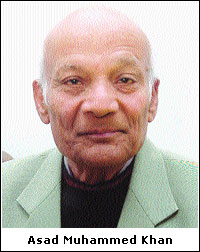 The widely respected and admired writer is not bitter about what he deserved but somehow did not get. Seeing his credentials, one, however, wonders what he should have done to get official awards such as the President’s Pride of Performance Award. If merit is anything, his contribution to literature and performing arts seems unusual.
He has to his credit several collections of short stories, a collection of poems and lyrics and has written or co-authored many serials and long plays for TV channels. He could be considered for the award even on the basis of his popular national and classic songs:
Mauj barhay ya aandhi aaya, diya jalayay rakhhna hai/Ghar ki khatir sau dukhh jhelay, ghar tau aakhir apna hai.(A crude translation may go like this: Whether a tide rises menacingly, or a windstorm blows violently, we have to keep the flame of this lamp alive at all costs and pains. After all, what we are suffering for is our own home).
Imagine the relevance of this song, sung by Shahnaz Begum, to the current challenges the nation is faced with and the inspiration and strength it may give to the people.
And see the following one sung by Efraheem:
Zameen ki goad rung say, umang say bharee rahay/Khuda karay yeh ...
(May this land remain enriched as it is with colours and the rays of hope. May its fields stay lush green forever).
And his contribution to classical music is also immense. Who hasn’t heard and enjoyed the songs such as:
Anokha ladla khelan kau mangay chaand
Kaisi anokhi baat ray or
Tum sung nainan laagay, laagay nahin jiara
Pia, pia bolay pia mun ka papihara.
Call it cronyism, favouritism or sheer nepotism at work that has stood between him and the award. He may casually mention “politics” for the exclusion of his name from the annual lists of the award, but prefers to remember what he has received in appreciation of his endeavours.
Laurels and works
He received the National Award for the Best Work of Urdu Prose (the Baba-i-Urdu Moulvi Abdul Haq Award) for Narbada, his collection of short stories in 2003, the Ahmed Nadeem Qasmi Award for Fiction in 2004, the Aalami Farogh-i-Urdu Adab Award at Doha, Qatar, in 2007, and the Sheikh Ayaz Award for Prose, also in 2007. Besides, a number of Pakistani and foreign scholars have done their theses on his works.
Asad began writing poetry in 1960 and short stories in 1970. His first collection, Khirki bhar aasman, published in 1982, comprises both poems and short stories. Rukay huay sawan, a collection of lyrics, was published in 1997, and the short story collections are: Burj-i-Khamoshan (1990), Ghussay ki nai fasl (1997), Narbada aur doosri kahanian (2003), Teesre pahar ki kahanian (2006) and Jo kahanian likheen (2006).
The Harvest of Anger & Other Stories and Fires in an Autumn Garden are the two volumes in translation published by the Oxford University Press. His works have also been translated and published in India.
Inspired mostly by English poets, Asad chose poems and lyrics as a medium to express his sentiments, and never tried his hands at ghazal.
He does not readily name his favourites among the Urdu poets. “I read and try to understand Saadi’s Persian verses. I read Rumi mostly through English translations. They are both giants of Persian poetry. Whereas Saadi’s verses have wisdom in them, Rumi’s have unrestrained devotion.”
Born in 1932 in the Aurakzai tribe of Pathans of Bhopal, the town, he says, was founded by his ancestors eight generations before him. He did his matriculation and received a diploma in commercial art in his hometown. He migrated to Lahore in 1950 to live with an uncle. His elder brother had graduated from a Sialkot college. But as most of his relatives had settled in Karachi, he also arrived and settled here in 1952. He sat an examination for the post of station master, qualified and underwent a year-long training.
Though he started working at the Hyderabad railway station, he did not like the atmosphere there and quit. He then joined the Karachi Port Trust’s traffic department as a clerk. His officers saw in him a budding poet and writer and encouraged him to pursue his writing career rather than doing office work. He did his graduation from Karachi University and also passed MA (previous) in English literature, but could not study for the final exam for lack of finances.
Reminiscing excitedly about his hometown, he also mentions the names of two luminaries of their respective fields in Pakistan. “Dr Abdul Qadeer Khan is also from Bhopal. His father was the headmaster of a school and my father was an art teacher in another school.” The other name he recalls fondly is that of Ahmad Ali Khan, the late editor-in-chief of Dawn. “Ahmad Ali Khan was my senior by several years and the school we both studied in will ever be proud of him as he had risen as a luminous star of English journalism.”
Communism
Asad sahib never joined any literary coterie, though he supported the Communist Party when it was banned in India. He narrates how he was put behind bars in his hometown of Bhopal for 17 days when he and his fellow students were caught writing pamphlets for the party.
“Being too young and because of our parents’ concern, we apologized and promised to shun our activities then. I believe the failure of the USSR was a big blow to the poor of the world. Iqbal had warned us decades ago that the monsters of imperialism would finally gobble up nations,” says Asad. “See what they are doing to Iraq and Afghanistan. Iran is looking them in the face, but how long it can do so has to be seen.”
Beyond the last mountain
In the early ’70s, he scripted the Urdu part of the English-Urdu film Beyond the Last Mountain. The English part was done by Javed Jabbar.
He blames the then government for the failure of the experimental picture. He says Sohail Rana, who was its music director, met Nusrat Bhutto in Islamabad and brought the government’s message that the script be changed as it alluded to the insurgency in Balochistan. The script was made topsy-turvy and there was nothing concrete left in it. So the film based on it was bound to fail.
The languishing market of literary journals
 It is true what Mansha Yaad said the other day about falling readership among our literate people. Sometime back when I went to Karachi on a visit, this old gentleman, Ahsaan Azim Siddiqui, who had been diagnosed some fatal disease, fished out copies of his bi-named Urdu magazine — Quest and Tajassus — from the mess that was his handbag bulging with transcripts of medical reports, prescriptions and X-rays and handed me two or three past issues with one special devoted to the revival of the Anjuman-i-Tarraqi Pasand Mussanefeen (Progressive Writers Movement). Small in size, of pamphlet thickness, the 82 page publication had a good number of progressive articles, criticism, short stories, ample share of poetry and among authors, a fair sprinkling of known names. It was encouraging to find it was being published from Kotri, a railway junction where the mail trains stop for a few minutes but also where survivors of the progressive movement were holding on. The ailing Mr Siddiqui was doing what he could, spreading the word at his own cost, getting no help from the railways or the reading public.
Time was Taj Saeed’s monthly Qand could reach bookstalls in Rawalpindi from the Mardan Sugar Mill where it was published and the editor had no need to distribute it free among his friends. But that was in the vanished haze of the first two decades after Partition. Hassan Askari’s Saat Rang while it lasted was one of the most widely read and sought after literary monthlies that one could not get a copy of within a week of its publication. The regular readership of other well established magazines, among them weeklies, made it possible for them to survive financially while some literary-cum-film magazines like the Shama, Delhi, were the publication world’s great successes. Rajinder Singh Bedi, Krishan Chander, Balwant Singh, Akhtarul Iman, Sahir Ludhianvi, Shakil Badayuni and the rest of the writing group of that period were published in these popular periodicals while some new writers who later made a name for themselves had their introduction in these magazines. In fact one’s ability to get published in the literary magazines was one’s launching pad to a writing career. Now writers publish their own books and get them launched at their own cost and distribute the product of their creative labour and hard earned money to friends and acquaintances with compliments.
I had the most depressing and embarrassing experience first hand when some friends started a ‘book series’ of Left writings, Irtiqa, in 1989 from Karachi. Not knowing the ethics of the business I volunteered to help them sell some ten or so copies of the second or third of its issue. I took the bundle to a thriving bookseller of the Super Market. After showing some signs of discomfort and reluctance during which he made me introduce the product, he agreed to keep just five copies to give it a try. I deposited the remaining lot with my friend Siddiqui, a second-hand bookseller who was at that time also dealing in pirated reprints of known fiction and other educational material. A week on when I returned to the posh bookseller, I had to hold my breath upon not finding any copy of Irtiqa on the shelf for Urdu periodicals. I was about to approach the cash counter for receiving the sale proceeds when a half open bundle of books lying on the floor caught my eye. Hiding myself from the manager’s view I picked up the copies, wiped off the dust and stealthily arranged them prominently with the other stuff. Then for a couple of weeks I returned to the shop every two or three days to check if any copy had found a buyer and if not, to rearrange my goods for best display. Fed up with this routine after some time, I allowed Irtiqa to try its luck on its own for a few weeks, which, to this day, is a mystery and part of the mystique of the success of booksellers. The manager told me he had sold no copies and I could look for them in the shelves or in the stacks lying on the floor. Like the passengers of the Mary Celeste in the Atlantic, the five copies of this mouthpiece of progressive thought had vanished into thin air without any trace.
It is some wonder though that despite that early loss of five copies, Irtiqa survives. Its 43rd issue came out recently with a section devoted to the memory of Prof Hassan Abid, one of its founding architects, who died last year. But many solo efforts of other enthusiasts have come to an end after a few issues because of lack of support from publishers, booksellers but mostly on account of readers’ apathy. Now our friend Ali Muhammad Farshi had started a very well edited periodical by the fancy name of Symbol. Its second issue came out just when it was being thought its first was its last. But now many months have passed and already there may not be many waiting for its reappearance. Similarly a gentleman into equestrian sports had started a very fine magazine on the subject but after probably four or five issues it has also ceased publication, though I believe it was a worthy effort well worth a longer life. Likewise I don’t know what happened to the bilingual Tadeeb which Hameed Qaiser, Helen Goodway and Ahmad Khalil Jazim were bringing out simultaneously from Pakistan and Britain. It had some refreshing stuff between its covers when I last read it, particularly its poetry section. The special issue on Faiz was probably its last that I saw.
Ataul Haque Qasmi’s barbed statement explaining the late arrival of his voluminous Mu’aasir says it all: “The situation for literary journals is getting more and more difficult with time. Roland Barth had announced the “death of the author”. Here the existence of the reader is threatened. Literary journals are published by writers and it is the writers’ lot to read them”. It is not that new audio-visual technologies and information explosion has caused the fall in reading habits, because that has not happened in neighbouring Iran and India. Qasmi holds the educational system and government’s unhelpful policies for this situation. So as a matter of policy he puts on sale only 20 per cent copies of his magazine. The rest are given away in charity.
| © DAWN Group of Newspapers, 2008 |