0
0

What good can good men do?
 Poets etc are quite inordinately and disproportionately associated with the notion of romance though theirs is largely confined to the kind we see in our movies. And if with some of them it goes beyond and ventures a little further, it ends up making a mess of Nature. The real expanse of romance lies in the realm of science and philosophy where new worlds unfold in the test tube and thought touches devastating frontiers within the cranium.
Geneticist Dr Anwar Nasim, whom you catch walking into literary functions when the proceedings are half through and vanishing before the end, has been commuting between the pool and the ocean from his college days. He has written sundry pieces of prose and fiction which have been published in literary journals and a second book, Woh Qurbatain, Yeh Faaslay, has recently come out that contains both old and new writings.
Writings relating to his scientific work are many more — five books and over a hundred research papers that he ‘suspects’ some people may have read. Having spent the greater part of his life in scientific research in Canada he is with Comstech now as its adviser and finds his return to Pakistan rewarding specially in terms of respect and recognition one can seldom hope to get abroad. Then one moves among friends of one’s own intellectual and social level, a facility rarely available overseas. These factors led to his decision to spend the rest of his life feasting in the homeland, if not rolling the beads.
Dr Nasim Anwar is not exactly a hail-fellow-well-met but he does possess that rare jollity and lightness of spirit that brings cheer to any heavy scene. I shouldn’t say it’s a technique or stratagem on his part but he seems to enjoy dismissing the seriousness of his own propositions. Both in his writings and speech he is not weighed down by self-importance as many of us are. He relishes understatements and their handiness serves for him the purpose of emphasis that most others employ rhetoric for. But behind this trellis of light and shadows you can be certain of meeting a very serious person who is deeply concerned about the moribund state of Pakistani society.
He doesn’t spread despair but one shares with him the general lack of optimism in not finding any reasonable effort being made anywhere to set things right so that we could also start moving in the direction we were supposed to be moving after achieving independence. The failure of institutions is appalling as well as of individuals who have not risen to the occasion. He sees no hope in any collective effort coming up but well meaning individuals whose number is not small can, in their own spheres of activity, bring change. A growing network of such individuals can ultimately become a great social force for change. On the analogy of NGOs he has developed the concept of NGIs — non government individuals. Examples: Abdus Sattar Edhi, Imran Khan et al. Exceptional people these; we cannot hope to have another dozen of their vision and determination. But it would be jolly good if the odd motorist does not break the red signal, the grocer does not sell adulterated chilly powder, the doctor does not ask the coughing patient to get a urine test, the CDA chairman stops the cutting of trees in Islamabad or the suicide bomber claims his reward in THIS world by exposing the masterminds. “But what”, I ask, “if another general...!”
“...decides to stay back in his barracks, do you mean?” quips Dr Sahib.
Remember Shyam Benegal’s 1978 film Junoon based on Ruskin Bond’s poignant novelette, Flight of the Pigeons, centring on the futile passion of a Pathan rebel fighter Javed Khan for an English girl Ruth in the backdrop of the crucial period of 1857, starring Shabana Azmi, Shashi Kapoor, Naseeruddin Shah, Kalbhushan Karbanda, Jennifer Kendal and the charming Nafisa Ali. Its memorable dialogue was written by the great Urdu novelist Asmat Chughtai.
After a church massacre in which her father is killed Ruth and her mother fall into the hands of the rebel fighter Javed Khan who gives them protection in his house but his insane lust to possess Ruth makes him enter into a symbolic bargain with her mother who promises him his love if Delhi falls to the rebels. His tragic delusion that the personal can be isolated from the collective dynamics is proved wrong when he loses both his love and the war of freedom. This compelling story has been smoothly rendered into Urdu by Hamra Khalique who has translated a number of other similar stories from English (Sushmita Bandopadhyay’s Kabuliwala’s Bengali Wife) and is also transforming into TV plays some noteworthy contemporary fiction which otherwise may not reach large audiences such as available to the electronic media today.
This elegant hard bound book published by Scheherzade titled Kabootron ki Parwaz is priced at Rs120 a copy.
Monstrosities along city roads
 I am amazed at the ability of our people to create ugliness and disfigure things that look nice. What weird psyche is this? Look at the ugliness created in the form of graffiti on walls, meaningless words, advertisements of quacks, preposterous slogans of politicians anxious to get to the assemblies to “serve” the people! The moment an overhead bridge, an underpass or a building is constructed, the walls are disfigured with graffiti, posters are pasted all over and every nook and corner is putrefied by pan-chewing people. Look around and you will see this spectral side of our fellow citizens’ attitude towards things that look nice and clean.
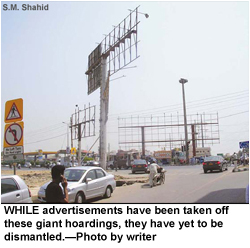
The mother of all ugliness, however, is the billboard. While graffiti, wall chalking and pan stains can be removed easily, the heavy billboards standing on solid steel pillars are difficult to remove. Perhaps those who are in this business have made it a point to construct them in such a way that you would think twice before even considering removing them! According to Ronald D’Souza of Shehri, till last summer as many as “17,000 billboards stood in Karachi out of which 13,000 were illegal.” At many places, they had even put up ‘multi-storied’ boards, one on top of another!
I hope people of Karachi have not forgotten the tragedy that struck the City of Lights on that fateful day of June 26, when a storm lashed it and brought down a large number of hoardings on the unsuspecting passersby, killing many, maiming many more, destroying properties. There was great hue and cry in the media – so much so that the authorities could not help but take action to remove them. But how adroitly the job was done! While most of the billboards in areas under the city government were promptly removed, a majority of them in the jurisdiction of various cantonment boards were only stripped of their “skin”. The massive steel frames fixed on heavy steel pillars were left untouched. They stood there, defiantly, menacingly, waiting for the dust to settle down. Now, after only six months, these ugly skeletons have started to be draped with advertisements offering consumer products to the bewildered masses.
One might recall that on March 27, 1992 one had presented in this newspaper extracts of a survey conducted in 1986 of hoardings installed haphazardly along major roads in the city. Yes, even in those days hoardings, even though only in hundreds, were a nuisance. That same year (1992) the then chief minister had constituted a “Chief Minister’s Aesthetic Committee” comprising prominent citizens, the main task of whom was to examine and oversee all activities for the beautification of the urban environment of Karachi. The committee’s recommendations were supposed to be implemented by the concerned civic agencies.
 The committee would also look into the eyesores called “monuments” built by the KMC and the KDA at various roundabouts without any care for aesthetics and stop their further proliferation.
Among the many things we did during the one year of the CMAC before it was disbanded unceremoniously by the next chief minister, the most difficult task was the removal of hoardings. Had it not been for the help of the then commissioner of Karachi, it would not have been possible to remove so many hoardings that stood at most inappropriate places. We were then told that they would come back in a big way. Indeed they did. Not only the Aesthetic Committee was sent home by the new chief minister, much larger, heavier and electricity-consuming billboards appeared all over the city turning Karachi from ‘The City of Lights’ to ‘The City of Hoardings’. What is noteworthy, however, is that while the old hoardings used to be sold for 10,000 to 15,000 rupees, the new ones are now sold to advertisers for one million to four million rupees each. Is it possible that the business flourishes without the approval and patronage of officials? It is a free-for-all – the CAA, the Railways, KMC, KDA, cantonment boards, all found a great opportunity to make money by selling their sites.
It is sad that even after so many lives lost on account of the falling billboards, the authorities are again allowing these massive billboards to proliferate all over the city. Haven’t we enough on our plate already in the form of insecurity, traffic congestion and pollution to be subjected to a new threat?
A lot of good work has been done in Karachi by the city nazim and his team. One hopes that they will have the political will to ensure that the city looks decent and presentable.
| © DAWN Group of Newspapers, 2008 |