0
0

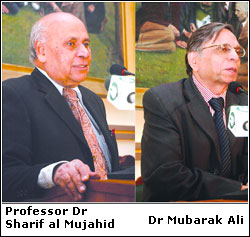 KARACHI, Dec 27: The 1857 War of Independence was more instigated by economic factors and less by religious reasons as taught in history books, said Professor Dr Sharif al Mujahid, the founding chairperson of the University of Karachi’s department of journalism. He was speaking at the inaugural session of a conference on the war at the KU’s Arts Auditorium on Thursday.
“The critical factor was not religion. In fact, it was the economic motivation that dominated the results,” he said, adding that the majority of conflict areas were those where sepoys were posted and where civilians joined them to avenge their grievances with the elite.
Dr Mujahid added that the consequences of the War of Independence were far more significant than the event itself since it brought about the departure of the East India Company and brought direct British rule in the subcontinent. Also, he said the war resulted in ending religious extremism and gave way to religious neutrality. Most importantly, he said, the war provided the emotional link that was a great inspiration towards independence from the British.
Explaining the history of the war and its different aspects, Dr Mujahid said that unfortunately, we are aware of only one side of the story, whereas the event had a far more human angle to it. “Our nation does not take its history seriously. History is extremely important in carving out a future,” he said. “Other than a few stray conferences, there is no serious debate on the War of Independence (here) as opposed to India, where an active debate is going on,” he noted. Dr Mujahid appealed to the KU administration to take measures to revive people’s interest in history.
Noted historian and editor of quarterly Tareekh Dr Mubarak Ali spoke about how perceptions change with time and new aspects emerge. Citing the example of the War of Independence, he said this was the biggest war against the British, but it also was a war between the common man and the elite. He added that one of the reasons that people are losing interest in history is that as a subject, it has been taken away from the curriculum, which has resulted in a lack of awareness about the subject in general, and the War of Independence in particular.
“In our country, history is taught in a very boring manner, which makes the subject sound unappealing,” he said, adding that he and his team of historians have tried to present history by delving into its different aspects to revive people’s interest.
University of Karachi Vice-Chancellor Dr Pirzada Qasim Raza Siddiqui reiterated the speakers’ viewpoints, adding that history is the memory of any nation, and if it is not documented, it loses continuity. He said that how history of events is related to us now is different from how it was related 50 years ago, and this process will continue, for which we have to be ready.
“We live with preconceived and fixed mindsets. In order to change our perceptions about history, we need to open our minds to change,” he said. The VC also stressed that we need to use the tools of modern history and unearth the different historical aspects of the War of Independence.
The conference was held to observe the 150th anniversary of the 1857 War of Independence and was organised by the KU’s Pakistan Study Centre and quarterly Tareekh (Lahore).