0
0

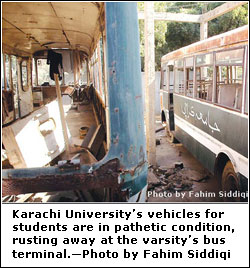 KARACHI, Dec 20: Thousands of students of the University of Karachi (KU) risk daily their lives and endure a lot of inconvenience while travelling on overloaded varsity buses, most of them in poor condition and needing constant repair. While the KU administration offers no immediate solution to the problem, the head of the university’s transport committee has sought the help of multinational firms and private organisations in this regard.
The problem of KU’s transport, say former students, is nothing new, though it has become more severe in recent years with the opening of different programmes in the institution. The students’ numbers have swelled from 12,000 to 15,000 in the 1990s to over 20,000 during recent years.
But the number of KU buses, referred to as ‘points’, has reduced from 35 to 26, according to sources. This includes two vehicles recently gifted by the city nazim. However, the KU officials put the number at 29. This reduction occurred in 1997 with the closure of the Karachi Transport Corporation (KTC), which used to assist the university in transporting students.
“We definitely need more buses, at least 100. The KTC, on its closure, gave away some of its old buses to the university, but it didn’t solve the problem as most of them were outdated. Around 11 buses are obsolete and are no longer in use. Five are under repair while the rest of the 26 buses develop faults quite frequently. The university faces an acute shortage of funds and staff as one can see the transport unit only has two mechanics,” a driver who has been working with KU for over six years said, adding that the death of a few students in the past years mainly occurred due to overloading.
Waiting for an accident?
“Perhaps the government is awaiting a ‘major accident’ because minor mishaps, which have become the norm, have failed to move it into action,” he sarcastically remarked. He also disclosed that KU, despite having an acute shortage of buses, had been completely ignored on the issue when the higher officials recently decided to give some vehicles to different educational institutions, which includes the Dawood University of Engineering and Technology, NED and Jamshoro University.
Most of the students Dawn spoke to were highly critical of the KU administration’s persistent failure to resolve the transport problem. When asked why they preferred university transport despite being so unsatisfied with the quality of its service, they mentioned a number of reasons. Most of them, especially girls, which comprised almost 65 per cent of KU students nowadays, argued that they did not travel on the points out of choice but rather out of compulsion, as most of them did not want to change three or four buses to reach the university. Quite a few of them have also hired contract buses which provide pick-and-drop services. But others said that the fare of these services was way too high.
“Also, because of a sense of security we prefer to travel on KU points, though the drive is extremely unsafe. If the administration is ready to increase the number of buses to an adequate level, we are ready pay a little more in fare,” some of them said. The KU points currently charge students Rs3 per ride.
Citing a recent accident, a student said that a bus got out of control after its brakes failed and it rammed into a vacant KU point parked on the other side of the road in Khokrapar, Malir. Luckily, no one was injured because the vehicle was not moving at a high speed, though the windowpanes were all broken. Some students alleged that the KU administration gave the buses to students having political affiliations for different functions and that, at times, had caused more problems for students.
Lamenting the fact that though the University of Karachi claims to be the biggest educational institution in the country, it has failed to provide an efficient transport system to students, a teacher at the English department said: “It should be a shame for any institution that its students endanger their lives every day and are not being facilitated even inside the university to access different departments”. He maintained that an efficient transport system was needed not only outside the university limits but also inside.
“Apart from regular students, hundreds of people visit the university for different purposes. Along with students, they, too, have to walk all the way to different departments as the shuttle service closes by 10.30am or so. This problem aggravates in the evening as not only is there no KU point, but also because public transport starts disappearing by that time. Boys can sit on the rooftops of vehicles, but girls have to wait for long periods. Also, the entire premises of the university is not properly illuminated, which adds to their woes,” he said, while suggesting that the problem could be partially resolved by renting out bicycles inside the university premises.
Corporate support
Another solution, suggested by Dr Shadab Zulqarnain, head of the KU Transport Committee, was to involve multinational firms and private organisations. “The university is ready to display their banners on the buses if they help us tackle the problem,” he said, emphasising that the administration was making a feasibility report to improve the situation.
“I feel that the infrastructure needs to be set up to sort out this problem for good. But this involves a lot of money, which we don’t have. We not only need more buses, but more staff and space too,” he said.
About the recent award of buses to some institutions, he said, “perhaps we didn’t pursue the matter with the Higher Education Commission hard enough”. Regarding the release of vehicles to some ‘specific’ students, he said that this may have been a practice in the past, but now requests were honoured only if they were backed by department chairmen.