



 0
0

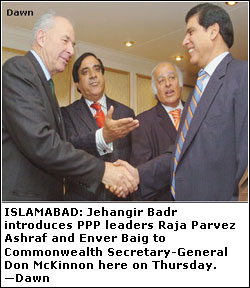 ISLAMABAD, Sept 20: Stressing that the Commowealth wanted to see restoration of full democracy in Pakistan, the visiting Commonwealth Secretary-General, Mr Don McKinnon, on Thursday said the next four months were very crucial for the country.
Addressing a press conference here after meeting various political leaders, government officials, including the Chief Election Commissioner, he said the election process in Pakistan was being closely monitored by all members of the Commonwealth and the world community.
He rejected the charge of meddling in internal affairs of Pakistan and asserted that it was the responsibility of the Commonwealth to keep watch on all activities of Pakistan as it had signed the Commonwealth Charter which called for ensuring the rule of democracy, development and welfare of the people.
He said that the Commonwealth could suspend the membership of any country if it violated the charter.
He said Pakistan joined the Commonwealth in 1949 and its membership had been suspended in 1999 because of the military takeover. As Pakistan was a member of the Commonwealth, he said, the organisation had concerns about developments here and it had been closely monitoring events in the country.
Mr McKinnon said he knew that the election process was very difficult and expressed the hope that it would be completed in a fair, free and transparent manner.
Answering a question, he said when the organisation talked of free and fair elections, it was not only about the general elections but also about the presidential election.Asked if he had raised the issue of amendments to the rules for the presidential polls with the Chief Election Commissioner, Justice (retd) Qazi Muhammad Farooq, he replied in the affirmative and said that the CEC had explained to him that the amendment “was necessary and it was in accordance with the Constitution and the law”.
He said the CEC had also assured him that all arrangements had been made to hold fair, free and transparent election and to revive a true democratic order in the country.
He said the Chief Election Commissioner had told him that he was fully independent in the discharge of his constitutional duties and that there was a mechanism in place to hold free and fair elections. The Commonwealth secretary-general said that he had a good understanding of the political environment in Pakistan, adding that the Commonwealth was encouraging the Pakistan government to restore full democracy.
Observing that there had been progress since 1999, he said: “We want the process to be taken all the way.”
He said there had been a lot of achievements and Pakistan had come through a long way since 1999 when its Commonwealth membership had been suspended.
Mr McKinnon said he was reassured by President Musharraf’s statement in the Supreme Court about his decision to relinquish the post of army chief, if elected president for the next term. He said the Commonwealth’s position was that it wanted separation of the offices of the president and the chief of the army staff.
He said that the Commonwealth would have no objection if Gen Musharraf took over as president after hanging up his military uniform.
“After all, you will need a civilian president,” he remarked.
He said he had very useful, candid and open discussion with President Musharraf and he (Gen Musharraf) had assured him that he would quit the office of Chief of Army Staff by the end of the year.
He said President Musharraf had also expressed his commitment to restore full democracy in the country.
Asked what would be Commonwealth’s position if the Supreme Court found Gen Musharraf ineligible for contesting the presidential polls, he said the question was hypothetical. “Let the court complete its proceedings,” he said.Mr McKinnon said that the Commonwealth had repeatedly discouraged imposition of emergency or martial law in the country.
”Martial law is an act which should be a rare occurrence,” he remarked.
He said there had been talks of imposition of emergency in the country a few weeks ago, but the government took an appropriate decision and avoided it.
Mr McKinnon said the Commonwealth had expressed its disappointment over the deportation of former prime minister Nawaz Sharif, adding that the court had allowed him to come to Pakistan.
“The issue should have been resolved in the court,” he said.
He said it was the right of all parties to contest the general elections, adding that he had held meetings with representatives of PML-N and PPP and other political parties and discussed with them matters relating to general elections.
The PML-N delegation which met Mr McKinnon comprised deputy parliamentary leader in the National Assembly Chaudhry Nisar Ali Khan, secretary-general Zafar Iqbal Jhagra, information secretary Ahsan Iqbal and foreign coordinator Muhammad Mehdi, while the PPP delegation consisted of secretary-general Jehangir Badr, Raja Parvez Ashraf and Farhatullah Babar.
In the meetings, both parties expressed the view that outgoing assemblies were not eligible to elect the president for another term.
They also stressed that all exiled leaders should be allowed to come back to Pakistan and contest elections.





























