0
0

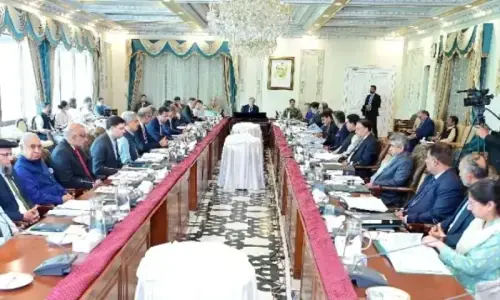
LAHORE, Aug 20: Prime Minister Shaukat Aziz on Monday said he would “always be a candidate” for prime minister’s office and indicated that both presidential election and general polls would be held on time.
He told a group of editors and columnists during a visit to the provincial metropolis that the constituency from where he would contest the election was yet to be decided and hinted that he might be a candidate for more than one National Assembly seat.
Mr Aziz ruled out emergency and martial law for now and reiterated that Pakistan would not allow any country to violate its sovereignty, while conceding to the remark that there had been a couple of instances where missiles fired by foreign troops had hit targets in Pakistan. “We strongly protested these acts,” he said.
He touched upon a variety of other subjects — from ‘contacts’ between the government and opposition parties to the country’s economy, the price spiral affecting the common man and traffic snarls caused by his own and president’s visits to various cities in the country.
On the key issues, such as the presidential election and the tensions between the judiciary and the executive, he stuck steadfastly to the Constitution and he was consistent with his theory of continuity: President Pervez Musharraf’s re-election is crucial to the continuity of the efforts that have propped up the country to its current economic position.
Mr Aziz pointed out that it would be the first time in the country’s history that an interim government would oversee a general election. “An interim government is different from a caretaker set-up that has come about under Article 58(2)b (of the Constitution),” he explained.
He said that a deal between the government and former prime minister Nawaz Sharif did exist, courtesy a friendly country.
In another reassertion of the official line, he said the government had not struck a deal with anyone. “We are in contact with them outside the parliament just as we are in contact with them inside the parliament,” he said and reminded everyone that many legal matters needed to be sorted out before a return of an exiled leader or a deal could materialise. “We will contest the elections along with our current allies and see what happens after the polls.”
Mr Aziz carefully avoided the thinly concealed traps laid by Lahore intellectuals and finally managed to bring the discussion down to his favourite topic: the economy, even if the poor man’s version of it. He rattled up figures to highlight just how lucky the Pakistanis were in comparison to their neighbours, which he didn’t name, just as he didn’t name the opposition leaders and the opposition parties and the friendly country.
However, he was not averse to drawing favourable parallels between the cities of Lahore (in Pakistan) and Delhi (in India).
He said Pakistanis were buying wheat flour, petrol and other commodities at much cheaper rates than their neighbours because his government had introduced certain checks and balances in the system. “This is because we have pursued an open yet conservative economic policy.”
But what if his own presence as the prime minister was somehow perceived as hampering the continuity of President Pervez Musharraf’s policies? There was this talk recently that President Musharraf could rid himself of so many of his problems if he were to find a scapegoat for some of the government’s recent measures.
Mr Aziz chose to answer the question by referring to a certain middle-class man’s rise to the office of the prime minister. “Anyone who has got the opportunity must take it.”