



 0
0

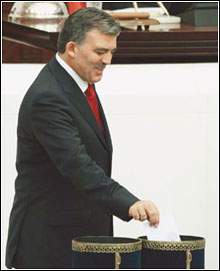 ANKARA, Aug 20: Foreign Minister Abdullah Gul, the frontrunner to be Turkey’s next president, failed to get elected in a first round of voting in parliament on Monday, but remained virtually assured of victory next week.
Gul, whose Islamist past has fanned concerns that his presidency would undermine Turkey’s secular system, garnered 341 votes from the 550-seat house, 26 short of the two-thirds majority needed on the first and second ballots.
The second round on Friday is expected to produce a similar outcome, but Gul should easily win in the third round on Aug 28, when only a simple majority of 276 is required.
Gul’s ruling Justice and Development Party (AKP) commands 340 parliamentary seats.
The other two candidates, Sabahattin Cakmakoglu from the right-wing Nationalist Action Party and Tayfun Icli from the centre-left Democratic Left Party, received 70 and 13 votes respectively.
AKP officials were confident of Gul’s eventual victory.
“The race will be completed in the third round,” senior AKP deputy Sadullah Ergin said.
It is Gul’s second bid for the presidency this year. His first attempt in April was blocked by an opposition boycott that denied parliament the quorum needed to hold the vote.
The turmoil, aggravated by a menacing statement from the army, forced snap general elections on July 22 in which the AKP won a huge majority it interpreted as a popular mandate to re-nominate Gul.
The main opposition Republican People’s Party again boycotted Monday’s vote, but the quorum was assured with the participation of other opposition parties.
Shortly before voting began, Gul repeated promises to adhere to “the basic principles of the Republic” — secularism prominent among them.
Turkey’s president is a largely ceremonial figure, but has the authority to name senior bureaucrats and judges and to return legislation to parliament.
Opponents say that with Gul in the presidential palace, the AKP, the moderate offshoot of a now-banned Islamist movement, will have a free hand to erode the separation of state and religion — an intention the party strongly denies.
For hardline secularists, the fact that Gul’s wife, Hayrunnisa, wears the Islamic headscarf is also a source of irritation.
At the climax of the crisis over Gul’s first presidential bid, millions took to the streets to protest against his candidacy and the military, which has toppled four governments in as many decades, said it considered the secular system under threat and vowed to defend it.
Ten years ago, the army did not hesitate to unseat the government — of which Gul was a member — led by Turkey’s first Islamist prime minister, Necmettin Erbakan.
It has remained silent about Gul’s re-nomination for the presidency, but many worry of possible tensions if he is elected.
Independent deputy Mesut Yilmaz, who served as prime minister after the army forced Erbakan to resign in 1997, hinted that Gul’s failure to adhere to the state’s secular principles could prompt the military to once again make its presence felt.
“Unfortunately, Turkey is heading towards a dangerous polarisation. The (new) president and the government must both assume their responsibilities to prevent that from happening,” the Anatolia news agency quoted him as saying.—AFP




























