0
0

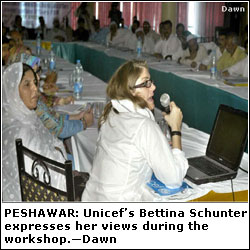 PESHAWAR, July 31: Donor organisations have called upon the government to set aside a portion of the Zakat fund for financially assisting people living with HIV/Aids so that they may arrange for their food, transportation and other needs during their treatment.
“During treatment, the HIV/Aids patients need balanced food and cash to cover their transportation expenses. They need monetary support,” said Unicef’s Bettina Schunter.
Speaking at a one-day workshop jointly organised by the Unicef, WHO and the Provincial Aids Control Programme (PACP) here on Tuesday, she said the patients be extended Zakat in such a way that their self esteem was not affected. According to her, there should be research at the local level to shortlist the most deserving patients for Zakat.
“The poorest of the poor should be given priority. HIV/Aids patients need better nutritional diet to strengthen their immune system,” she added. The patients also required money for some essential laboratory tests which were not available free of cost.
She said that Pakistan was spending a huge amount on the welfare of the patients, but owing to lack of discipline among various implementing departments, benefits were yet to trickle down to the patients in an effective manner.
“A management information system regarding the deserving patients should be devised to avoid duplication of activities,” she suggested.
Dr Iqbal Khalil was of the opinion that Islam had put in place a complete system for social welfare and only through following the Islamic injunctions could the poor patients get appropriate help.
He said that Islam had forbidden extra-marital relations more than 1,400 years ago. Only now were the western countries waking up to the reality that sex with multiple partners could lead to disaster.
“The only hope to keep the pandemic of Aids at the bay is to strictly follow the teachings of Islam,” he said.
Dr Nabila Zaka of the Unicef was of the view that some of the chronically-ill patients, including HIV/Aids, required prolonged treatment. She said that Aids patients desperately needed money to pay for the expenses of their families besides their own treatment and diet requirements.
“The selection criteria of deserving patients for receiving Zakat would be made transparent to facilitate only the eligible ones,” she said. She said that the patients hailing from slums be accorded priority for Zakat.
Discretionary powers should be done away with in the departments of Zakat, Baitul Mall and other welfare bodies, she said, adding that often the affluent people get Zakat that deprived the deserving lot of their right.
She said the women were often ignored by the welfare bodies because they weren’t as vocal as men. She proposed an increase in the number of Zakat centres to cater to the needs of the increasing number of patients.
Former provincial minister Qari Ruhullah Madani urged Zakat chairmen and officers of the province to select the patients on the basis of their poverty. He said the Zakat committees know the financial status of the people in their respective areas and they should select the most poor as their first priority for free treatment.
NWFP Minister for Zakat, Ushr and Women’s Development Hafiz Hashmat Khan said his department spent Rs56 million on the healthcare of the poor population per year of its total budget of Rs490 million. “The federal government is reluctant to allocate the NWFP its share in the rehabilitation funds of TB, HIV/Aids, hepatitis and other patients despite several requests,” he said.
He said that Islam had resolved the menace of poverty long ago and recalled there was not a single Zakat recipient in the entire Mecca and Medina.