



 0
0

Karachi’s public libraries
“WHY is there not a Majesty’s library in every county town? There is a Majesty’s jail and gallows in every one,” wrote Thomas Carlyle. My question is: why is there not a public library in every union council? There is a garbage dump in every one. The local government has installed huge garbage dumps at a large number of places across the city. One such dump can be seen from miles – and can be smelled as well – right in front of the Urdu Dictionary Board’s office, courtesy the nazim of Gulshan-i-Iqbal Town.
Somehow I feel that the more libraries you have, the fewer jails and gallows you will need. It’s an oft-repeated lament that a megacity like Karachi does not have enough libraries and, with skyrocketing prices of books, the public simply doesn’t know where to go to find a book on a subject that interests them. Baffled especially are those who don’t have an access to the internet or need some information that is not available online.
Yet there are others (like this writer) who are simply technology-shy. For them, the good old way of reading a book -– a process that involves holding a book in your hands rather than staring at a computer screen -- is so easy that they are pathologically averse to becoming acquainted with modern technology. Some modern Rip Van Winkles seek refuge from overbearing wives in the broadsheets of a newspaper and that too in the peaceful atmosphere of a public library. But where are the libraries?
Though not on a scale one would have desired, Karachi does have a good number of libraries. Many Karachiites simply don’t know where the libraries are. When Mohammad Yousuf Naeem, a young researcher and author, set out to do some spadework for his book he was planning to write, he was at his wits’ end as to where to turn to for books because he knew nothing about Karachi’s public libraries.
Finally, he did find a library and many other good ones but the hardship he faced in locating them made him think about other booklovers. “Why not write a book that would guide the booklovers to Karachi’s public libraries?” he wondered and started collecting data for the book 'Karachi Ke Awami Kutub Khane: Aik Taaruf’.
The book is an introduction to the public libraries of the concrete jungle otherwise known as Karachi. The slim volume gives brief but very useful information, stating the location of the libraries, their phone numbers, number of books and even the route numbers of buses and mini-buses that take you there.
The book catalogues some 60 libraries. The number is obviously smaller than expected and many libraries have not been mentioned. The author admits that there are many more and told me, a couple of months back, that he was working on the second, updated and revised edition as the first edition, published only in January 2007, was running low on stocks.
The otherwise good book contains some minor calligraphic errors and at times the language is coarse. Since the book is published by the author, he can always insert a thing or two. Some of the entries need more elaboration.
Some information that seems too good to be true needs double-check: the number of books, for instance, at Karachi University’s Dr Mahmood Husain library has been put at 600,000. That makes it Pakistan’s largest library, which it is not.And it would be nice to put in the book that there is a library at Karachi’s central prison. The poor fellow Carlyle would be pleased to know that gallows and books go together now.
drraufparekh@yahoo.com
Handmade
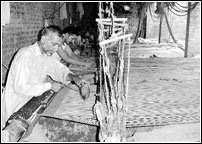 GAKHAR, one of the key cities of Gujranwala district, is the biggest manufacturer of handmade darri (a kind of a mat) in Pakistan. Half of the city’s population is associated with darri-making, but the business has been shrinking fast for the last several years.
There were more than 150 darri-making factories in Gakhar in 2002 that have now reduced to 55, the labour force has reduced from 6,000 to 1,000 and darri shops from 300 to 60. Moreover, the daily income from darri-making in Gakhar and its suburbs has fallen from Rs3 million to Rs600,000 and the Rs20 million monthly income from darri exports has reduced to zero.
Two of the three big darri-making factories of Gakhar, Butt Darri Industry and Mian Fancy Darri, have closed, while the third, Mian Darri Industry, is on its last breaths.
Gakhar and its suburbs like Nutt Kallan, Peerkot, Noorakot, Ibenwali, Bhatti Mansoor, Gillwala, Banka Cheema, Mitranwali, Kalair and Adalgarh were the hub of handmade darri till 2002, but now the business has shrunk only to Gakhar, Mitranwali and Banka Cheema. These areas were making darris on handlooms for homes, schools and mosques, but now machine-made darris, plastic sheets and carpets have replaced them.
Mian Rashid Tufail, owner of Mian Darri Industry, told Dawn that handmade darris had been replaced by cheap machine-made darris of Jhang and carpets. He said a handmade darri made for floor cost Rs30 per square foot, while a machine-made darri for floor cost Rs10 per square foot. He said high quality carpets were also available for Rs10 to Rs30 per square foot. He said this difference in the prices of handmade and machine-made darris had made all government departments and the Pakistan Army to buy machine-made darris or cheap carpets. He said that cheap handmade darris of India and cheap carpets from China and Iran knocked down Gakhar’s handmade darris in the international market.
Muhammad Yousaf Sethi, general-secretary of the Gakhar Darri Manufacturers Association, said the handmade darri business had shrunk because of a lack of government interest in it, a lack of investment and shortage of labour. He said that as a result of this downfall thousands of women workers had lost their livelihood. He said that most of Gakhar’s darri factories were registered under the relevant act, but they could not provide social security, old age benefits, medical and pension to their workers. He said that darri manufacturers were not entitled to loans from banks.
Sethi said Gakhar used to export its handmade darris to Saudi Arabia, Gulf and Europe, but there were no darri exports to these countries in 2007 because of a lack of variety in darris, high prices of handmade products and availability of their alternatives in the international market. He said Peshawar and Afghanistan were big markets for Gakhar’s handmade darris, but now cheap carpets and machine-made mats had been dumped in these markets.
Muhammad Boota, who works as salesman at a darri-making factory, said that ever-rising cotton prices and costly labour were behind the shrinking handmade business. He said a pair of bed darri, which was being sold for Rs200 in 2002, was being sold for Rs800. He said several people previously dealing in handmade darris had now started dealing in machine-made darris of Jhang.
Amjad Raza, a handmade darri wholesaler, said most manufacturers of handmade darri were poor therefore they could not offer workers benefits or register with the Gujranwala Chamber of Commerce and Industry to get help from the government.
Azmat Ali, Muhammad Hidayyat and Shahid Javed, who made darris at a factory, said a darri-maker could hardly earn Rs200 a day, while in other works he could easily make up to Rs300 a day. This was the reason that most darri-makers had left this field, they added.
They said darri-makers were getting Rs1 raise annually. They said the environment of darri-making factories was unhygienic as several workers were suffering from breathing problems.
| © DAWN Group of Newspapers, 2007 |


























