



 0
0

FM: a ubiquitous part of urban life
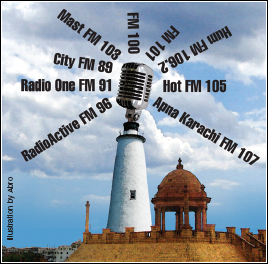 KARACHI: FM radio, or frequency modulation radio, has become a ubiquitous part of life in the metropolis. From once teetering on the edge of oblivion, FM has injected new life into the medium of radio, making it an unmistakable part of the urban fabric.
In Karachi alone, as of last count there were nine FM radio stations competing for the listeners’ attention. These are, in no particular order: Mast FM 103; City FM 89; Radio One FM 91; RadioActive FM 96; FM 100; FM 101; Hum FM 106.2; Apna Karachi FM 107 and Hot FM 105.
All these stations, with the exception of the Pakistan Broadcasting Corporation’s FM 101, are privately owned enterprises. But before proceeding any further, a clarification must be made between FM and the other popular format of radio, AM (amplitude modulation).
“The main difference between the two formats is that FM has much better sound quality than AM, but a smaller geographical range. For instance, AM can be heard hundreds of miles (or more) away from the transmitter, whereas even the strongest standard FM transmitters have a broadcast range of up to a 50-km radius. FM is capable of delivering close to CD-quality sound,” says Sharaf Qaiser, Head of Production at Mast FM 103.
Talking about the demographics of FM, it has crossed all class and status boundaries, especially in Karachi. Whether it is blaring out of the expensive sedans of the nouveau-riche, or piped through the pocket-sized FM players of students on public buses, after about 12 years of proper existence in Karachi, FM has arrived and is here to stay.
Advertisers have moved in to stake their respective claims in radio-land and radio stations are trying to cater to almost every stratum on the socio-economic totem pole. As Mr Qaiser, a radio insider with nearly a decade of experience commented, the socio-economic divide seems to be quite pronounced in the world of FM radio.
“Everything below the ‘100’ mark on the dial (FM 89, 91 and 96) seems to cater to the English-speaking elite; those who are ‘upwardly mobile’ or at least wish they were. Stations ranging from FM 100 downwards (the FM broadcast band starts at 87 and usually goes up to 108) target what is known as the ‘Urdu medium’ crowd,” he observed.
Whatever the merits of this claim, it just might be that local FM stations are pursuing the policy of ‘narrow-casting,’ or targeting specific segments of the population.
But apart from the apparent division of FM stations along class-based lines, one thing that united most listeners this writer talked to was their distinct distaste for the antics of the majority of on-air personalities. Many listeners claimed that the majority of RJs (radio jockeys, the politically correct way to say DJ, or disc jockey) are habitual abusers of both the English and Urdu languages.
They said that these mostly young, hip neophytes (and even some of the older lot) make a mockery out of language, and what is being spoken on air is a mutilated witch’s brew that is neither here nor there. Listeners added that they much prefer the segments and stations (primarily 106.2) that play back-to-back music.
However, Mahrukh Shaikh, a broadcaster formerly associated with FM 101, defended the RJs’ on-air claptrap thus: “Most of the time we blab on air as we have to fill dead air. I admit, mostly RJs don’t make sense. They think they can get away with it, and in fact they are getting away with it. The listeners only criticise us when we don’t play their requested song right at that instant or if we fail to read out their text messages on air. People in fact enjoy bakvaas (gibberish) and call up and contribute to the bakvaas!”
Compare this to the glory days of Radio Pakistan, when on-air personalities were looked up to for their linguistic prowess and art of enunciation, whether broadcasting in Urdu or English. A former RJ of FM 101, who did not want his name mentioned, recalls being censured by his seniors during the early days of the FM boom.
“I had just finished doing my regular English show, when I had to fill in for the next presenter, who could not make it on time. The next programme was in Urdu and since my Urdu is not of broadcast quality, I had to wing it through the entire two-hour programme. Naturally, I got an earful from the senior Radio Pakistan people after the show. But listening to the kind of language that passes on radio nowadays, I am simply flabbergasted,” he said.
But is FM radio in Karachi today simply reflecting the changing cultural mores of society? Has the art of language really sunk to the depths that a good chunk of listeners and critics claim it has? Whatever the answer, the at times endless, nonsensical banter blabbed by certain on-air personalities may well be a cultural harbinger of the shape of things to come.
Of moral monitors and enlightened moderation
ISLAMABAD: With our religious affairs minister and speaker of the largest province’s assembly acting as Johnny Bravo and self-appointed moral monitors like Lal Masjid and Jamia Hafsa brigade policing the society, President General Pervez Musharraf’s much trumpeted concept of ‘enlightened moderation’ has been reduced to a mere propaganda gimmick.
First it was federal minister Ijazul Haq who made an impassioned speech in the National Assembly last week suggesting that the British government’s decision to knight controversial author Salman Rushdie could justify suicide attacks.
Then it was the speaker of the Punjab assembly going a step further to declare war on ‘blasphemer’ Salman Rushdie, saying he was personally ready to kill him. These pronouncements created quite a stir in the diplomatic circles here. Some diplomats even wondered what would happen if Johnnies like these were in charge of Pakistan’s nuclear programme!
Getting upset over the conferment of knighthood on Rushdie whose novel ‘The Satanic Verses’ outraged the Muslims worldwide, is understandable given that it has hurt the religious sentiments of millions of Muslims.
However, it does not by any means justify such mindless pronouncements by those holding public offices and speaking not for themselves but the state.
While peaceful protest and expression of concern or even anger, is the right of every individual, threats of violence against an individual by those speaking on behalf of the state makes no sense and is no solution. Such an approach would only erode the merit of the point that Muslims are trying to make. The Muslim world ought to proactively and constructively engage on issues of concern with members of the international community.
An emotional outburst is no effective statement of a case. Questions can be raised about Britain’s lack of sensitivity and its disdain for Muslim sentiments. Calls for addressing concerns of the Muslims, respecting their sentiments and the dignity of Islam are legitimate. Death threats from those representing the state are absurd.
When some Muslims made calls for the killing of a cartoonist following the publication of blasphemous cartoons in Denmark and other European countries last year, the OIC secretary-general emphatically disapproved of them. He termed issuing of any such fatwa “dangerous” and declared: “Such a fatwa goes against the essence of Islam…We have no authority to kill anybody and take law in our hands.”
Now that Britain’s decision to knight Rushdie has again created uproar and is feared to spark more protests by Muslims around the world, the OIC should caution against violent reactions. So far the secretary-general of the 57-member pan Islamic body has remained tight-lipped on the issue as have other key Muslim countries like Saudi Arabia, Malaysia and Indonesia.
However, Pakistan has now formally approached the OIC to state its position on this issue.
Last week Pakistan formally registered its protest with the British government and conveyed its disappointment over the decision to knight Salman Rushdie. However, the government on Monday distanced itself from the resolutions adopted by parliament and provincial assemblies demanding apology from the British government and seeking withdrawal of the knighthood title from Rushdie. When the Foreign Office spokesperson was asked if the resolutions also reflected the position of the government, her response was that they represented the sentiments of the people of Pakistan and the public representatives. Perhaps mindful of the fact that demanding withdrawal of the title would amount to challenging the sovereignty of the
British government, Pakistan opted for a more nuanced position where parliament has rightly spoken for the people of Pakistan and the government has moved only to protest the British decision.
MENACING BRIGADE: What has been even more disconcerting and a matter of grave concern for the diplomatic community in Islamabad is the ugly demonstration of intolerance by the high-handed Jamia Hafsa brigade last week. In flagrant violation of the law of the land, they abducted Chinese nationals for indulging in what they called ‘immoral’ activities. Notably this was the first time that members of this notorious outfit held foreigners hostage. Perhaps there could not have been a more embarrassing moment on the diplomatic front for Pakistan. Those citizens of its most trustworthy and friendliest country living in the heart of the capital city are conveniently kidnapped. While China, being a good friend of Pakistan, did not lodge a formal protest with the Foreign Office it has conveyed its deep concern over this episode to the government at different levels. Apparently this issue has also been raised with Pakistan’s Ambassador to China Salman Bashir.
The kidnapping episode of the Chinese nationals has also made other foreign nationals living in the capital feel rather insecure. They fear the intrusive Lal Masjid and Jamia Hafsa brigade may knock at their doors next.
Even the diplomats living in the cloistered diplomatic enclave do not feel safe any more. Apparently some diplomatic missions have also been compelled to issue Lal Masjid and Jamia Hafsa alerts. And they have good reason for that. The Lal Masjid and Jamia Hafsa brigade have literally been getting away with murder each time. The standard pattern has been that these ‘prophets of virtue’ kidnap individuals for their ‘vices’, then a team headed by the ruling Pakistan Muslim League’s damage-control master Chaudhry Shujaat Hussain steps in to negotiate on behalf of the government and subsequently the captives are released. Once that happen it is again business as usual for the stick-wielding and gun-toting brigade till they have hit their next target. Making a mockery of the president’s ‘enlightened moderation’ this brigade continues to bulldoze its own brand of morality on the residents of Islamabad. It has a virtual licence to operate as a state within a state and is not held accountable by the powers that be.
No worthwhile legal action seems to have been initiated against this menacing lot.
The talk about deployment of around 90,000 troops by Pakistan on the border with Afghanistan to fight extremism and terrorism will impress few when seeds of intolerance and extremism continue to be sown right in the heart of the capital.
Housing schemes eating up farm land
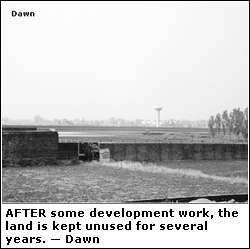 THE ever-increasing number of housing schemes in Gujranwala is not only reducing the cultivable area but also affecting crop production in this agriculture district of the province.
The wheat production in the district dropped considerably in 2007 compared to 2006. Muhammad Rafique of the Agriculture Department (Extension) told Dawn that the district had produced 559,117 tonne wheat in 2007 compared to 565,678 tonne in 2006.
Dost Muhammad, a statistical officer at the Crop Reporting Services, said the per acre wheat production was 32.93 maund in 2006, which increased to 34.11 maund per acre in 2007, but the total wheat production decreased in the district. He said that 562,000 acres were cultivated in 2006, which decreased to 552,000 acres in 2007. He said that a 10,000 acre decrease in the cultivated area was the major reason for decrease in wheat production in the district. Housing scheme owners usually walled their lands even if they were not in use, leaving several acres of agricultural land uncultivated for years, he added.
Muhammad Younas, a revenue record keeper of Sadar, said the district had 768,883 acres of irrigated and 124,047 acres of non-irrigated area.
“Two tehsils of the district, Gujranwala City and Gujranwala Sadar, have 181,998 acres of irrigated and 33,018 acres of non-irrigated area. Housing schemes have already consumed about 3,000 acres of the irrigated area recently and the process goes on unchecked.”
Khaili Shahpur Town Planning Officer Muhammad Umer Farooq said almost 1,200 acres of agriculture land had been occupied by housing schemes in the town.
Aroop Town Planning Officer Nauman Raza said almost 400 acres of farm land had been converted into housing schemes in the town.
Qila Didar Singh Town Building Inspector Nisar Ahmed said housing schemes had occupied almost 60 acres of the irrigated land in the town.
In Wazirabad, Nandipur, Noshehra Virkan and Kamoke towns, almost 1,400 acres of agriculture land has been consumed by housing schemes. Several landowners have developed small housing schemes on their own, which are not on the record of town administrations.
Anees Butt, a local industrialist who has invested in housing schemes and plazas in Gujranwala, said it was due to the government’s policies that industrialists and traders were investing in non-productive projects like real estate. The result is a decrease in the farm area and increase in unemployment, he added.
He said that an influx of smuggled Chinese products into the Pakistani market had destroyed several industries whose owners invested whatever left with them in the real estate. He said big landowners followed industrialists and set up housing schemes on their farm lands. He said the government should formulate a policy to bring industrialists back into productive activities to stop the spread of housing schemes.
He said the rate of agricultural land’s conversion into housing schemes was higher than the rate of population growth and people’s demand for accommodation, adding that the government must check this tendency. He said the Agriculture Department should increase per acre yield rather than relying on the extent of cultivable area because population growth would soon lead to more land use by housing schemes.
Green Town Housing Scheme marketing manager Jan Muhammad said the project was spread over 125 acres of agriculture land. He said that the land, now walled, had been lying unused for the last five years.
Agriculture Department (Extension) District Officer Rab Nawaz said the rising number of housing schemes in the district had decreased the cultivable land to a considerable extent. He said the department was aware of the decrease in cultivated area and was focusing on increasing per acre yield.
| © DAWN Group of Newspapers, 2007 |



























