0
0

Handicapped but eager to face challenges
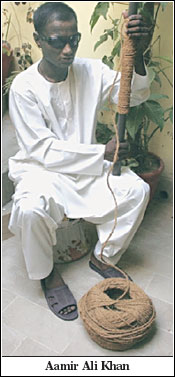 “We don’t need charity, we need to work,” says Aamir Ali Khan, speaking for Pakistan’s disabled people and those with special needs. “Don’t treat us differently; we have much potential but it remains untapped because people just don’t have confidence in us.”
His situation is a glaring reminder of how very far Pakistan needs to go for its special needs’ citizens, yet Aamir radiates a joie de vivre and the ability to stand firm in the face of adversity.
Adversity for this 27-year-old came in the shape of renal failure, which led to the loss of eyesight and a partial loss of hearing. The third of five siblings, Aamir lost the use of both his kidneys when he was 13, after suffering a severe reaction to a medicine administered for typhoid.
Since then, he needs dialysis treatment three times a week. While the procedure itself is free, the family must pay Rs1050 for an injection administered during every session, and cover the cab fare of Rs300 per trip. Well aware of his family’s meagre resources, Aamir desperately wants to pitch in — but the opportunities are limited.
“We can do everything, there is a wide range of alternative techniques,” he points out, referring to potential avenues of employment.
“Just give us the opportunity to prove ourselves; let all of us find out what we are capable of doing.”
What he is asking for is no more than that desired by every Pakistani, yet the journey of people such as Aamir is far more arduous. He says that certain employers, amongst them Pakistan Telecommunications Limited (PTCL) and the police force, hire physically challenged people under equal-opportunities policies but then tell the employees not to bother actually going to work.
“Getting a job and then being told this is what hurts most,” says Aamir. “It shows that our country and our people neither accept us nor believe that we can be productive citizens.”
Such discriminatory views of disabled people are disproved by the determination Aamir has himself shown. Prevented by his failing health from attending school regularly, he sat for his Matriculation examination as a private candidate.
Upon being refused admission to the Ida Rieu school for the visually impaired because he suffered renal failure, he became a member of the neighbourhood library and borrowed audio-cassettes that would help his studies.
He has taken the Intermediate Part 1 exam — the hardest part is not studying, he says, but arranging for a writer. “Many ditch you at the last moment,” he comments.
And having met with little success in getting a job, Aamir nevertheless earns a small income by making cocopoles — PVC pipes twined with rope that are put in pots to support plants and vines. As he works, he tunes in to a FM radio station, a favourite pastime (other than playing the flute).
“Except for procuring the raw materials, I manage everything else, from cutting the pipes with a saw and punching holes in them to twining the rope around,” he smiles proudly. “You can’t get a better quality in Pakistan, if I say so myself. My brother helped me browse through the various techniques on the internet.”
This young man believes that “there’s still much ground to cover.” Meanwhile, he’s doing what he can to help others. Throughout this interview, the personal pronoun ‘I’ was noticeably absent from his conversation. He refers to his disability in the context of ‘us’, thus raising the issue of other physically challenged people in Pakistan. Considering his lack of sight as merely a somewhat limiting nuisance, he says that “once people realise this simple truth, blind people will be freed from discrimination and prejudice.”
To this end, he has formed a circle of physically-impaired friends, a support group or help-line of sorts that can take collective action when the need arises. A notable example is when they recently raised funds for an operation needed by a visually-impaired girl. “She had spilled scalding tea on her thighs and the wounds were turning gangrenous. Doctors had warned if that if they were not taken care of soon, she may lose her limbs,” recalls Aamir. “She’s an orphan, living with her brother who’s not too well-off either. So a few friends decided to pool in the money they earn, for her operation and the doctors’ fees.”
Infectious enthusiasm and the determination to rise above adversity are what make Aamir so different. He was offered a kidney transplant but sadly, a match could not be found. His mother is diabetic while his father suffers high blood pressure; his brother’s kidney did not match. Offers from his two younger sisters were gently declined.
Nevertheless, life is far from easy for Aamir. “I don’t want to sit idle because all sorts of negative thoughts creep up,” he says. “They can undermine even the strongest among us.” He appreciates that he is lucky to have a family that loves and supports him unconditionally, but he also knows many people like him who have become a liability. “I wish I could help them by finding work,” he keeps saying.
Certainly, work is an issue since his biggest problem is marketing his merchandise. A friend helps get the cocopoles sold to various nurseries around town but this is sporadic. As a result, Aamir cannot invest large sums since the return is slow.
On days when there is no work for him, when all the cocopoles lie neatly stacked to one side, packed in plastic and ready to be sold, Aamir confesses to feelings of depression. Those are the days when his suffering begins to feel as real as physical pain. “I can do more work than this and engage other friends who desperately need to work too,” he says. “If only I could somehow arrange bigger orders.”
The abyss gazes into you
ALCOHOLICS and people drunk on power share at least one defining trait. When the affliction takes hold and the brain begins to rot, both lose sight of the consequences of their actions.
Life doesn’t come with a rewind button, there is no such thing as a time machine. The clock can’t be turned back and damage control is the only hope after the event. Drastic surgery, an excision of the demons perhaps? No, just patch me up, won’t do that again. Right.
By accident or design, there is no shortage of quick-fire remedies for that sinking feeling of impending doom. Another swig from the bottle can do the trick or, in the case of the strongman, the morale-boosting company of those who are paid to praise till they’re blue in the face.
Staggering down the slippery slope of self-destruction, bouts of paranoia wrestle with supercharged moments of hubris and grandiosity. But the bravado — “mein kise sey nahin darta” — soon gives way to a sense of persecution, the feeling that plots are being hatched and stratagems devised behind your back.
Pumping up that punctured tyre is a futile exercise, chief. All it’ll do is take you a few miles further, well short of whatever dreamland the current fantasy may have conjured up.
In any case the antennae are up. The public, like Rottweilers, can sense fear.
Too late in the day, the yes-men in Islamabad are scrambling to rein in a monster of their own creation. The president has aged ten years in the three months since March 9. The jowls have fallen, the swagger is gone and he seems to be sporting a reverse facelift.
The terrorists of Karachi also blundered badly. They killed more than forty on May 12 but in the process shot themselves in the foot. In the space of a few trigger-happy hours on that definitive day, bang went any chance of redemption.
Where’s that time machine? Damn, who broke the rewind button?
The politics of terror is self-defeating in the sense that the number of victims can never be limitless. This is a big city. Starting with me and you, how many can they kill? Their cover, what was left of it, is blown for good.
They thrive on fear, so let none be shown. Let them do their worst.
To retain its hold, the psychology of terror demands deafening silence. Eik, dou, teen… But the dams have burst and the unthinkable is being said — openly by some and with the thinnest of disguises by others constrained by corporate policy, not personal choice.
Particularly troubling for the terrorists is not the condemnation of their opponents but the doubts sown in the minds of those who supported them all these years. Now the fascists must go door to door reconverting the faithful.
Who knows, the siege mentality cultivated so carefully these past 20 years — if it weren’t for us, such and such community would eat you for breakfast, nihaar moonh — could actually lift one of these days.
Maybe the time will come when those whose ‘grievances’ are based not on discrimination but the denial of preferential treatment may ultimately realise that they are not intrinsically superior to anyone resident in the province of Sindh.In any case, the chinks in the armour are widening, the façade is cracking and the terrorists of Karachi are feeling the heat from the fallout of their own deeds. There must be no letting up, no papering over, no reconciliation concerning the carnage of May 12. Never.
But mark the risks. Nietzsche had a point when he warned: “Battle not with monsters lest you become a monster and if you gaze into the abyss, the abyss also gazes into you.”
Dare to live or die wondering.
Enough said, for now.
imalik@dawn.com
Environmental crisis posing new challenges
BEIRUT: If rising sea levels force the people of the Maldive Islands to seek new homes, who will look after them in a world already turning warier of refugees?
The daunting prospect of mass population movements set off by climate change and environmental disasters poses an imminent new challenge that no one has yet figured out how to meet.
People displaced by global warming — the Christian Aid agency has predicted there will be one billion by 2050 — could dwarf the nearly 10 million refugees and almost 25 million internally displaced people already fleeing wars and oppression.
“All around the world, predictable patterns are going to result in very long-term and very immediate changes in the ability of people to earn their livelihoods,” said Michele Klein Solomon of the International Organisation of Migration (IOM).
“It’s pretty overwhelming to see what we might be facing in the next 50 years,” she said. “And it’s starting now.”
People forced to move by climate change, salination, rising sea levels, deforestation or desertification do not fit the classic definition of refugees — those who leave their homeland to escape persecution or conflict and who need protection.
But the world’s welcome even for these people is wearing thin, just as United Nations figures show that an exodus from Iraq has reversed a five-year decline in overall refugee numbers.
Governments and aid agencies are straining to cope with the 10 million whose plight risks being obscured by debates over a far larger tide of economic migrants — and perhaps future waves of fugitives from environmental mayhem.
HARSHER CLIMATE: The United Nations High Commissioner for Refugees (UNHCR), which marks World Refugee Day on Wednesday, says the global political climate for refugees has already become harsher.
“They used to be welcomed as people fleeing persecution, but this has been changing — certainly since 9/11, but even before then,” said William Spindler, a UNHCR spokesman in Geneva.
“Growing xenophobia, intolerance, political manipulation by populist politicians who mix up the issues — the whole debate on asylum and migration has been confused,” he said.
People fleeing threats at home and those seeking a better life could be in the same group washing up on a Spanish beach, but Spindler said it is vital to keep the distinction between them to provide effective protection to those who need it.
Whatever their motives, migrants deserve to be treated with dignity and as human beings, he added. “We have seen people in the Mediterranean in boats or hanging onto fishing nets for days while states discuss who should rescue them.”
Before sectarian violence exploded in Iraq last year, global refugee numbers had been shrinking. The Taliban’s overthrow in Afghanistan, along with peace deals in trouble-spots like Congo, Liberia, Angola and southern Sudan, had allowed millions to return home — although 2.1 million Afghans have yet to do so.
“I’m not suggesting that life is all beautiful in those countries, but there have been advances,” said Joel Charny, vice-president of Washington-based Refugees International.
“The big exception is Iraq, the fastest-growing refugee crisis in the world,” he said. “Everyone’s fleeing. It’s really broad-based insecurity displacing people in Iraq and outside.”
The UNHCR says 2.2 million Iraqis have fled abroad and over two million have left their homes inside the country, where they are much harder to track or assist than those overseas.
INTERNALLY DISPLACED: Around the world, nearly 25 million people are internally displaced — fleeing for the same reasons as refugees, but lacking international recognition or protection.
While Iraq and Darfur often hit the headlines, aid officials worry about the “forgotten crises” that uproot people within national borders, often far from television cameras.
“Hardly anyone is concerned about the Central African Republic,” said Sarah Hughes, UK director of the International Rescue Committee (IRC). “And in Chad for instance, refugees from Darfur get three times more provision than Chadian displaced.”
Recognising the scale of internal population upheavals, the UNHCR last year took under its wing some 13 million displaced people, many of whom had to be reached in conflict zones.
“In Darfur, the problem is not funding but security and access to the people we are trying to help,” said Spindler.
The bloodshed in Iraq has made it a virtual no-go zone for international humanitarian staff, but aid workers also grapple with violent environments anywhere from Afghanistan to Colombia.
“The biggest challenge is security, the shrinking of humanitarian space,” said the IRC’s Hughes.
HOSTILITY: Refugees may also feel the world has less room for them as they try to cross borders into countries where hostility to migrants of all sorts has grown, compared with the Cold War era when fugitives from communism won sympathy and asylum.
“The reaction now is scepticism,” said Charny. “It’s ‘Who is this scam artist trying to get a job in our country?’”
North Koreans fleeing to China or Zimbabweans crossing illegally into South Africa are widely treated as economic migrants though many may also be escaping persecution, he said.
“We have to maintain a refugee protection regime that doesn’t just assume everyone is an illegal economic migrant,” Charny added. “That tendency exists in the industrialised countries and in the wealthier countries of the global south.”
With those escaping environmental upsets likely to swell flows of migrants and refugees, any quest for legal definitions tying governments to new obligations might prove tricky.
“That’s not to say that practical arrangements can’t be found to deal with this,” said the IOM’s Klein.
The focus should be on contingency plans for nightmare scenarios that could prove all too real, Charny agreed.
“How will we approach displacement when, say, the Maldives go under?” he asked. “We have to plan for it, but in a way that doesn’t lead us all to start jumping out of windows.”—Reuters
| © DAWN Group of Newspapers, 2007 |