



 0
0

A treasure trove of rare Urdu journals
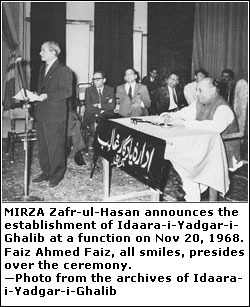 FOR a literature researcher, literary magazines and journals are an indispensable source of information. Three libraries in Pakistan are known for their collection of literary periodicals and journals: Sardarpoor Jhandeer library, Mailsi, (about 100,000 issues), Abdul Majeed Khokhar library, Gujranwala, (over 150,000 issues) and Ghalib Library, Karachi, (about 50,000 issues).
Ranked high among Karachi’s good libraries, Ghalib Library was established in September 1971. Ghalib Library is, in fact, an offshoot of Idara-i-Yaadgaar-i-Ghalib, which was founded by Mirza Zafr-ul-Hasan in February 1968.
The idea behind the venture was to set up an institution that would promote literary activities and research and would especially cater to the needs of those who wanted to carry out research on Ghalib and other prominent literary figures.
Faiz Ahmed Faiz (1911-1984) was founder president and Mirza Zafr-ul-Hasan (1916-1984) was founder secretary.
In 1969, Idara-i-Yaadgaar-i-Ghalib commemorated Ghalib centenary on a grand scale. Leading men of letters, not only from Pakistan but also from India and other countries, took part in the programmes.
Realising soon after establishing Idara-i-Yaadgaar-i-Ghalib that the objectives of the institution could not be fully served without a well-stocked library, Mirza Sahib decided to set up Ghalib Library. The moving spirit behind the Idara and Ghalib library was, of course, Mirza Zafr-ul-Hasan, who even went from door to door collecting books for Ghalib library from donors who could not come to the library for one reason or another. He was supported and helped by such luminaries as Faiz Ahmed Faiz, Muslim Ziai, Begum Aamna Majeed Malik, Mushfiq Khwaja, Sibt-i-Hasan, Mumtaz Hasan, Muhammad Umer Muhajir, Dr Jafer Ali Hashmi, Mukhtar Zaman and scores of other prominent personalities from all over Pakistan.
Appeals were made for donations. The response was simply overwhelming. Books and money poured in from all over Pakistan. Many scholars sent books from India. Mirza Sahib had a novel idea for collecting money: he launched ‘Ghalib Pencil’ priced at a very high premium as it was meant to be a Ghalib centenary souvenir. It sold like hot ‘cakes’ because people wanted to help and contribute. Sadequain donated a few of his paintings, specially created for the occasion. He even designed and painted the signboard and insignia of the library. Finally the library opened on Sept 1, 1971.
Mirza Zafr-ul-Hasan made Idara-i-Yaadgaar-i-Ghalib and Ghalib Library a cultural centre where celebrities such as Faiz Ahmed Faiz, Ralph Russel, Nabi Bakhsh Baloch, David Mathews, Ibn-i-Insha, Mushfiq Khwaja, Ghulam Rasool Mehr, Shaukat Subzwari and Farman Fatehpuri attended literary and cultural gatherings. Writers, poets, journalists, intellectuals and artistes used to frequent the library.
Today the library, housed in a spacious and well-lit building, boasts of over 35,000 books and 50,000 issues of some 600 journals. Some of the books are extremely rare. The library has a copy of an Arabic book, printed in 1847 and titled ‘Faraiz-ud-Dahr’, which is, perhaps, the only known copy of the book.
The periodical section is another feature Ghalib Library is known for. It has a complete record of some very rare periodicals. Some 19th century and early 20th century journals are the valued treasure library is proud of. You could find rare magazines like ‘Hasan’ (Hyderabad Deccan), ‘Music Gazette’ (Faizabad), ‘Rafiq-ul-Atibba’ (Lahore), ‘Doctor’ (homeopathy magazine) (Lahore), Al-Mualij (Amritsar), Ghar Ka Ved (Amritsar) and ‘Oudh Punch’ (Lucknow), to name but a few.
Hundreds of college magazines also adorn the library. More importantly, about 2000 ‘Khas Numbers’ or special issues of literary journals are stacked here. In addition, letters written by authors and intellectuals are preserved in the library. Mirza Sahib somehow obtained the scripts of TV and radio plays for the library.
Ghalib library houses, naturally, a very good collection on ‘Ghalibyaat’. Apart from its invaluable collection of books and periodicals on Ghalib, it has published a good many books on one of the greatest poets of Urdu.
The affairs of the library are run by a committee. All the members of the committee work on an honorary basis, with Fatima Surayyia Bajya as president, Dr Farman Fatehpuri as vice-president, Raana Farooqi as secretary-general, Dr Moinuddin Aqeel as joint secretary and Syed Aijaz Hussain as treasurer.
Ghalib Library is one of those few literary and cultural institutions Karachi can be truly proud of.
Praying for the monsoon
WHAT happened during the recent heatwave — with temperatures soaring near 50 degrees Celsius in many localities — would have been considered an emergency situation in many other countries.
Not only were people dying by the scores on the roadside from heat stroke with many more others being hospitalised for heat exhaustion, in many parts of the country the people’s suffering was made intolerable by the relentless power breakdowns and incessant water shortages.
This resulted in riots in Karachi and street protests in several cities of NWFP, where the chief minister himself admitted that the power outages were unbearable, causing unrest and threatening the writ of the government.
The report that five people who fainted from heat stroke in Sahiwal died in the District Headquarters (DHQ) hospital because they could not be provided treatment due to loadshedding ought to have put any government with a conscience to shame.
If these events aren’t enough to constitute an emergency situation in the country, what will? When the power and water supply breaks down in the corridors of power in Islamabad?
In England, an emergency may be declared locally, regionally or nationally if a heatwave is judged so severe and/or prolonged that its effects extend outside health care, such as power or water shortages.
By these standards, Pakistan would be in an emergency situation between May/June to August/September every year!
Emergency is the highest level of response (level 4) under England’s heatwave plan of action, the other levels being heatwave (level 3), alert (level 2) and awareness (level 1). The levels of response are based on threshold day and night-time temperatures and duration as defined by the Meteorological Office. These vary from region to region but the average threshold temperature is 30 degrees Celsius during the day and 15 degrees Celsius in the night.
In Pakistan, if we had a heatwave plan the average threshold temperature would probably be much higher, may be 35 or even 40 degrees Celsius. But despite heatwaves becoming an annual summer plague in our country as in many other countries because of climate change, not only do we still lack a heatwave plan, most of us didn’t even know that the recent heatwave was approaching.
Our Meteorological Department must have known about it but its coming was not publicised to the public well in advance and neither was the public duly advised to take preventive measures.
A heatwave plan that gives advance warning to all people across Pakistan that a heatwave was going to happen again this year and predicted to be much hotter than last year which killed many people, would not only make sure the ministry of health and hospital services are prepared when a heatwave arrives, but that the general public is well informed about how to cope with a heatwave. This could have helped reduce the number of deaths and hospitalisations from extreme heat.
Much of the advice about how to cope with a heatwave may sound like common sense, e.g., keeping out of the heat particularly during the hottest part of the day between 11am and 3pm, drinking plenty of fluids, avoiding caffeine, wearing loose- fitting and light-coloured clothing, wearing a cap or wide- brimmed hat and sunglasses, staying in the coolest room of the home, keeping windows closed and curtains drawn when room is cooler than outside, taking plenty of cool showers, eating smaller meals — especially salads and fruits — more frequently instead of large meals, etc.
But the general public usually does need reminding about how to protect themselves, the elderly and vulnerable groups against extreme heat, particularly in certain types of environment which may exacerbate the risk from extreme heat, such as accommodation in single-storey houses, top floor flats, lack of air- conditioning, or work places such as construction sites, foundries, kitchens of restaurants and bakeries, etc.
England’s heatwave plan spells out the responsibilities at the national and local level for alerting people once a heatwave has been forecast and advising them what to do. The plan comprises three main core elements. First, a heat-health watch system operates from June 1 to September 15 based on forecasts by the meteorological office which will trigger the respective levels of response from the health department and other bodies.
Second, the health department sends out advice and information to the public and healthcare professionals in hospitals before a heatwave is forecast and when one is imminent. Third, the media is used to publicise heatwave warnings and health advice by the meteorological and health departments before and during a heatwave.
In Pakistan’s case, however, of equal importance before and during a heatwave is the role and level of preparedness by all levels of our government and our civic agencies, viz., Wapda, KESC, all the electric supply companies and Wasa. But as recent events in many parts of the country have shown, failure to accurately estimate the increase in power demand together with failure to upgrade and maintain our power generation and distribution systems and our water supply and distribution systems to meet these demands resulted in our inability to provide reliable electricity and water services to the public, services which are so crucial for public health during summers, particularly during a heatwave.
Instead of drawing up and setting into motion an action plan to brace the country against the onslaught of heatwaves in ever hotter and hotter summers every year, we seem to be merely sitting tight and praying for an early summer monsoon to solve our heat, water and electricity problems!
Even as the heatwave continued to claim lives in Rawalpindi last week, the city district government announced measures to brace the city against the upcoming monsoon season! It was reported that the district coordinator officer had held a meeting with the officials to review the pre-flood arrangements, including the cleaning up of blocked drains and the establishment of flood emergency centres.
While the effort to deal with the upcoming monsoon season with this advance plan of action is commendable, it was expected of the government and civic agencies to have had a similar action plan to deal with the heatwave.
It was only after countless deaths and untold misery from extreme heat across the country, and ironically just when temperatures were taking a slight dip midweek due to some rains in several parts of the country, that the federal government finally announced several major steps to help reduce the power outages, chief of which was allowing the sale of electricity by captive power plants to power utilities or other buyers.
The question is: why weren’t these measures taken weeks ago at the onset of summer as part of an action plan to counter the heatwave or even the ordinary summer heat so that the public could have been spared from all this suffering?
EU treaty deal hinges on ‘unpredictable’ Poland
EUROPEAN Union leaders meeting in Brussels this week are set for fierce jousting over power and influence as newcomer Poland demands more say in EU decision-making to counter Germany’s clout in the 27-member nation bloc.Poland’s tough stance has cast a pall over preparations for an EU summit in Brussels on June 21-22, called by German Chancellor Angela Merkel to revive the bloc’s constitution which was vetoed by French and Dutch voters in summer 2005.
But despite Merkel’s impressive last-minute diplomatic efforts to secure a deal on the treaty, EU diplomats admit that chances of success at the summit are modest. And if the talks do fail, most will be pointing the finger at Polish President Lech Kaczynski who is expected to chair Warsaw’s delegation to the talks.“Success or failure in Brussels hinges on unpredictable Polish negotiators,” said a European Union diplomat, pointing out that Warsaw was alone in seeking a revamp of the complicated voting system included in the now-crippled draft constitution.
Merkel has warned that she does not favour any new discussion of voting rights. Germany argues — with backing from most other countries — that re-opening the hard-fought compromise on EU voting rights would open a chaotic Pandora’s box of equally difficult and contradictory demands from other EU states.
The stakes are high for EU governments. French and Dutch rejection of the treaty, two years ago, has plunged the bloc into a serious crisis of identity and confidence. In addition, institutional changes needed to efficiently run an expanded EU remain unimplemented, making decision-making in the bloc even more difficult than usual.
For Warsaw, it’s all a question of power — and prestige.
Warsaw is demanding fresh EU talks on voting procedures in a bid to increase its weight in the bloc’s decision-making, especially compared to larger countries such as Germany.
The “double majority” system included in the EU draft treaty says EU decisions require the support of 55 per cent of member states, representing 65 per cent of the population.
But Poland has proposed an alternative voting system based on the square root of each country’s population. This would narrow the gap between Germany, with 82.4 million people, and Poland, with 38.5 million. Germany would get nine votes and Poland six under the formula.
“The primary goal of the Polish proposal is to ensure a balance between big, medium and small states,” said a Polish diplomat. It would also ensure that medium-sized countries could set up so-called “blocking minorities” to stop decisions deemed unfavourable to their interests.
So far, only the Czech Republic has voiced support for Poland but Czech Prime Minister Mirek Topolanek has warned he does not want a fight over the issue at the summit.
“We have a strong tendency towards compromise,” Topolanek said, adding: “We support the Polish proposal, but we don’t have a mandate from the government to die in a ditch over it, if it would kill a compromise.”
EU diplomats say that part of the problem is that Poland — which joined the EU in the bloc’s 2004 “big bang” enlargement — has not yet learned that making deals in the EU involves a complex game of compromise and give and take between EU states.
Also, when making strong demands, countries need to have a so-called “plan B” or fallback option allowing them — in case of failure — to save face and win concessions in another area.
Poland’s “square root or death” stance leaves no such room for manoeuvre and ultimate compromise, argue EU diplomats.
This is not the first time that Warsaw has played tough with other EU states. Earlier this year, Polish negotiators also derailed the bloc’s plans to sign a new cooperation treaty with Russia, arguing that Moscow must first lift its ban on imports of Polish beef.
Polish leaders have also gone their own way on accepting US plans to station elements of a missile defence system on their territory.
German Foreign Minister Frank-Walter Steinmeier is urging Poland to look beyond its national interest to the wider good of the EU as a whole.
“We will lose or win together,” said Steinmier. Failure at the EU summit would mean “we have all lost,” he warned.
While Polish demands are expected to dominate the Brussels meeting, other countries are also coming to the meeting with requests in hand.
The status of the Charter of Fundamental Rights remains controversial with Britain opposing a document that is legally binding.
France and Spain are demanding the scrapping of a number of national vetoes included in justice and police matters, a move Britain opposes.
Other outstanding issues for the summit include whether the EU should have a single legal personality, enabling it to sign international agreements and Dutch demands that national parliaments should have a greater say in EU policy-making.
There is an agreement, however, that new constitution — to be called an “amended treaty” — will be simpler than the failed draft version.This will allow France to avoid holding another potentially risk public referendum on the document.
The treaty will also drop planned references to EU symbols such as a flag, anthem and Europe Day which are seen as giving the bloc super state status.
If EU leaders are successful in Brussels, another intergovernmental conference to negotiate details of the new treaty will start in autumn.
Negotiations are expected to be completed by the end of the year, allowing the new treaty to be ratified and enter into force by summer 2009 to coincide with elections to the EU parliament.
| © DAWN Group of Newspapers, 2007 |



























