



 0
0

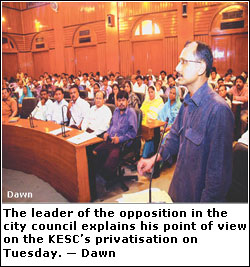 KARACHI, June 12: Treasury and opposition members of the City Council, who recently displayed rare unity in condemning the media restrictions, again sank their differences to pour scorn on the Karachi Electric Supply Corporation and adopted a unanimous resolution calling for the abrogation of the power utility’s privatisation agreement.
They demanded an immediate constitution of a judicial commission, comprising judges of the Supreme Court, with a brief to conduct an inquiry into the KESC’s controversial sell-off.
The resolution noted with concern that the ever-deepening power crisis affected every segment of society. It said the electricity crisis, which did not allow children to concentrate on their studies and government employees to discharge their duties with a peace of mind, also adversely affected the city’s economic progress.
The city council members held the KESC privatisation – and its new management – responsible for what looked like a never-ending crisis.
The council session was chaired by senior presiding officer Masood Mehmud in the absence of the convener of the house, Nasreen Jalil, who on Monday left for Canada on a private visit.
The senior presiding officer informed the house at the very outset that two important resolutions had been moved for debate. The one tabled by the treasury benches was about the power crisis and price-hike while the other submitted by the opposition benches called for the annulment of the KESC privatisation agreement.
Since both resolutions had considerable public importance, he insisted that the house adopt a unanimous resolution.
Initiating a debate on the issue of the power crisis, the leader of the house, Asif Siddiqui, and the leader of the opposition, Saeed Ghani, gave expression to public resentment over the failure of the KESC’s new management to honour its commitments consequent upon its privatisation.
They condemned the power utility’s apathy towards the sufferings of the citizens, saying that prolonged load-shedding and power breakdowns had caused untold suffering to the people of Karachi.
Mr Siddiqui, who is also leader of the Haq Parast Group, criticised price-hike, saying that an increase in the workers’ wages from Rs4,000 to Rs4,600 was not in proportion to the rise in prices of essential commodities. He called for an effective mechanism to control the prices at the union-council level by establishing utility services and appointing a magistrate in every union council.
Awam Dost Group leader Saeed Ghani assailed the KESC for mismanagement and what he described as its utter failure to solve the electricity problem in the city. He accused the power utility of indulging in lavish expenditures.
He said the opposition’s apprehensions about the KESC’s privatisation, which had earlier been dismissed by the government as exaggerated, were not misplaced.
PRICE-HIKE: The council also adopted a unanimous resolution on price-hike and urged the government to take measures to control the prices of essential commodities on an urgent basis. It demanded appointment of magistrates in each union council who should coordinate with the respective UC Nazim so that grievances of the citizens could be heard and attended to.
The resolution also called for the establishment of utility stores in each union council.
After the debate was over, senior presiding officer Masood Mehmood again insisted on adopting unanimous resolutions and suspended the session for 10 minutes so that the members could consider his suggestion.
When the house met again, opposition leaders Saeed Ghani and Ramzan Awan tabled an amendment to the main resolution which was unanimously adopted by the house members.
Later, the presiding officer adjourned the session till June 14.





























