



 0
0

Raipuri and the progressive literary movement
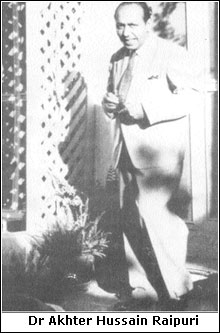 BORN on June 12, 1912, in Raipur, (Central Province), Dr Akhter Hussain Raipuri, the renowned progressive writer, critic, research scholar, translator and civil servant, got his early education at Raipur and graduated from Aligarh University.
Akhter Hussain Raipuri rose to prominence in 1935, aged only 23, when his critical essay ‘Adab Aur Zindagi’ got published in ‘Urdu’, a quarterly published by Anjuman Taraqqi-e-Urdu and edited by Baba-e-Urdu Moulvi Abdul Haq. ‘Adab Aur Zindagi’ pronounced the arrival of the progressive literary movement in India. The Progressive Writers’ Association, which took the literary scene by storm, was formed a year later. Akhter Sahib was among those who laid the philosophical foundations of the movement in India. Sajjad Zaheer, in his book ‘Raushnaai’, has acknowledged Akhter Hussain Raipuri as one of the pioneers of the progressive literary movement.
In 1935, Moulvi Abdul Haq invited Akhter Hussain Raipuri to join him in Hyderabad (Deccan) and assist him in compiling an English-Hindi dictionary and editing the quarterly ‘Urdu’. Akhter Sahib did join, albeit reluctantly, but the idea of the English-Hindi dictionary was shelved and he worked on an English-Urdu dictionary instead.
In 1936, Akhter Sahib married Hameeda, daughter of Zafar Umer Zubairi. Zubairi is the author of famous detective Urdu novels like ‘Neeli Chhatri’. The special thing about this wedding was that Baba-e-Urdu came along with the ‘baraat’, or the wedding entourage, and recited wedding songs on the occasion. Begum Hameeda Akhter Hussain Raipuri has given a vivid and delectable account of this wedding party in her captivating autobiography ‘Hamsafar’, or Fellow-traveller. The book has invaluable biographical material for researchers and gives intimate insights into the lives of the two great men.
Akhter Hussain Raipuri went to Sorbonne, the prestigious university in Paris, in 1937, to earn a doctorate in Sanskrit. Sorbonne conferred, in 1940, the doctoral degree on his dissertation written in French and titled ‘Life in ancient India as mirrored in Sanskrit literature’.
On returning home, he worked for All India Radio and M.A.O. College, Amritsar. He was selected for the education department by the Public Service Commission in 1945. After partition, he migrated to Pakistan and joined the education ministry where he worked till 1956 when he joined Unesco and served in Iran, France and Somalia. In the beginning, Akhter Hussain Raipuri wrote essays and short stories in Hindi and Urdu and was acknowledged as a good short story writer while he was still a student at Aligarh University. Though his approach was Marxist, in his stories he blended romanticism with realism. But he was never apologetic about these short stories. Once he wrote: “I am not ashamed of these romantic short stories before my progressive friends because romance too is a bitter fact of life.” Two collections of his short stories ‘Mahabbat Aur Nafrat’ and ‘Zindagi Ka Mela’ have been published. ‘Aag Aur Ansoo’ is a collection of his Hindi short stories. Akhter Hussain Raipuri’s short stories have been translated into many languages.
Akhter Hussain Raipuri translated into Urdu from almost every language he knew: Hindi, Sanskrit, Bengali, English and French. ‘Gorki Ki Aap Biti’ is translation of Maxim Gorki’s autobiography. ‘Payam-e-Shabab’ is an anthology of Qazi Nazr-ul-Islam’s poems translated from Bengali. The influence of these translations on modern Urdu poetry can be traced down to the poetry of Josh, Majaz and Makhdoom. From Sanskrit, he translated ‘Shakuntala’.
The collection of his critical essays, ‘Adab Aur Inqelab’, includes his signature essay ‘Adab Aur Zindagi’. His other critical work is ‘Raushan Meenaar’. Akhter Hussain Raipuri’s autobiography ‘Gard-e-Rah’ has recently been rendered into English.
Dr Akhter Hussain Raipuri died on June 2, 1992, in Karachi and was buried at Karachi’s society cemetery.
How safe are our vaccines?
A Canadian aid agency Friday last pledged $1.2 million (about Rs62m) grant for eradication of polio in Pakistan which had already contributed $3.5 million to our polio eradication campaign. But two recent events have raised a big question mark about the safety of vaccines being administered to infants and children across the country.
A week ago, the Pakistan Medical Association and the Saarc Medical Association had asked the health ministry to withdraw from the market a stock of Hepatitis B vaccine manufactured in a country in the Far East which is said to have claimed many lives in Bangladesh, Vietnam, Philippines and Russia.
An outright denial by the ministry the next day that any such suspect batch of Hepatitis B vaccine had been supplied to Pakistan, was hardly any consolation to the public.
Just before this incident, the safety of the polio vaccine was questioned in the Peshawar High Court where a member of the public had filed a writ petition claiming that polio drops contained substances that weakened the reproductive system besides causing some other diseases.
Although the Peshawar High Court had dismissed the petition — based on technical reports on polio drop samples conducted by a hitherto unheard of local facility called the National Control Laboratory — and ruled in favour of continuation of the polio vaccination drive in the country, the case has nevertheless drawn attention to the existence of anti-vaccination movements in other countries like Nigeria and even in the US itself, where there has been longstanding concern about the safety of polio and other vaccines being administered to American infants and children.
In Pakistan, objections to the polio vaccine — that they contain substances that could cause sterility — have usually been portrayed as the paranoia of some religious clerics who believe that WHO’s polio eradication programme is a plot by westerners to depopulate Pakistan.
However, Pakistani clerics are apparently not the only ones who harbour this conspiracy theory. As was told to the Peshawar High Court, an anti-polio campaign in Nigeria, the most populous country in Africa, had resulted in a boycott of the vaccination in 2003 which reportedly resumed many months later only after WHO apparently agreed to the condition that the polio vaccine administered in Nigeria would be manufactured in Indonesia and nowhere else.
Other countries where WHO’s vaccines have reportedly also been found suspect are Mexico, Nicaragua and the Philippines. In these countries, tetanus vaccines were alleged to contain substances that could cause miscarriage and sterilisation. There are countless books, reports and websites that purport to document the intentional (as well as non-intentional) contamination of vaccines with disease-causing viruses and the alleged relation of these vaccines to diseases like AIDS and cancer.
Conspiracy theories aside, it is an established fact that serious concern about the safety of vaccines, particularly about the presence of thimerosal (a mercury-based preservative used in vaccines), exist in the US itself, where anti-vaccination organisations have been trying to educate and inform the public about the risks associated with vaccinations.
While adverse reactions to vaccines in general has been a concern in the US since the 1980s, the dangers of mercury poisoning from vaccines was first raised in the US Congress in 1999 when an investigation was initiated into this problem. Countless studies and reports have emerged in the US about the presence of toxic substances like mercury (a neurotoxin), formaldehyde (a known carcinogen) and aluminium in vaccines like polio, Hepatitis B, DPT and MMR.
These toxic substances have been linked to sharply rising incidences of autism (a neurological disorder) in American children as well as other diseases including Sudden Infant Death Syndrome, allergies/asthma, leukemia (especially leukemia in infants and children), lymphoma, cancer, tumours and other diseases.
Eventually in 2003, the US Congress investigation report specifically identified thimerosal in childhood vaccines as the cause for the huge jump in the cases of autism and other related neurodevelopmental disorders in the US, where some 30 over childhood vaccinations are mandatory, most of them made mandatory during the 1980s.
The result of this campaign on the safety of vaccines is that today vaccines in the US are supposed to contain no trace of thimerosal. Besides, oral (live) form of the polio vaccine (OPV), which some studies found to be directly responsible for the majority of new polio cases in the US as well as the major increase in childhood leukemia, was removed from the US market in January 2000, it being replaced by the inactivated and killed polio virus vaccine (IPV). Said to be a less potent vaccine than OPV and a very costly injection, IPV apparently does not contain thimerosal.
As for the Hepatitis B vaccine, it was recommended for newborns in the US in the second half of the 1990s and made mandatory in 2000 for infants aged two months, but concern has been raised about the thousands of averse reactions to the vaccine with hundreds of deaths which have been reported in the country since the vaccine was made mandatory (figures which some claim are only the tip of the iceberg).
Why are vaccines being introduced in the US one after the other when the risks apparently far outweigh the benefits? Why are the defects in the vaccines and their adverse reactions not usually reported well in time? Some writers have termed this phenomenon a corrupt public policy stemming from financial conflict of interests and scientific fraud involving the drug manufacturers, the disease control centres as well as the food and drug authorities.
The question that we in Pakistan should ask is: Are the vaccines being supplied to Pakistan and being administered to our infants and children free from anti-fertility substances as well as from toxic substances (like mercury) and unwanted contaminant viruses (like SV40) that cause cancer, HIV, etc.?
Also, why are we and many other developing countries still being given the apparently less safe OPV when this form, which is capable of causing, though rarely, paralytic polio, has already been removed from the market in the US? (The official argument being given for continuation of OPV in developing countries like Pakistan is its low cost, ease of administration and superior capacity to provide the population immunity.)
As for the Hepatitis B vaccine in Pakistan, although our ministry of health has claimed that they are not suspect, organizations like the PMA and the SMA have a moral and ethical duty to continue to pursue this case to ensure that the Hepatitis B vaccines, as well as all other vaccines, supplied to us are really safe for the public.
While vaccinations have certainly saved many Pakistanis from the sufferings of several diseases like smallpox and polio, a key part of our vaccination programme should be to do everything possible to ensure that the vaccines are as safe as possible and that adverse reactions are fully disclosed. The total number of confirmed polio cases in Pakistan dropped from thousands in the 1980s to 558 in 1999, 98 in 2002, 40 in 2006 and eight so far this year, but do we know for sure that these handful of new polio cases have not contracted polio from the polio vaccination itself? Have we ever studied the possible correlation of this vaccine with rising infant and childhood diseases, like for instance lymphoma, leukemia and other forms of cancer or with infertility problems?
Whether or not drug manufacturers and promoters of vaccines like WHO and other foreign aid agencies have a hidden or secret agenda, on our part we should build up our capacity to conduct tests that would reveal whether the vaccines supplied to us contain unwanted contaminants. Our scientists and researchers can also be encouraged to engage in studies to find out whether these vaccines cause other diseases.
| © DAWN Group of Newspapers, 2007 |


























