0
0

 THE total geographical area of our country is 80 million hectares or 197 million acres, with a very good canal irrigated system of about 62,400 km long and mainly confined to the Indus plain covering an area of 19.43 million hectares (48 million acres). The salt- affected soil is mainly situated in this plain.
Of the total, about 6.30 million hectares are salt-affected. The magnitude of the problem can be gauged from the fact that the area of productive land was being damaged by salinity at a rate of about 40,000 hectares annually.
It is estimated that out of 1.89 million hectares saline patches, 0.45 million hectares exist in Punjab, 0.94 million hectares in Sindh and 0.5 million hectares in NWFP. Out of 19.3 mha area available for farming, irrigated agriculture is practised on about 16 mha. Irrigation water is mainly supplied through canal system arranged through dams. Intensive and continuous use of surface irrigation has altered the hydrological balance of irrigated areas, especially the Indus basin. The substantial rise in water table has caused salinity and water logging in large areas of Sindh, Punjab, NWFP and Balochistan.
The country is located in arid and semi-arid climatic zones. Generally high evapo-transpiration in semi-arid and arid zones is the basic cause for salt accumulation on soil surface. The average summer temperature is 40°C and the minimum winter temperature remains between 2°C to 5°C. The annual rainfall varies between 100 mm to 700 mm throughout the country. The evaporation rate is generally very high and exceeds that of precipitation. Thus, the insufficient rainfall followed by high evaporative demand and shallow ground water depth, enhances the movement of salts towards soil surface.
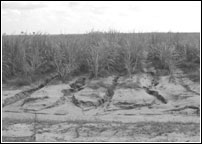
Salinity is a serious problem affecting irrigated agriculture. Improper irrigation practices and lack of drainage have generally led to accumulation of salts in soil in concentrations, which are harmful for the crops. There is a major imbalance in the amount of salt entering and leaving the soil. Each year about 120 million tons of salts are added to the land in canal water and brackish underground water. Only about 1/5th of this salt finds its way to the sea. The remaining accumulates in the soil, it continues to reduce the growth and survival of crops.
Salts exert general and specific affects on plants which directly influence crop growth and yield, and also affect certain soil physio-chemical properties which, in turn, affect the suitability of the soil as a medium for plant growth. The major effect of salts on plants is that it reduce plants growth rate. Chloride, sodium and boron may exert specific toxicity effects on susceptible crops, especially woody perennials. Plants vary in their tolerances to salts and many are sufficiently tolerant, especially after seedling establishment, to produce well when irrigated with saline waters, especially typical drainage waters, provided appropriate cultural management practices are followed.
The soils with electrical conductivity less than 4 dSm-1 are considered salts free, where all crops can be grown. As salt concentration increases, the choice becomes limited and one has to go for tolerant plants suited for specific conditions.
There is usually no single way to achieve salinity control in irrigated lands and associated waters. Many different approaches and practices can be combined into satisfactory control systems. The appropriate combination depends upon economic, climatic, social, as well as edaphic and hydro-geologic situations.
The leaching of salts through irrigation however, requires extreme care as this should not add to underground water table. Tube wells are generally sunk to get rid of such shallow water tables without which leaching may not be advisable. The upward movements of saline water from shallow water tables can cause salt build up in the plant root zone. A water table should be at least 41/2 to five feet below the surface during most of the crop growing season.
Green manure through leguminous crops and application of farm yard manure not only provide organic matter and other nutrient, but also make the soil porous for aeration and moisture absorption and enhance soil micro-organisms, thus improving the overall condition of the soil. Similarly replacement of sodium-ions by calcium using gypsum helps in mitigating the adverse conditions.
Modern research has identified more than 1500 plant species that have high levels of tolerance to saline soils, these are called halophytes. Some of these are able to withstand salt concentrations in excess of those found in sea-water. These plants (trees, shrubs and salt tolerant grasses and herbs) are a major resource that can be used in the development of agricultural systems for salt-affected soils. In addition, there are opportunities to increase salt tolerance of existing crops using conventional plant breeding and molecular biological approaches.
Beside several efforts success rate is least due to number of constraints. Output obtained is much less as compared to time and money exhausted. So there is a need to pioneer cost effective and farmer friendly strategies. If the plant survives the shock at seeding/ transplanting stage, the chances of its subsequent survival and growth are likely to be increased. Since less germination rate and reduced plant population is a major setback under saline conditions, so improving seed emergence is the only cure to the problem.
Pre-sowing seed treatment or seed priming is best fit in this scenario. Seed priming is a controlled hydration process followed by re-drying that allows pre-germination metabolic activities, to proceed rapidly. Generally priming improves the rate and uniformity of seedling emergence and growth particularly under saline conditions. The effectiveness of various priming agents differs under different stresses as well as in different crop species.
Seed priming is an easy low cost and low risk technique and an alternative approach recently used to overcome agriculture salinity problems. It can be effectively used for a number of crops like wheat, maize, rice, tomato, sunflower, parsley, pearl millet, cotton, beans, peas, carrot, lettuce and onion.
Interaction between salinity, soil water and climatic conditions change the plant’s ability to tolerate salinity. A basic understanding of the interaction between salinity and environment is necessary for an accurate assessment of salt tolerance in crops. In addition to precipitation, atmospheric humidity and temperature can markedly influence salt tolerating capability of crops.
The rapidly growing demand for increased food, fibre and fuel in the presence of rapidly declining availability of agricultural land use due to increased soil salinity make it imperative that crop production under saline conditions be significantly improved. Now the importance of seed priming techniques goes without saying as well as the application of seed priming techniques to almost all agricultural crops is easy, feasible and cost effective maximising output to the farmer. So there is dire need to boast up research activities involving various crops and priming agents under both laboratory and field conditions. This will help to get rid of such turmoil salinity situation and will reduce our dependence for wheat and cereals on foreign countries.