



 0
0

 In the recent decades, tourism has become a primary economic activity for many countries and it is considered as a major source of employment, household income, a source of foreign exchange and a revenue earner for national and local governments.
Pakistan has many tourist attractions. There are few places on earth that possess the majesty and grandeur of its northern region. Northern Pakistan remains a land of contrasts, unique in its legacy of a landlocked civilization and blessed as few other destinations with an amazing array of some of most beautiful valleys, lakes, rivers and mountains.
Here, four of the world’s most formidable mountain ranges meet; namely the Karakoram, Hindukush, Himalayas, and Pamirs. Nanga Parbat at 8,126 meters – among the highest ranges.
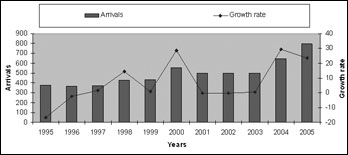
The government is actively involved in the development of tourism, by capitalising on the country’s unique scenic diversity, Tourist whose numbers were only around 0.378 million in 1995, exceeded 0.648 million in 2005.
The graph given here shows tourists’ arrivals and their increasing numbers during the period 1995-2005 Tourism receipts for the period increased from $114.1 million to $185.3 million, respectively.
The success of the industry originates from the second five-year development plan--1960–65--when the government provided numerous fiscal and other incentives to attract local capital and foreign investment in the tourist industry, Both the government and the people, generally view tourism favourably as a source of employment, and economic growth.
Pakistan makes a positive impression on tourists as a busy, well-organised place offering a view of ethnic and cultural diversity. Receipts from the main tourist-generating countries in 2005 were United Kingdom (57.7 per cent), USA (28.22 per cent), India (16.15 per cent), China (6.87 per cent), Germany (5.74 per cent) and Japan (3.28 per cent).
These earnings represented 0.2 per cent of GNP in 2004 and 2005. Most of the tourist hotels built are locally financed and are run by local managements. In cases where foreigners are involved, such hotels are owned as joint ventures with local shareholders; hence not all profits are remitted abroad. Outflows of foreign currency are in the form of debt repayment and overseas promotional expenses. To promote tourism, numerous fiscal and other incentives have been offered.




























