



 0
0

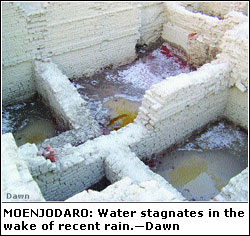 LARKANA, March 12: Rain not only created havoc in the lives of people; damaged the standing crop especially in interior of Sindh, but has also badly damaged our national heritage — the invaluable relics and structure of the historic site of Mohenjodaro.
A naked eye can see trails which the recent rain had left in the DK-south and DK-north areas. The fissures created in the main platform of stupa were evidently visible on Monday when this scribe visited the area.
Yet, the people of the department concerned were sure that the spoils were not very severe as the rainwater had been sucked out from the rooms of the relic — again negating the reality which the scribe substantiates through the images he had made of.
Denial of the curator that no big damage has been done reflects poorly on his aesthetic and national insight. Whether he is pushed by ignorance or was trying to cover up the inefficiencies is a question of national importance.
The archaeology department had covered the area (consisting of historic relics) with tin sheets to protect it from sun, wind and rain. Unfortunately, they could not keep a track of how those sheets fared — over the period of time did these sustain the exposure of changing weathers?
Result, holes in sheets making the water trickle down to the last bit of earth creating fissures and making gullies on this portion of the site.
Another sore point is improper drainage arrangements because of which water did not only accumulate in the rooms but finding no outlet is furthering the already leaning walls which are in majority.
The `Great Bath’ is now a reverse of its name — courtesy to the apathy of `great bosses’ and `unpleasant’ otherwise a pleasant season.
The water could be found standing in rooms. The concerned people did try to control the damage but what to say of upward movement of salts which results from rainwater. The salts would move upward through capillary action in walls which would ensue into a damaged structure, said the sources.
Much to the chagrin of the sources, the underground water level which should have been 12 feet has gone up to 15 feet, again a dangerous sign for the site.
At some points in the relics the water-table has risen by seven and three feet. Rain effects will come out in the shape of salt reaction and whitish coating on, and at the bases of walls, sources concluded.
DELEGATION: A 34-member delegation taking part in naval exercises ‘Amn 07’ arrived at Mohenjodaro on Monday in the lead of Commander Yakoob.
They belong to 17 countries who are participating in the exercises in the Arabian Sea.
The teams are from the US, the UK, Bangladesh, Philippines, Malaysia, China, France, Sudan, Turkey, Sri Lanka, Yemen and others. They went round the old city of Indus Civilisation and visited the museum.




























