0
0

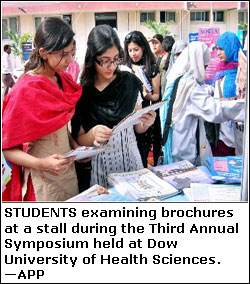 KARACHI, Feb 24: The third annual international symposium of the Dow University of Health Science (DHUS) began on Saturday with the resolution that government should ensure development of environmental health professionals, in addition to judicious use of finite natural resources.
During deliberations, national and foreign experts noted that the increasing rate of environmental pollution demanded proper management of contaminants, otherwise environmental health and human safety conditions would worsen significantly in the years to come, causing huge losses in economic productivity.
The four-day symposium, organised on the theme “Environment Pollution: a Silent Killer”, was inaugurated by Federal Health Secretary, Anwar Mahmood, at Moin Auditorium of DUHS. The speakers of scientific sessions and plenary sessions were from abroad and within the country. According to recommendations framed for the government at the inaugural session, which were read out by Karen Salama, a PhD holder, from France, it was suggested that efforts be made for the promotion of research and development with particular reference to preventive health care.
Towards the generation of data on environment, the forum suggested, establishment of a technical expert committee on environmental health at DHUS with the mandate for evaluating research and training needs in the environmental health, to guide medical and nursing graduates and to promote their interest in environmental health and to establish useful productive links with other postgraduate institutions for exchange of technical expertise and collaborative research and training in environment health.
The moot also called for use of natural resources in a judicious manner so that future generations can also share. For this purpose, beneficial waste recovery and recycling technology be developed for sustainable use of natural resources.
Mr Mahmood was of the view that in a situation when today’s unbridled world of consumers was causing havoc in the environment, there was a great need to adopt measures to overcome environment pollution. In addition to preventions, creation of awareness is also needed.
Referring to the government’s efforts, the secretary said that the environment was receiving due attention in the government’s policies as it was committed to the environment’s protection. He said the government was spending more than Rs12 billion on various national preventive health programmes. He also called for segregation of irrelevant and unnecessary subjects and topics from medical education curricula and inclusion of contents pertaining to environmental health. Environmental strategies were important aspects of public health and those should be taken well at all level, he added.
Vice-Chancellor of DUHS, Prof Masood Hameed Khan, said that the importance of environmental viability was undeniable for the health of a nation and relevant issues should be addressed at every level by the government and the private sector.
He also apprised the audience about various high profile teaching, training and research activities undertaken at DUHS after its inception in 2004 and said the country’s first genome centre was being established at the university.
In a special lecture on “Implementing clear air laws”, Dr Karen Slama focussed on involuntary exposure to tobacco and resolved that global tobacco control should be a top public health priority. “Any immediate implementation of comprehensive tobacco control programmes can work in both high and low-income countries”, she added, saying that any delay can prolong tobacco epidemic needlessly and result in thousands and millions of preventable deaths.
For success in enacting clean air (smoke free) laws, she emphasised on gathering of scientific evidence to inform policy-makers and the public of the adverse effects of exposure to second-hand smoke. Foresee and weaken opposition, involve all concerned parties for common goals and have a consistent communication campaign about health rights, she suggested were the keys towards elimination of tobacco smoke, a toxic air contaminant.
An HEC visiting professor at the University of Karachi, Dr M Altaf Khan, discussed different environmental issues confronted by developing countries, including Pakistan and held that those were not only damaging the lives of people, including children, gradually, but also were depriving the countries of their economic activities, including export of fishery and other items. According to him the top environmental health issues of developing countries included poor water supply and sanitation, both in urban and rural set up, air pollution, largely in urban centres, inadequate management of solid and other hazardous waste, specially in urban centres, industrial waste and agriculture related waste, including pesticides and fertilizers.
Dr Zaman Shaikh, the chairman of symposium committee, Dr Salman Matiullah also spoke at the inaugural session.
The speakers of scientific sessions held during the day included Dr A Ghaffar Billo, Professors Wasim Jaffery, Zeenat Isani, D S Akram and Irshad Waheed, Drs Jawaid Alam, Tahir Shamsi and Dr Sultan A Paradhan of India.