



 0
0

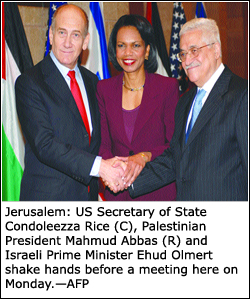 JERUSALEM, Feb 19: Talks between US Secretary of State Condoleezza Rice and the Israeli and Palestinian leaders, initially billed as a new US push to restart peace efforts, ended on Monday with little progress other than a commitment to meet again.
In a 90-second statement following the two-hour meeting, Ms Rice said that the two sides exchanged views of the political future and agreed to hold another summit.
Neither Palestinian President Mahmoud Abbas nor Israeli Prime Minister Ehud Olmert joined Rice as she delivered her statement, and she left the room without taking questions from reporters. Israeli and Palestinian officials were not immediately available for comment.
The meeting was beset by low expectations amid US and Israeli dissatisfaction with a Palestinian power-sharing deal. It got off to a lacklustre start, with Rice, Abbas and Olmert clasping hands together and flashing polite smiles for the cameras in an unadorned hotel conference room.
The three met without any aides, except for Ms Rice's Arabic interpreter, officials said. After about an hour, they moved to Rice's suite overlooking Al Quds's Old City, continuing talks for another hour in a more comfortable setting.
The three leaders reaffirmed their commitment to the internationally-backed “road map” peace plan and agreed that a solution to the conflict would not be “born of violence,” Ms Rice said.
“The president and prime minister agreed that they would meet together again soon. They reiterated their desire for American participation and leadership to overcome obstacles, rally regional and international support and move forward toward peace. In that vein, I expect to return to the region soon,” Ms Rice said after the meeting.
Mr Olmert was to meet with members of his Kadima party later on Monday to discuss the talks.
Ms Rice reported no progress in restarting final-status talks, the ostensible purpose of the meeting when it was announced last month. Expectations for the talks plummeted last week after Mr Abbas and the Islamic Hamas group, which controls the Palestinian parliament, agreed to a power-sharing deal that fell short of meeting international demands.
The coalition deal, forged earlier this month in Saudi Arabia, only pledges to “respect” past peace agreements.
State Department spokesman Sean McCormack said the first third of Monday's meeting focused on the unity deal.
Ms Rice told US journalists on Sunday night that Washington would “withhold judgment” on the coalition agreement until it was fleshed out. But she acknowledged that the outlines didn't meet the international conditions put forth by the Quartet of Middle East negotiators -- the US, European Union, UN and Russia.
“If there's going to be a Palestinian state, then the Quartet principles would obviously have to be recognized because ... this is the foundation for peace,” she said.
“I haven't seen anything to date that suggests that this is a government that's going to meet the Quartet's principles, but you know...we will see once the government is formed,” she said.
Mr Abbas has said that this is the best deal he could wrest from Hamas, and that he would move ahead with forming a coalition. The power-sharing deal is seen as crucial to halting deadly Hamas-Fatah fighting that has killed dozens in recent months.
Hamas spokesman Ismail Radwan called Monday's summit a failure. “Rice did not succeed in pressuring President Abbas to withdraw from the unity government. We call on the US administration to respect the Palestinian people's will and recognise the government and open a dialogue with the government,” he said.
Mr Olmert, who met separately with Ms Rice on Sunday, said Israel would not deal with a government that doesn't recognise the Quartet principles. But on Monday, his spokeswoman, Miri Eisin, repeated the prime minister's position that Israel would continue to deal with Abbas directly.
She acknowledged that expectations of the summit had been lowered, but said the meeting was significant because Olmert and Abbas, who rarely speak face to face, were “sitting and having dialogue”.
Before the meeting, Rice said it was important for the summit participants to discuss the outlines of a Palestinian state and how to get there. However, she told journalists that she did not expect things to move along quickly in times she described as “complicated” by the Palestinian coalition talks.—AP





























