



 0
0

 FIVE years after its incorporation, it was announced that operations of the National Commodity Exchange will start from February 7. This did not happen and a new date is awaited. for starting its three-month gold futures initially. Other commodities including rice, sugar, wheat, crude palm oil and cotton yarn will be added in the trading hopefully be the end of the current year..
The exchange was incorporated on April 20, 2002 and was expected to be operational in six months. Delays occurred because of lack of proper software, human resource, risk management, regulatory and legal issues. Added to these were problems relating to its building and share holding distribution to and within the country’s three stock exchanges.
NCEL director Ghani Usman says an 80 per cent majority of the board has agreed on 15 per cent shares for the KSE, 7.5 per cent each for LSE and the ISE but the LSE has not agreed on this and instead asked for 10 per cent. The NCEL board has given LSE few more days to agree on 7.5 per cent.
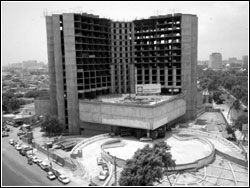
According to Ghani Usman, the government did not handle the NCEL building issue properly. The NCEL management purchased the Heyaat Regency building in 2003 worth Rs530 million from the Privatisation Commission. Some legal issue regarding transfer of the building could not be sorted out. The building was to house the NCEL offices.
Currently, the exchange has a paid-up capital of Rs50 million and has raised the capital y issuing licenses to 283 members at one Rs1 million each. Since the exchange will be a demutualised entity, its shareholding has been distributed as follows: the Karachi Stock Exchange 40 per cent, the Lahore Stock Exchange 20 per cent and the Islamabad Sock Exchange 20 per cent. . In addition, Kuwait Investment Bank and the Agriculture Development Bank of Pakistan share equally the rest 20 per cent of shares.
The SECP has prescribed that cumulative holding of all these three exchanges should not exceed 30 per cent of the total paid-up capital and for individual exchanges it is not more than 15 per cent. It means all the three exchanges were required to disinvest their holdings to bring their cumulative holding to 30 per cent from the current 80 per cent.
The distribution of shareholding to other professional organisations, it is stated, will bring transparency and professionalism in the exchange. The commodity exchange can help bring much of the informal gold imports into the official trading and if the government provides some incentives in form of taxes, it will result in increased trading volume through official means.
In the last five years, gold prices have seen a phenomenal rise in the international markets and local investors missed the opportunity to enjoy the benefits of that bull run. Gold out performed all the major currencies of the world and also outperformed world’s major stock indices. It remained focal point of international funds to hedge against rising inflation but absence of a commodity exchange deprived local investors from this avenue for investment.
Trading in commodity exchange will be beneficial to the economy when future trading will start in agriculture items. It is very important to protect growers from wild fluctuations in the prices. The most beneficial tool, in this regard, will be hedging in agricultural commodities.,It will hedge growers against any risk of low output, sudden and bad climatic conditions.. The availability of futures will transmit direct price signals to growers and they will become aware of the real worth of their produce and will not let middleman to take any undue advantage.
Future trading in sugar will remove uncertainties that have been prevailing in its prices since last couple of years. Millers will judge by the trading prices in the commodity exchange that what margins they will have in the days to come so that they can have an estimate of the prices at which they should procure the sugar cane, so that risk can be avoided while maintaining margins, and this will be achieved by using hedging as a tool in the commodity.
It is expected to create uniformity throughout the chain from grower to miller and then to end consumer and also avoid occurrence of disputes that were observed in previous months in which millers were not ready to buy sugar cane from growers due to prevailing low sugar prices despite promises from the government about maintaining floor prices of this commodity. However, in future, if sugar cane will be put on the board, it will directly help growers and will ensure fair prices.
The commodity exchange will also serve as a platform where textile manufacturers will be able to ensure competitive prices for their exports by hedging themselves against any short fall in cotton output and hike in its prices. Farmers will also benefit as they will be able to get fair prices.
Other commodities like rice, wheat and crude palm oil will also be efficiently priced as a result of their trading in the commodity exchange and benefit will pass on to the grower. Pakistan’s rice exports exceeded $1 billion and thus are one of the major sources of foreign exchange earnings. However in some cases, exporters faced problems due to export of same quality rice at low prices by China. The exchange will create awareness among the exporters about reasonable pricing according to international trends and will thus keep them competitive with other countries. For the commodities traded, the government will not have to intervene to ensure sufficient income to growers. On the other hand, market based methods of risk management will do this job. by reducing the risk of high international price volatility on domestic market.
The exchange could also serve as a platform for local and foreign market participants in accordance with international practices by ensuring transparency and professionalism. In the short span of four years, the National Commodity and Derivative Exchange of India now facilitates trading in 57 commodities to its members at more than 550 centres.





























