



 0
0

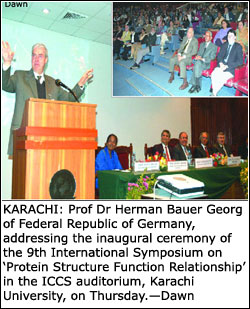 KARACHI, Jan 11: Two new engineering and technology universities set up in collaboration with the technologically advanced countries, France and Sweden, would go operational this year, Dr Attaur Rehman, chairman of the Higher Education Commission, said here on Thursday.
Talking to newsmen after the inauguration ceremony of an international symposium on “Protein Structure Function Relationship” at the International Centre for Chemical and Biological Sciences, University of Karachi, the HEC chief said that process of admissions to the University of Engineering, Science and Technology, being set up in Karachi, would start in two-three months while teaching in October this year.
The work for the establishment of the university had been kicked off a few months back after Prime Minister Shaukat Aziz laid foundation of the project at the Marine Academy Building, near PAF Base Masroor.
The key faculty and administrative positions, including those of rector and examination chief, at the proposed university will be held by French professors and the successful graduates will be awarded degrees of a French university, said Dr Atta, adding that the initial enrolments at the university for bachelor, masters and PhD degrees would be around 150.
He further said that a similar university, originally planned to be set up in Sialkot in collaboration with Sweden’s Royal Institute of Technology, would temporarily be made functional in Lahore until the time a permanent campus with teaching and training facilities was readied.
He said that government had planned to establish more universities in different cities of Pakistan in collaboration with technologically advanced countries. The international organisations and consortiums will be providing technical and human resource support, like course content, university management, staff and quality control mechanism, he added.
Replying to a question, Dr Atta expressed the view that the state of both Natural and Social Sciences teaching in the country was not up to the mark, but the HEC had already initiated measures to address the problem. He said that for an improvement in the Social Sciences discipline, the HEC was providing 30 per cent foreign scholarships to students and members of the relevant faculty. He hoped that foreign-educated students and teachers would prove their worth towards the up-gradation of Social Sciences education.
He said that the problem of illegal universities, functioning in the country in the past, had almost been eliminated while some of the institutions imparting substandard education in the private sector had also started taking remedial measures in line with the requirements of the HEC and the federal government. The deadline for showing improvement had been extended by the federal government to June 30, 2008, after which the failed institutions would have to wind up their business, he remarked.
Earlier, speaking as chief guest at the inaugural session of the symposium, Dr Atta, highlighted the goals and objectives of the HEC, and mentioned that he was optimistic about the future of science and technology as well as the other fields of higher education and human resources development in line with the set standards.
He said that scientists at the HEJ Research Institute of Chemistry, KU, had worked hard also in the filed of protein chemistry and some of its faculty members were surely contributing towards developing keen and energetic groups of young scientists.
He said that the symposium had brought together the leading figures of protein chemistry at forum which could lead to a global partnership for common benefits of humanity.
Dr Pirzada Qasim, KU Vice-Chancellor, said that his university had the strength of about 25,000 students studying in 58 different departments while the university enjoyed foreign collaborations in the fields of Science and Research with 23 countries.
More than 200 delegates from abroad and within the country are expected to make presentations at the four-day symposium, which would be followed by a workshop on characterisation of proteins. The foreign delegates have come from USA, UK, Germany, Sudan, Australia, Denmark, Iran, Hungary and France.
Dr Herman Bauer from Germany, Dr S Samar Hasnain from UK, Dr Roger Fourme from France, Dr Iqbal Choudhary, Prof Atiya Abbasi, also spoke on the occasion.






























