0
0

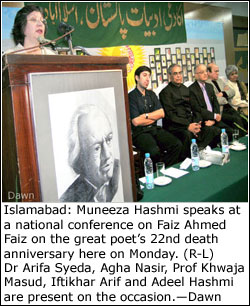 ISLAMABAD, Nov 20: Senior broadcaster Agha Nasir is arranging a new anthology of Faiz’s poetry, aligning his verses with the turn of events in the country.
“It is possible to reconstruct the history of Pakistan in Faiz’s poetry,” he said disclosing his plan at a literary meeting convened at the Pakistan Academy of Letters (PAL) on Monday to observe the 22nd death anniversary of Faiz Ahmad Faiz, easily the most influential and revered Urdu poet after Allama Iqbal in recent times.
His book will have 16 sections, each catching the poet in a distinct mood. The compiler intends to name the anthology Ham Jeete Jee Masroof Rahe (I remained ever busy in life).
“Faiz wrote many things at different periods of history. It is possible to find many events reflected in his poetry,” he said. The book would be his tribute to the man he had shared many events with.
“I promised to do such a book in his lifetime but could not. Now I must do it to inform the young generation about the poet as well as the circumstances which made him write great poetry,” he explained.
A large audience had gathered at the PAL auditorium to pay tributes to the great poet of love as well as revolution.
Speakers recalled the revolutionary nature of Faiz’s poetry and his love for humanity.
Prof Khwaja Masud, who chaired the memorial meeting, observed that Faiz believed that truth has to fight to survive against falsehood. This propelled the poet to align himself with the forces of liberation, peace and progress.
“Yet Faiz also found time to speak about the moon and the beauty glimmering in the pretty face of a woman,” he said.
National Commission on Status of Women’s chairperson Dr Arifa Syed said, Faiz walked in the company of the courageous persons who kept their head high, despite heavy odds. “This is what I inherited from Faiz,” she said.
Dr Arifa said when she was studying at Hawaii, Faiz suddenly came there for a visit. “I enjoyed his company for about a month forgetting the tutorials and daily tests and from him I learnt the lesson that things happen to those who dared to experiment and research.”
Faiz’s younger daughter Moneeza Hashmi described the great poet’s last day. It was a day of rejoicing in the family. Guests waited for the chief guest who for no reason had gone to his Sialkot village.
“When he arrived he told me he was tired and would like a cup of tea. Then he asked his grandson to accompany him to his house which was a furlong away. Thereafter he was rushed to the hospital to die the next morning,” she recalled with tear in her eyes.
That was her last meeting with her father. It was in the month of November that she was married and it was in this month that she lost her “greatest companion”. But she would wait for February, the season of flowers and spring and her papa’s birthday.
Adeel Hashmi, grandson of Faiz, described the small pleasures that he shared with his grandfather who wondered why people considered him a great man.
Adeel said the letter he wrote from jail to his grandmother Alys — asking her to be patient for ‘a few days more, my love, however long it might be, it is just a few days more’ — as a great message of hope for humanity.
PAL chief Iftikhar Arif paid the greatest tribute to the poet when he said the world honoured Urdu language as well as Faiz’s country, Pakistan, “because of the magnificence of this man’s poetry”.