



 0
0

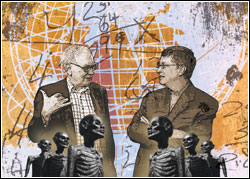 AN extraordinary event took place in New York last month when Warren Buffett pledged to donate the bulk of his estimated $44 billion fortune to the charitable foundation created by the only man richer than himself, Bill Gates.
This landmark event has been celebrated in both investment and philanthropic circles as having changed the environment and purpose of money-making and money-giving in capitalist economies.
While Wall Street is still reeling with the scandals of Enron, WorldCom, Tyco and other corporate entities, the news about two of the richest tycoons joining hands to attack some of the world’s most intractable problems such as poverty, disease, environment and human resource development, is unlikely to convince many that the capitalist leopard has begun to change its spots.
Mr Buffett’s donation to the Gates Foundation of $30 billion, to be disbursed in annual installments of about $1.5 billion, along with the $6 billion he gave to the foundations for his late wife and each of his three children, is the largest philanthropic donation in history , worth some $37 billion dwarfing those of the two earlier giants of American philanthropy, John D. Rockefeller and Andrew Carnegie, who gave away only $7.6 billion and $4.1 billion respectively, measured in 2006 dollars.
With Buffet’s gift, the Gates Foundation will eventually be able to count on assets of around $60 billion, making it by far the world’s biggest charitable foundation, surpassing that established by the Swedish furniture giant IKEA.
Although the Buffet-Gates partnership in philanthropy is without precedent in terms of scale, enabling the foundation to double its annual giving to around $3 billion, its real significance is more symbolic and paradigmatic.
The importance of the new initiative lies not in its direct impact on humanitarian causes, but on the demonstration effect it will have on other newly rich people in the U.S. and other countries.
It could become the precursor of a second “golden age of philanthropy” that would far surpass that of Carnegie and Rockefeller, which had inspired many other industrial tycoons to establish foundations in their names. Already, the Gates initiative has inspired a growing number of new billionaires, including the generation of technology tycoons, such as the founders of eBay and Google, as well as of Infosys and Wipro in India.
Its significance also lies in the departure from tradition of gifting the bulk of the wealth to a foundation established to celebrate the donor’s family name,(even though Mr Buffet has not been oblivious to that ritual either), choosing instead to enlarge the resources of a foundation whose work he admires and thereby saving the overheads that would have cut back into his donation. Even more significant is the choice of the foundation he opted for.
Although himself an “old economy” investor, Buffet has chosen to “outsource” it to Gates’s “new economy” philanthropy. While Carnegie and Rockefeller were pioneers in bricks-and-mortar philanthropy, giving large sums of money to building institutions such as libraries and universities, the prototype, post-modern Bill and Melinda Gates Foundation more closely resembles a 21st-century software company than a typical 20th-century industrial complex.
The Gates Foundation has attempted to create a different style of foundation, following a strategy of intervention and networks, rather than through an extensive bureaucracy involved in examining and approving unconnected projects.
Nonetheless, the Gates Foundation has also been accused of promoting Microsoft’s strategic interests, such as the grant of $100 million to fight AIDS in India, where his company has been involved in the development of information technology and where AIDS is also perceived as a direct threat to the workers in this new industry.
Another criticism against the Gates’ Foundation’s activities is that while it claims to champion research on health issues of direct concern to developing countries such as malaria, tuberculosis and HIV_AIDS, its parent company Microsoft’s active espousal of the World Trade Organisation’s trade-related intellectual property rights (TRIPS), “the rule which helps Gates rule”, also bars African governments from buying AIDS, malaria and tuberculosis medicine at cheap market prices.
The Buffet-Gates contribution to philanthropy needs to be put into perspective. In 2004, the total amount of funds given in philanthropy in the US (the world’s largest philanthropic country) was $248.52 billion, three fourths of which came from living individuals, the majority (60 per cent) of which is given to religious charities.
The share of private foundations was only 11.6 per cent(or about $30 billion) in the total amount given for charitable purposes in the US in 2004, making the Buffet-Gates annual giving about 10 percent of the private foundation’s funds for philanthropy and just one per cent of total US funds.
To contextualise the role of philanthropy in alleviating poverty and promoting human welfare, we, therefore, need to recognize some important underlying features. First, that the largest share of America’s charitable contributions, not unlike many other countries including Pakistan, goes to the sustenance of religious groups – for their facilities, their operating costs, and their clergy salaries.
According to a recent research undertaken by US academics, the remainder of Americans’ contributions likewise seem not to serve the less fortunate. Social welfare groups receive only two per cent of charitable dollars and human services only nine per cent. A larger amount goes to education, health, and science (13 percent), which is potentially redis- tributive but not obviously so. If we look simply at the distribution of individuals’ charitable donations, the bulk does not seem to flow from haves to have-nots.
An authoritative researcher similarly concludes that “relatively few non-profit institutions serve the poor as a primary clientele.” Even if one takes a more charitable view of the work of private foundations, it can at best be characterised as “modestly redistributive”. Even so, their effect would not change the aggregate picture of philanthropy towards redistribution in view of their small share of giving in the United States.
A more fundamental issue with philanthropy is the way it competes with the state in defining and implementing the global agenda of social reform. The philanthropic and non-profit sector is often described as the “independent sector” or “third sector.” However, the public policies designed to support it represent a wide-scale, costly governmental intervention, funded through a tax-subsidy.
In the United States, this sector which includes a broad rainbow of organisations – churches, social service agencies, foundations, institutions of higher learning, arts organisations, think tanks, neighbourhood associations, and hospitals, to name a few, receives tax concessions under tax code 501(c)(3).
(For a detailed analysis how of the impact of US tax system helps philanthropy “to short-change the poor” see “A Failure of Philanthropy” by Rob Reich, Stanford Social Innovation Review, Winter 2005, www.ssireview.com).
The tax subsidies don’t differentiate between the public benefits produced by various non-profit institutions. For example, assuming that A and B are in the same tax bracket, A’s $1,000 donation to baldness research subsidised exactly to the same extent as B’s $1,000 donation to Pakistani earthquake relief. Thus because American tax policies governing philanthropy are indifferent toward helping the poor, American individuals and institutions likewise fail to funnel their money to those in need.
Moreover, if someone in the 15 per cent marginal tax bracket gives $100 to charity and takes a charitable deduction, this person will save $15 in taxes, making the net cost of the gift$85. If the person is in the 31 per cent tax bracket then the $100 gift would have a net cost of $69. Thus, the higher one’s tax bracket, the lower the net cost of giving.
Although estimates of the extent to which charities will be adversely affected in the absence of large tax subsidies have varied widely, empirical evidence shows that high-income donors are more responsive to tax incentives than low-income donors.
Another empirical finding on this issue suggests that while contributions to educational institutions and hospitals would drop by 40- 65 per cent, those to religious organisations would fall by only 7-13 per cent, if tax deductions are withdrawn.
On the basis of the evidence presented above, philanthropy does not appear to be channelling money to the needy any better than a responsible government would be able to do.
The US has been shown to give “the world’s most generous tax concessions” for philanthropy and that “no other nation grants subsidies at such a high level or across so many types of activities”. It has been estimated that in 2000 the charitable deduction alone cost the US Treasury nearly $26 billion in forgone income tax.
That amount is expected to jump to $36 billion in 2005, according to the 2005 US federal budget. By way of comparison, the US government spends more on subsidising philanthropy than it does on ‘temporary assistance for needy families’ (TANF)—one of US’s largest anti-poverty programmes, which received $25.4 billion in 2002.
The Good Samaritan image of USA which the Buffet-Gates alliance is supposed to bolster is undermined by its record in the international field. Measured as a proportion of gross national income (GNI), aid lags far behind the 0.7 per cent target the United Nations set 35 years ago. Almost all rich nations have constantly failed to reach their agreed obligations of the 0.7 per cent target.
By 1975, only two countries, the Netherlands and Sweden, had succeeded in living up to that promise. Since then, rich nations have reaffirmed the 0.7 per cent target on various occasions, most recently at the 2002 Financing for Development Conference in Monterrey, Mexico.
But the results have been meagre. After 35 years of promises, only five of them have reached the goal. USA’s aid, in terms of percentage of its GNP has almost always been lower than any other industrialized nation in the world, though paradoxically since 2000, their dollar amount has been the highest. (Only since 2004 have they move up from last place, by one.) It took 9/11 for donors to gain back their appetite for development assistance.
With the steady erosion of the state and rise of neo-liberalism, philanthropy seems to be destined to play a major role in the 21st century. Philanthropy is giving a face lift to capitalism. While greed and animal spirit are still the driving forces of capitalism, it is now being given a transplant of a human heart, with obvious risks of a rejection problem.
Not surprisingly, the Economist has re-christened it as “philanthrocapitalism” and it is being groomed to fill the vacuum created by the demise of socialism and the besiege of the welfare state by neo-conservatism.
sm_naseem@hotmail.com





























