0
0

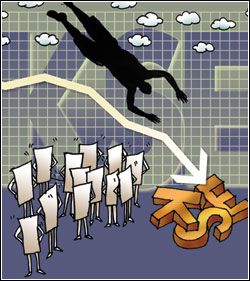 STOCK market is in turmoil. On June 14, 2006, KSE-100 was down 29 per cent or 3543 points from its peak level of 12,274 on April 17, 2006. The spreading pre-budget downturn in May gained momentum in June following the budget proposals.
A host of factors were being held responsible for the crash including market abuse, impending broker defaults, increase in CVT and withholding taxes on share dealings, problems in privatisation, increase in budgetary deficits, rise in interest rates and so on.
On June 9, SECP issued a press release stating that it has started an investigation into different forms of market abuse, from blank selling to re-lending of Badla financed shares. It was obvious that such highly publicised action could push the prices further down.
It appears likely that at that point in time, apex regulator enjoyed some support from government, which probably took the view that brokers had gone too far in engineering market declines to negotiate budgetary taxes.
But the market situation threatened to spin out of control and create another crisis on the national scene when the dust is yet to settle on the sugar and cement crisis. On June 14, the KSE-100 fell by a record 5.8 per cent or 545 points and a much greater fall was expected on the following day. That was perhaps the turning point.
The board of directors of KSE met in an emergent meeting and changed important regulations regarding intra day price limits, margin deposits in futures, list of securities eligible for Badla financing, and limits on short positions in futures. These overnight changes were made with the formal approval of SECP and perhaps, tacit support of government.
What all this means is that market decline was proving too much to digest for the brokers, SECP, and government as all three stood to loose money or face. They seem to have bridged their differences for now and are working together to stem what had become the June 2006 crisis. Not surprisingly, the market has all of a sudden started a recovery on June 15.
Spin doctors are jumping in to claim that the extreme downturn was “normal” market behaviour, changing rules in the middle of the game is “dynamic” decision making, high profile investigations are a “routine” matter, news about broker defaults and bail outs were “rumours”, and this turmoil has actually sent a “positive signal” to investors because it was handled without closing down KSE. The underlying message in their statements is that investors should forget about the past and focus on “attractive values.”
Indeed, many investors may soon forget this crisis, as they have forgotten past crisis, but there are some people who are unwilling to either forget or forgive. These are a few young anchors who are throwing tough questions to decision makers in fast paced live television shows - questions which reach the heart of the issues and to which there are no answers. It is likely that they would continue to remind every one about what has happened and what could happen again.
There are three major lessons that should guide all stakeholders in preparing for the future.
First lesson is that unless structural problems in market are solved, they would continue to produce crisis. Take for instance the problem of Badla financing. It is a system now unique to Pakistan’s stock market and one which has contributed to all past crisis.
After a failed attempt to phase it out, it was renamed CFS in August 2005. On paper, new CFS regulations were “implemented” immediately, but most of these are not in force to date. The solution to Badla financing is not renaming or modifying it but replacing it with derivatives.
Another structural problem is lack of settlement guarantee. As per current regulations, if one broker defaults in meeting his settlement obligations, the clearing company is bound to pass on the shortfalls to other brokers, which carries a grave systemic threat for both capital market and banking system. Thus each time a default situation is created, bail outs are arranged from public and private money. A risk management regime that relies on bail outs is a contradiction in terms.
The solution to this problem is that risk management be transferred to the National Clearing Company which should improve it in line with international practices. Those who cannot settle their obligations must be declared defaulter and liquidated. Unless structural problems like Badla and risk management are solved by structural solutions, rather than flimsy measures like “new exit mechanism”, they would continue to breed crisis.
Second lesson is that without required capacity at the exchanges and SECP, little can be expected from long drawn investigations into market abuse, beyond detection of blank selling. At present, building blocks required to effectively deal with market abuse are weak or missing.
These are (i) trained surveillance and investigation staff with specialized tools like a surveillance software (ii) transparency in trading through disclosure of proprietary dealings and UIN tagging (iii) legal framework that clearly defines different forms of abuse and provides a range of remedies (iv) procedures to quickly gather information from different sources including depository, clearing company, and settlement banks (v) informal network to gather market intelligence from insiders and (vi) decision makers who have the independence and courage to punish wrong doers. Due to lack of required capacity, detecting something like collusive wash sales to manipulate prices is very difficult, if not impossible.
Third lesson is that there is tremendous need for honesty in stock market. For far too long, “bullish” market commentators have consistently understated risks inherent in this market, particularly risk of manipulation and settlement failure due to broker defaults.
Unfortunately, instead of questioning their understatements, regulators have also been endorsing them in public speeches and annual reports. Investors need to be made aware that in addition to assuming economic risks inherent in listed securities, they have to assume risks specific to local market structures and practices, which are not incorporated in discount rates used to estimate “fair values.”
In sum, stakeholders in the stock market have to accept the fact that meaningful progress in stopping frequent crisis shall only be made when they would be willing to learn from past mistakes. George Santayana couldn’t have had Pakistan’s stock market in mind when he wrote this famous line but it applies here rather well: “those who cannot remember the past are condemned to repeat it.”