0
0

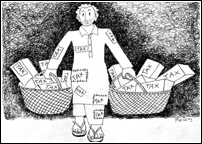 KARACHI: Without much effort, the government pockets a reasonable chunk of taxes and duties from consumers through the multinational companies in three major items — petroleum, electricity and gas.
In oil products, the government grabs around Rs21 on one litre petrol in the shape of petroleum development levy (PDL) at Rs12.53, 88 paisa as excise duty and Rs7.53 as general sales tax (GST) on a retail price of Rs57.70 per litre. In diesel, the government nets around Rs8.30 — Rs5 as GST and 10 per cent import duty which amounts to Rs3.20 per litre — in the retail price of Rs38.73 per litre, an oil industry official says.
In December 1999, the government was collecting Rs15.65 per litre when petrol was available at Rs27 per litre. The break-up of taxes included 88 paisa as excise duty, Rs9.08 as fixed development surcharge, Rs2.17 as development surcharge and Rs3.52 as GST, he adds.
When diesel was selling at Rs11.50 per litre in December 1999, the government was collecting 25 paisa as excise duty, seven paisa as petroleum development levy and Rs1.5 as GST, thus hardly getting Rs1.34 per litre.
The Oil and Gas Regulatory Authority (Ogra) took over the onus of announcing fortnightly oil prices from the cartel of oil marketing companies one-and-a-half month back. But this provides no benefit to the consumers, as formulas to determine prices are same on which Ogra is also dependent like the Oil Companies Advisory Committee (OCAC).
“The only way to provide relief to the consumers is the abolition of excise duty and a 50 per cent cut in GST,” a market analyst says.
In gas, the government has been collecting a 15 per cent GST in lieu of central excise duty since October 16, 1999, an official at Sui Southern Gas Company Limited (SSGC) says. In 2004-05, SSGC had paid Rs8.136 billion as GST to the government as against Rs2.759 billion in 2003-04. The company has a current customer base of 1,788,689 in Sindh and Balochistan, including domestic, commercial and industrial consumers.
In electricity, if a domestic consumer pays a KESC bill of Rs1,000, it means that the bill includes 21 per cent taxes that amounts to Rs210. Out of this, the federal and Sindh governments pocket 15 per cent and six per cent in the shape of GST and electricity duty, respectively.
A KESC official said the 21 per cent share of taxes in a bill being collected by the government had been in vogue for the last five years. However, he said the GST amount was reflected or calculated in the bill of “domestic residents” but in the next line of the bill it reads “minus GST adjustment”. In case of a government notification, KESC will start collecting it from the domestic consumers. However, commercial and industrial power users pay GST in their bills.
Commercial and industrial consumers also pay fixed income tax on their bills. For instance, if a commercial bill amounts to Rs400 then the income tax rate is Rs60, while in case of Rs20,000 bill, income tax accounts for Rs2,000. There was no income tax rate or slab applicable on the residential consumers, the official said.
KESC has also started collecting Rs25 as TV licence fee from last year. This collection also goes to the government exchequer.
Tax statutes: history of Pakistan>
Believe it or not around one thousand amendments have already been made in Income Tax Ordinance 2001.
First tax law Act of 1922 incorporate by the British rulers remained in operation for 57 years.
In 1979 new Income Tax Ordinance was incorporated, this law remained effective for 23 years and thereafter Income Tax Ordinance 2001 was incorporated in 2001.
However, ever since its incorporation about 1,000 changes and amendments have been made in the ordinance.—PIR