0
0

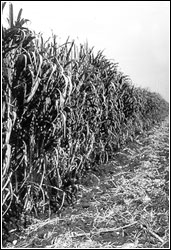 Sugar industry is the second largest after textile based on the sugarcane crop. The contribution of sugarbeet is only two per cent of the total output.
Refined sugar, gur and khandsari are three main products with the former manufactured in mills and the two last in more primitive small-scale and less efficient cane crushers.
Cane tops and molasses are valued as the livestock feed, while bagasse is used as the fuel and as an input in the paper industry.
In 1947, the number of sugar mills was three or four which increased to eight in 1961; 31 in 1981; 47 in 1990; 74 in 1997; and 78 in 2003-04, including one in Azad Kashmir. This will further increase as new mills are being built. The indiscriminate increase in the number of sugar mills is political rather than economic. For instance, nearly 70 per cent of these mills belong to politicians, including 12 ministers of the present government.
Hoarding of nearly 86 per cent of production by these influential persons, poor cane production, and problems related to crushing during the current year have created historic sugar crisis.
The scribe had warned the government in the 80s that this indiscriminate increase in sugar mills in the wheat and cotton belt in Punjab and rice and cotton belt of Sindh was not a healthy policy.
The policy makers were advised that the limited scope of increasing cane production due to its high water requirements and other agronomic factors, the growers and industry will face serious problems with the common man being the ultimate sufferer, besides affecting the future national economy. The policy should be made purely on economic basis, it was further advised.
The National Commission on Agriculture’s report in 1988 also conceded that the area under sugarcane was suffering from the water stress, and it would be unrealistic to base further production increase on area expansion alone, especially when further irrigation supplies were expected to be limited. The Commission made a number of recommendations for achieving or nearly achieving self-sufficiency in sugar, but none was implemented at the field level because of the politically influential mill owners of the successive governments. As a result, the country now has come under serious sugar crisis.
As a consultant for the agriculture and water sectors of the Eighth Five-Year Plan (1993-94-1997-98), this scribe advised the policy makers giving examples of the Seventh Five-Year Plan that the production of cane did not increase at all as was anticipated to grow by 4.6 per cent every year during this Five-Year Plan period. Although, the area showed an upward trend, but the yield did not, rather went down.
Similarly, I advised the policy makers that the setting up of sugar mills in Sindh may increase the area under cane which, in the long run will create problems of water-logging and salinity which presently is affecting the crop productivity.
Similarly, indiscriminate increase in mills in Punjab may not only create these two menaces but will also pose sugar production and trade deficit problems. But the policy makers did not pay heed to these advices. The number of sugar mills in the two provinces further increased from 56 to 69 during the Eighth Five-Year Plan.
Consequently, the area under cane has also increased from 2,66,000 hectares (ha) to 2,71,000 ha in Sindh and from 5,96,000 ha to 7,80,000 ha in Punjab during this period. Besides, continued marketing problems of cane grower, the area under waterlogged soils with ground water table depth of 0-5 feet from the ground surface increased from 3.63 million ha to 3.72 million ha in Sindh and from 1.12 million ha to 1.31 in Punjab after the end of the Plan period.
Similarly, area under various categories of salinity increased from 1.51 million ha to 2.11 million ha in Sindh and from 1.61 million ha to 2.67 million ha in Punjab during this period. These twin menaces seriously affected the crop productivity of both the provinces. Similar situation prevailed in the NWFP.
Instead of learning lessons from these harsh realities, the number of mills continued to increase to 77 by 2003, with plans to increase further, reflecting on dismal sugar policies.
The fact is that the area under sugarcane was 0.83 million ha in 1960-61 when the number of sugar mills was eight. It increased to 0.88 million ha in 1981 when the number of mills had increased to 31 and further increased to 1.06 million ha in 1996-97 when mills increased to 70 and became virtually stagnant with minor yearly fluctuations.
However the number of sugar mills continued to increase to 77 in 2003 and may increase further. Likewise the production increased from 11.64 million tons in 1960-61 to 47.17 million tons in 1994-95 and thereafter it became stagnant with a maximum production of 55.19 million tons in 1998-99 which is a record production in the history of the country. Thereafter, it started declining and was 45.32 million tons in 2005-05 and around 40.1 millions in 2005-06.
Similar was the situation in yield. For example, the yield of was 30,003kg per ha in 1960-61. It increased to a maximum record yield of 50,279kg per ha in 1997-98 and has declined to 47,852 kg per ha. Even the record yield ever obtained is 72.6 per cent below the achievable potential yield at farmers’ field by the FAO experts. The highest yield of 50,279kg per ha ever obtained in Pakistan was below the average yield of major cane growing countries.
For example, the average cane yield of India is 67,442kg per ha, Brazil 72,825kg per hectare, China 70,707 kg per ha, Ecuador 77,978 per ha, Egypt 90,909kg per ha, Thailand 76,363kg per ha, South Africa 70,548kg per ha and the US 77,891kg per ha.
As a result of low production and yield due to various limitations, the country is virtually importing sugar every year with the exception of early 80s in spite of increasing the numbers of mills. With their production capacity of over 5.5 million tons as against the present domestic requirements of 3.6 million tons, these mills could never work to their full capacity due to lower cane production, poor management, and marketing policies. There appears no justification in further increasing the number on political grounds.
Again, the policy should have been to import sugar on the basis of deficit between the local production and domestic requirements, and sufficient stock to meet the shortages during poor production years. But the policy makers were virtually importing and exporting sugar every year at the same time under the pressure of politically influential sugar mill owners.
For example, the industry and the exporters earned Rs33 billion from its export from 1993-94 to 2002-03, while the government had to spend Rs29.2 billions on its import. Again, due to the government statistics, the production of refined sugar was 3.5 million ton during each year of 1997-98-and 1998-99, 3.6 million tons in 2002-03 and 3.99 million tons in 2003-04 which was enough to meet the domestic requirement. Why then the government spent Rs3.68 billion during these years.
The industry was exporting sugar and received subsidies from the government to compete in the international market due to high cost of domestic sugar production. Not only that, they got import duty levied on cheaper imported sugar to increase its price in the domestic market.
Again, due to their deliberate policies of delaying cane crushing from early October to late November and early December, under weighing, delayed payments to farmers and other cumbersome procedures made the growers ultimate sufferers.
These mill owners had even asked the government to purchase their stock so as to make payments to growers and to return loans taken from the banks, but even after agreeing to their demand, they often did not fully meet the conditions, thus further increasing the problems of growers, while the few influential landlords had no problem in getting immediate payments.
It forced the majority of common growers to gradually shift to other crops and increased making of gur which is more profitable than cane. Exporting gur to Afganistan, the Central Asian States and Iran further increase their profit, especially growers of the NWFP.
The influential and ministers owning mills got a tax of 15 per cent imposed on gur to discourage the growers and force them to sell their cane to sugar mills. This may further create serious problems in the near future.
Due to these inept policies, the price of sugar during the last two years has increased from Rs32 to Rs42 this year in the open market which is the highest, so far. The common man is the ultimate sufferer.
Although the government withdrew subsidies on sugar export and duty on its import but due to hoarding by millers and profiteers, the situation may further deteriorate especially when the international market price of sugar has increased to $485-$490 per ton.
The government is planning to import 150,000 tons of sugar at international prices to meet the domestic deficit caused by the hoarders.
However, India after sending earlier consignments of relatively poor sugar at $440 per ton is now trying to withhold export of sugar to Pakistan due to higher prices in the international market.
Due to the malpractices of mill owners and bad sugar policies as mentioned earlier, the farmers especially the small ones may shift to crops causing short supply of cane for crushing.
Sugar beet, competing with major Rabi crops, has no potential to replace cane. Thus due to inept policies, the country should be ready to face further crises of sugar as well as other food and fibre items unless sound policies are pursued.