0
0

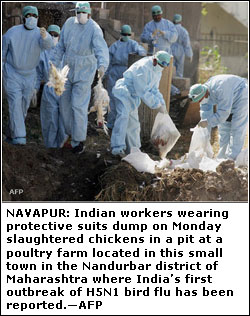 NAVAPUR, Feb 20: India quarantined eight people in hospital on Monday and slaughtered some 96,000 chickens as it tried to contain the country’s first outbreak of the deadly H5N1 strain of bird flu.
Teams of inexperienced agricultural workers struggled to kill the chickens near the small town of Navapur in western Maharashtra, where the outbreak occurred, while the authorities isolated eight people with mild fever.
“None of them has so far shown any symptoms of bird flu,” Deepak Gupta, a senior official from the federal health ministry, told reporters in New Delhi.
Authorities have opened a special 26-bed ward in the hospital at Navapur as a preventive measure against human bird flu infections.
Gupta said 95 samples collected from those either in contact with poultry or with respiratory infections had been sent for testing by the National Institute of Virology in the western city of Pune.
Officials said some 96,000 birds had been killed in the mass slaughter which began on Sunday near Navapur.
Agriculture ministry official Upma Chawdhry said another 26,000 birds were expected to be killed in neighbouring Gujarat state by the end of Monday.
Teams of workers in protective suits fanned out around Navapur but found many farmers had already killed and buried their stocks.
Maharashtra chief minister Vilasrao Deshmukh said a total of 130,000 birds were to be killed in 49 poultry farms around the town, the Press Trust of India reported. Earlier estimates by officials put the figure at half-a-million.
Some government teams, including vets and animal workers, stood back and allowed unprotected workers to slaughter birds and dump them in pits, according to press reports.
“Nobody is aware of how to kill the birds. This is the first time,” Anees Ahmed, the state’s animal husbandry minister, told reporters.
At one farm, the doctor in charge told AFP that “poison” was being added to the water supply to try to kill the birds in five to 10 minutes. Several hours later, members of the teams were seen strangling and beating still live birds.
Khalil Bardolia, 53, owner of Khalil poultry who was watching from his office the work by some 25 men in protective suits, said he had 27,000 birds to be slaughtered.
“There’s no disease in this area. What they’re doing is unacceptable,” said Bardolia. “I’m thinking of committing suicide.”
He claimed that birds which had been dying since January had not been infected with bird flu.
At a farm on the opposite side of the road, Dr B. R. Patil, leading a team of animal husbandry volunteers, said the method of poisoning the water was working and more than half of the 22,000 birds there had been killed.
Asked if he would sanction strangling the birds, he said: “We’re not doing it manually; that’s a cruel method.”
Another farmer, Hasim Khurshiwala, whose remaining 5,500 birds were being killed on Monday, said he handed over his keys to the inspection teams because he could not bear to see his birds slaughtered.
He said the promised government compensation of Rs40 (80 cents) a bird was not enough.
“I argued with them because there’s no disease on my premises,” he said.
Furious over the slaughter, poultry bosses earlier said they would eat chicken tandoori and eggs in front of government offices in the town, but later called off the protest.—AFP