



 0
0

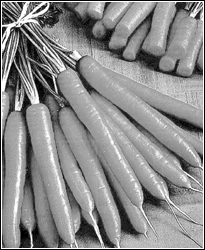 Vegetables are second to cereals with highest quantity of carbohydrates. Their nutritive value is high because of the minerals and vitamins they carry. In Pakistan, about 1.8 million tons of tropical, subtropical and temperate vegetables are grown. Carrot is used in food since ancient times due to its high vitamin A contents.
Nutritive value: The edible portion of carrot contains 88.2 per cent water, 9.3 per cent carbohydrates, 7.5 per cent sugar, 1.2 per cent protein, 0.3 per cent fat, 1.12 per cent iron, 1730 I.U of carotene per oz, and fairly a good amount of vitamins Bl, B2 and C. It has caloric value of 205 per lb. The best food values are obtained when eaten raw.
Climate and soil: Carrot is a cool-season vegetable. It thrives in clear weather in temperature ranging between 15 oC to 20 oC from the time of seed sowing to harvest. These grow best in deep stone free-well drained fertile soils with plenty of rotten organic matter. The pH value should be 6.5 to 7.5 for best growth. Heavy and waterlogged soils restrict root development and cause forked roots.
Propagation: As root crops are direct seeded, seeds are drilled in well-prepared flat seedbeds. The seeds are sown in two seasons. In Kharif from April to June, while in Rabi from September to October. The recommended rate ranges from 10-15kg/ha. The rate depends on some important factors such as seed viability, germination percentage, sowing method or planting distance. Two common varieties of carrot grown are Mirpurkhas Selection and Red Long Lord.
Manuring and irrigation: Fertilizer is the most important and costly input to enhance the crop yield as it plays an active role in increasing crop yield. Systematic manure with balanced fertilizer mixtures is an essential practice in vegetable cultivation. Carrots need both organic and inorganic fertilizers.
An easy and cheap source of organic matter is farmyard manure. Rotten farmyard manure is useful in improving the soil texture. It makes heavy soils more friable and increases the water holding capacity of sandy type soils. About 30 to 40 cartloads of well-rotted farmyard manure are added at the time of field preparation.
In 1989 it was found that the application of 100kg/ha N, 100kg/ha P205 and 125kg/ha K2O gave a higher yield. This indicates the importance of the FYM supplemented with the NPK for yield increase. The plant tolerates considerable dry weather.
Water is best applied after the plants are set. Frequent light irrigations are preferred to heavy applications at long intervals. Irrigation frequency should be increased during root development.
Weeding: As carrots are poor competitors with weeds because of slow growth therefore, weed control is important during the early stages of development. Inter-culturing should be completed within a month as it is beneficial for the development of healthy roots. Three to four inter-culturing are necessary for weed control.
Insect pests and diseases: Generally, carrots are not attacked and damaged by insect pests and diseases, the few are:
Carrot Weevil (Listronotus oregonensis): The larvae of this insect damages carrot by feeding and making tunnels in roots. In severe attack, carrots become wilt and unmarketable.
Carrot Caterpillar (Papilio polyxenes): This large, 2” long larvae is green with black cross band on each segment and six yellow spots on the front margin. Two to three generations can proliferate each year. Substantial damage may occur.
Carrot Rust Fly (Psila rosea): The larvae of this insect damages carrot by feeding and making tunnels in roots like the larvae of Parrot weevil and provide an entry for root-rot pathogens. The adults are shiny and dark with a yellow head. Symptoms appear as wilting and a slow or rapid collapse of the plant. A water-soaked lesion can often appear at the base of stem. Carrot develops a dense purple stain that may finally cover the entire root-rot pathogens.
Control: Collect egg masses, larvae and pupae by hand and the butterflies with hand nets; kill them in water to which kerosene oil is added. In serious infestation spray Malathion 0.05 per cent or Diazinon 0.02 per cent is recommended.
Selerotinia Rot: The first symptoms are soft and moist scabs. With relatively high humidity, a white, cottony stain may appear covering the entire piece. High temperatures encourage the disease as do water condensation on roots.
Fusarium: This disease starts on the upper part of the root as a small and dark scab which increases in size. On the surface and towards inside, dry and spongy rotting occurs. If the disease is severe, the whole carrot top is killed. This fungus disease usually attacks older foliage. It appears as a black ring at the top of the root.
Control: Adopt effective crop rotation for at least three years. Immerse seeds in water at 50 0C for 20 minutes at least. Control can be achieved with the use of fungicide sprays applied as soon as symptoms are visible.
Harvesting and yield: Usually crop takes 70-80 days to mature. Carrots are dug out manually. For this purpose spade or khurpa is used. The yield varies from 20,000 to 30,000kg/ha. Per hectare yield of carrot obtained in our country is still low as compared to other countries.
It might be due to improper cultural operations like plant configuration, irrigation application, sowing time, insect pests, disease, and weed control and unbalanced application of essential nutrients like nitrogen and phosphorous.




























