



 0
0

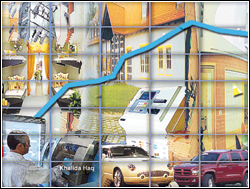 SHOULD the priorities be to save more, invest more and develop faster, producing a larger exportable surplus and flourish all around?
Or should the priorities be to spend more and consume more, import more luxury goods and create an illusion of prosperity, and seek more loans at concessional rates and get old loans written off or rescheduled later?
It is one thing to create an impression of prosperity by increasing agricultural and industrial production based on more and more domestic raw materials and quite another to seek an illusion of prosperity through imports and building up foreign exchange liabilities.
The consumer credit being promoted now in the name of free market economy has a large content of imported luxuries, like completely built-up cars which increased by 256 per cent during the first half of this financial year. SKD vehicles swelled by 61.98 per cent during 2004-05.
House financing has also increased immensely. Here the luxury housing has a higher priority over middle-income housing and because of that, the prices of house building materials have been going up, making it difficult for low income groups to build their own houses.
Look at the kind of luxury housing blocks coming by the sea where a room can cost nearly Rs10 million. We are pampering the rich as if it is their right to be treated that way with the defence housing societies in Karachi Islamabad and elsewhere taking the lead.
While private cars like Rolls Royce and Porsche and Super Luxury Mercedes are receiving high priority while the much talked about mass transit scheme has become a distant vision and the circular railway is only inching ahead despite the fact that the MQM dominates the provincial government.
We can import more and more luxury cars, but where do we get the roads and the parking space?
We are talking of energy efficiency and energy conservation. If we really mean that we should now opt for an adequate public transport system and less of private cars through high cost bank credits.
When we talk of energy conservation we should look at the thousands of wedding gardens throughout the country particularly in cities like Karachi that are lavishly illuminated and decorated whether there is a marriage ceremony or not.
And of course, 40 per cent of the power in the KESC system is stolen. Those who steal with such impunity use too many air conditioners and for long and waste a great deal of costly energy at no cost to themselves.
Much of the high living promoted though bank credit obtained at 12 to 15 per cent interest per year. So bank advances in 2005 rose by 29 per cent to a total of Rs2 trillion.
The banks are too happy to lend more and more with such a large gap or spread between the average rate of lending and the average rate of deposits, which is 7.06 per cent. The spread had risen in three years -– from 4.1 per cent in 2004 to 6.3 per cent in 2005 and to 7.15 per cent in 2006. The average spread for last six months is 7.13 per cent
The difference between the lending rate and the borrowing rate may not be too large if the deposit rate was above the inflation rate of nine per cent but the average is only 3.20 per cent including long-term fixed deposit of five years. Some banks pay up to 11 per cent for five-year fixed deposits. But fixed deposits are barely five per cent of the total.
So, with inflation at 8-9 per cent a depositor is a loser by six per cent so he will be wiser to spend his savings on some consumer durables or a small luxury item or other items whose prices are going up.
All this is going on in a country where the household savings is too small and until recently, the corporate savings were very low while the government is running a deficit which has come to four per cent of the GDP from 8-10 percent.
Hence, investment is also low at about 17 per cent inclusive of foreign aid and if the investment is adjusted for inflation, it is indeed a very low figure that explains poverty and increasing unemployment. And the high cost of bank credit has been with us for a very long time while the returns on bank deposits have always been low and far below the inflation rate.
Bank profits went up in 2003 by 87 per cent and due to some adjustments by 23 per cent in 2004.
The State Bank of Pakistan did not want to interfere with the bank lending and deposit rates. Dr Ishrat Hussain as the governor banked on competition between banks to improve the situation but that did not happen. The bankers delightfully welcomed the big spread and the high profits that came with it.
But now the new Governor Dr Shamshad Akhtar has expressed her concern over the rising spread and emphasized the need for shifting some of the benefits to the depositors in the wake of the rising lending rates.
She wants to develop and deepen the fixed income security market to offload credit pressure on commercial banks for long-term corporate financing. The positive steps she will take to get a fair deal for the depositor’s remains to be seen.
What is certain is that 2005 will go down in the history of banking as a year of record profits which pushed up their share prices very high. Not only the strong banks will benefit but the relatively weaker ones also.
It should be obvious to the SBP that the bankers will not raise the deposit rate and lower their profits. How ever the spread is expected to go below seven per cent in 2007.
This is the time for Pakistan to get its priorities right if it wants to wipe out the absolute poverty of 30 per cent of its people and not depend on foreign loans and donations.
We have to save more like Japan with 35 per cent household savings or India with its 23 per cent savings which is labelled as the ‘Hindu rate of savings’.
We have to invest in savings and produce more and export more and reduce the domestic consumption of the profligate among us.
We have to profit from our friendship with China, not merely ask for more and more help from it and commercial concessions but to begin with, follow the Chinese development model of ten per cent growth witnessed for last ten 10 years.
We have to hold our population explosion in check and make the people more and more productive and reduce wasteful consumption. And we have to manufacture more and more of what we use and less and less of imported luxuries.
We have to operate our agriculture and industry to full capacity and produce as much as possible of industrial raw materials. We should seize to be a dependant economy and become more and more a self-reliant economy.





























